
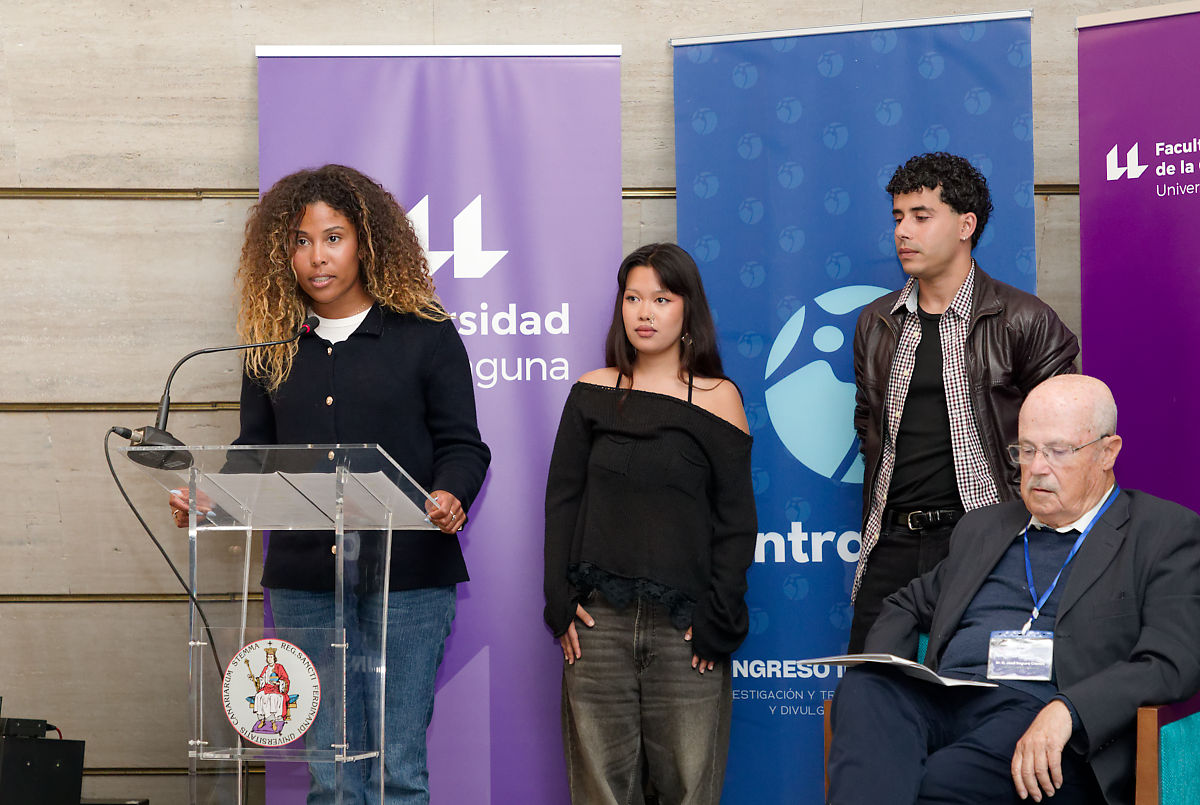
The students, during the reading of the manifesto.
Several students from the Faculty of Social Sciences and Communication – of Italian, Nepalese and Brazilian origin – read today, April 11th, the Guajara Declaration, a document that puts the finishing touch on the sixth edition of International Congress on Human Rights and Globalization, held this week at the University of La Laguna, in collaboration with the University of Seville.
The text categorically rejects xenophobia and the stigmatization of migrants, recognizing their right to freedom of movement. Likewise, the university condemns the fact that the sea around our islands has become a mass grave for so many families. Cultural diversity is a value for society and its progress, it adds, and acknowledges the role of research in this area.
The closing of this event coincided with the ratification by the Congress of Deputies of the decree-law promoting the redistribution of migrant children in cases of overcrowding in the destination autonomous community, thus allowing the entire country to contribute to the well-being of these individuals in a spirit of solidarity. This issue was extensively discussed at the closing ceremony, presided over by the rector, Francisco García, who reminded attendees that “we must establish rules when common sense fails, by putting on the ‘glasses of human rights’.”.
At a time of great international upheaval, the current retreat of borders, with its disastrous economic consequences, is also bad news for migrants, he added. “That is why I am very proud that these two public universities, La Laguna and Seville, have brought to light different aspects of this global phenomenon at this congress.”,
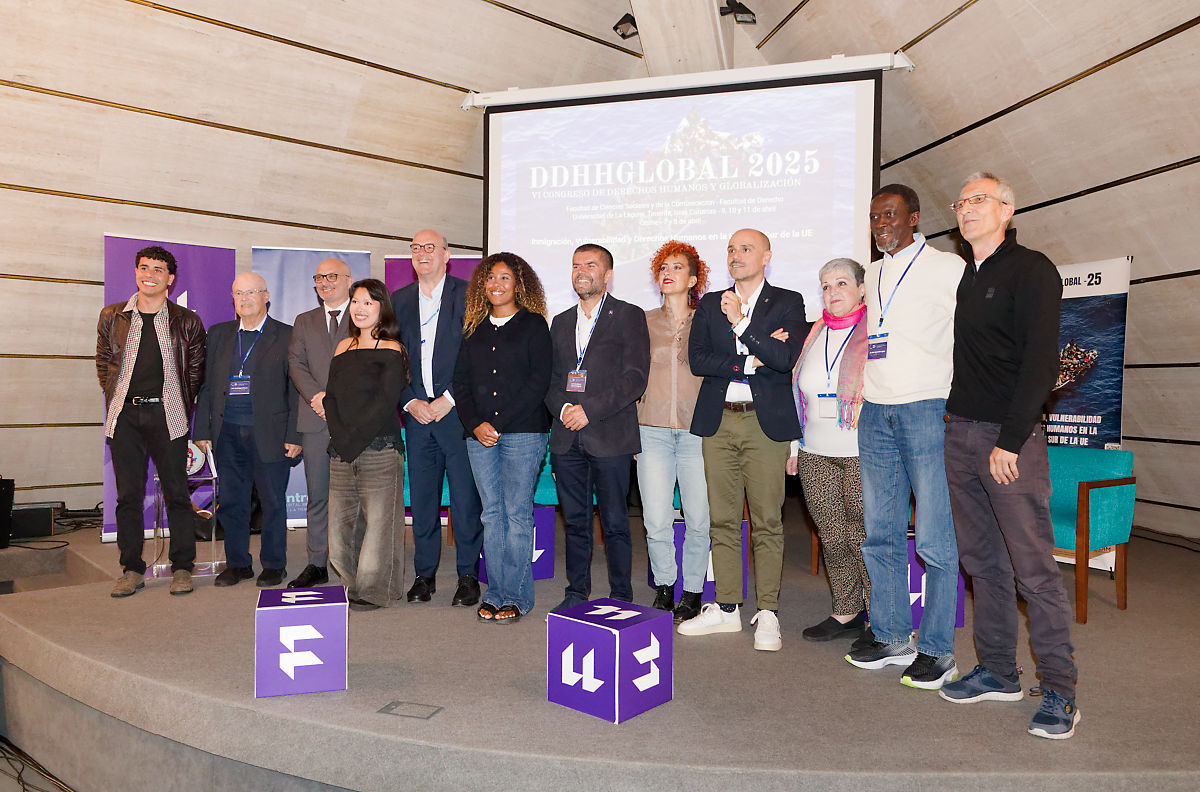
Authorities, students and academic management of the congress.
He added, “It is a mistake to deny diversity; we must embrace migration as a fundamental resource for facing the future.”.
José Segura, Director General of Casa África, also participated in the event, noting that it was very gratifying to be at a conference at the University of La Laguna “to talk about human beings who, in the irreducible exercise of their freedom, decide to seek other horizons.” He recalled that the Canary Islands' experience with emigration over the last two centuries is exceptional. “In the last 30 years, we have experienced the opposite, which I have personally documented in 18 monographs. The Canary Islands' public universities, non-governmental organizations, and other entities have built an intellectual framework around this phenomenon,“ he stated, also highlighting the immense value of the volunteers at reception centers during this process.
Alfonso Cabello, Deputy Minister of the Presidency of the Government of the Canary Islands, also referred to the coincidence of the congress being held with the ratification of the decree law. “This congress has
”He has contributed his vision to the shift in European consciousness, which is now looking south,“ he said. ”There are no high walls that can stop the need for survival, and that is why we must distinguish what should be above politics.”.
Anselmo Pestana, the Government Delegate in the Canary Islands, addressed the glorification of cruelty in politics and the media, particularly regarding migration. He described the gradual improvement of reception centers in the islands in recent times. With the parliamentary approval, he asserted that "this is a better country today," adding that conferences like this one and the work of universities in support of human rights are very timely. Mamadou Agne, the UN Migration representative in the Canary Islands, was also present at the closing ceremony.
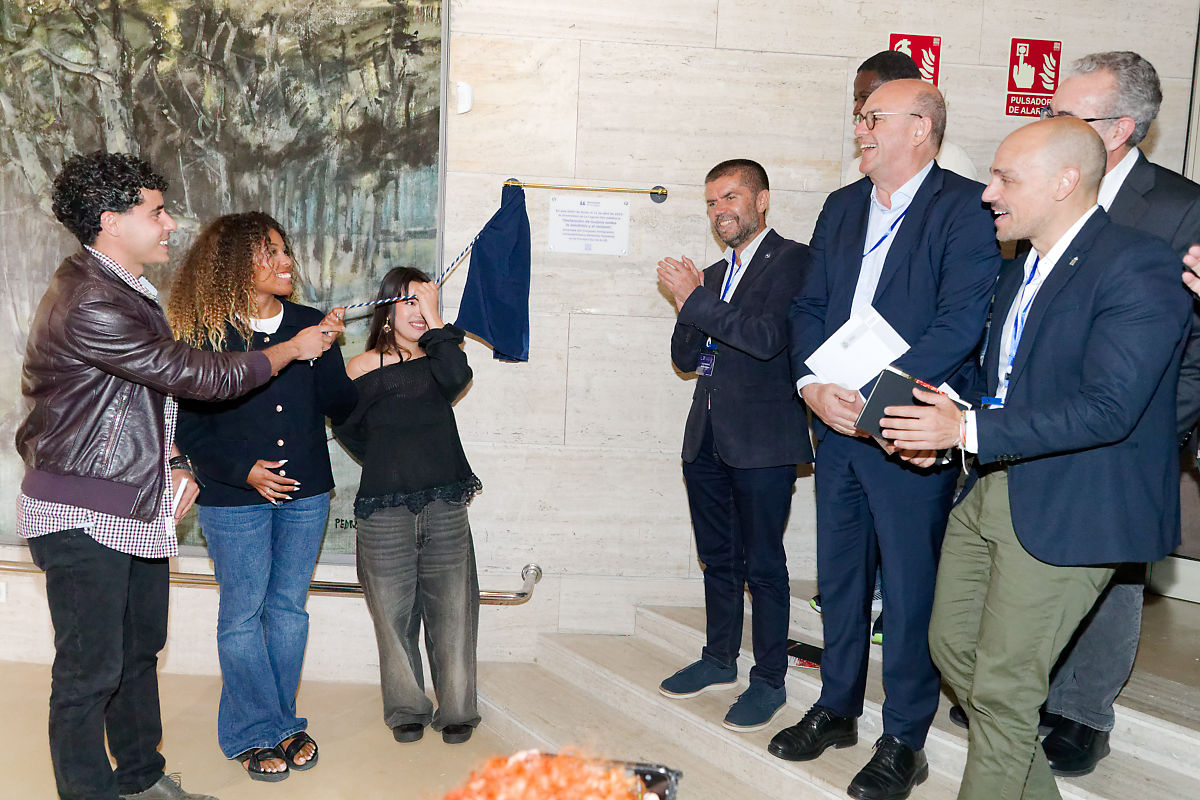
Unveiling of the plaque commemorating the reading of the manifesto.
Migrants and refugees
The University of La Laguna congress featured a closing lecture by Antonio Campillo, a professor at the University of Murcia, who analyzed, among other topics, the difference between migrant and refugee, which, from his perspective, has become obsolete. Legislation on this matter is completely outdated, he said, given that most migrations are forced, because no one leaves their country for pleasure. “What happens is that this distinction between the two serves the interests of states so they can discriminate.”.
From his perspective, the rise of neoliberalism and fascism is driven by the closing of borders, “by saving the whites of the North from the blacks of the South,” and that is the prevailing discourse. “What is at stake is knowing who has the right to live in safe spaces and who does not.”.
In 2023, a total of 24 million people were displaced due to natural disasters, although some returned later, the expert noted.
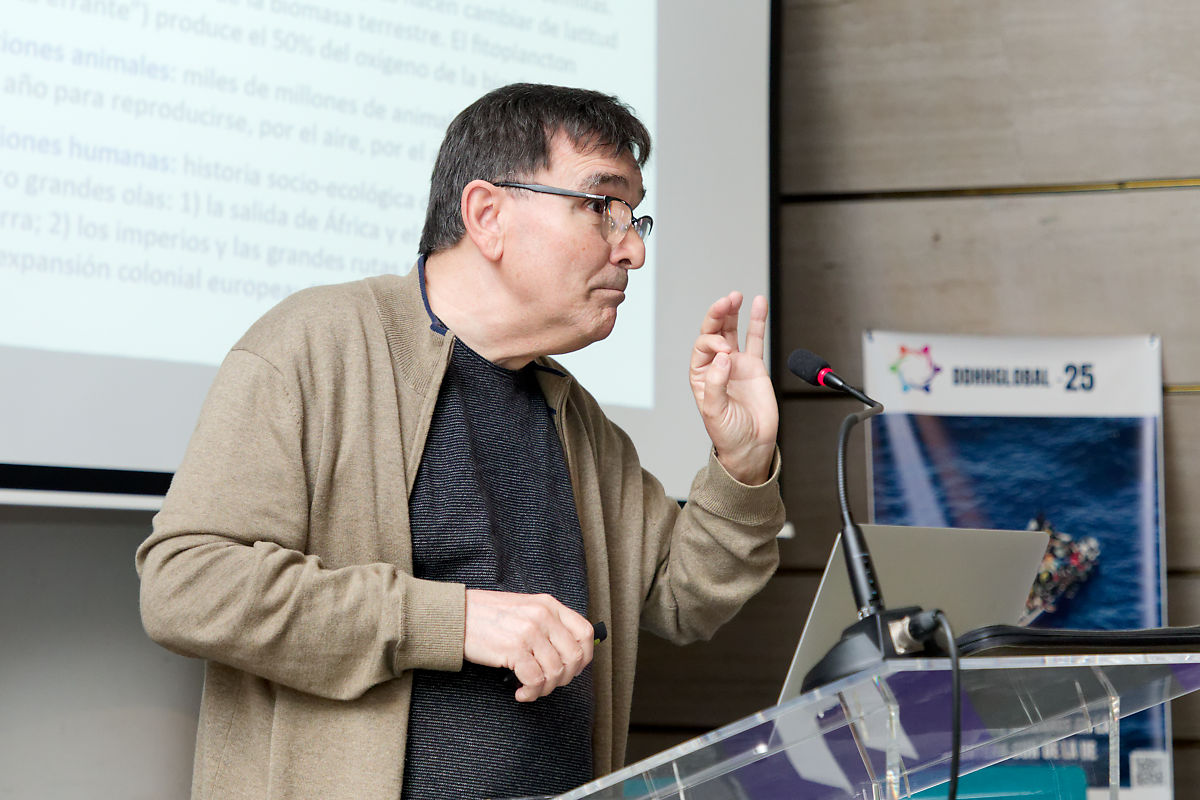
Speech by Antonio Campillo, from the University of Murcia.
At every climate summit, states call for common but differentiated responsibilities, because there is a climate injustice that must be addressed, so that countries in the Global South can carry out their energy transition and envision a more sustainable future with a different production model. None of this has been fulfilled. Thus, Latin America, Africa, and South Asia are the regions of the planet most vulnerable to climate change, precisely the countries that pollute the least. “In other words, on one hand, there are the countries that emit greenhouse gases, and on the other, the recipients. Conversely, with migration, young people from the Global South will be the ones caring for the elderly in the Global North,” he concluded.

 Spanish
 English
 French