
He General Research Support Service (SEGAI) The University of La Laguna provides scientific, instrumental, and technical support to research within the institution itself and in collaboration with external entities. This support is not limited to the health or basic sciences; a clear example of its cross-cutting approach is the Phonetics Laboratory, This center conducts studies to objectively analyze and identify the human voice, encompassing articulatory, acoustic, and physical perspectives. The analyses performed by specialists using advanced equipment and software are exhaustive and precise.
Located in the Faculty of Philology at the University of La Laguna, this laboratory is key for areas such as linguistics, speech therapy, psychology, medicine and forensic analysis for official bodies. Josefa Dorta Luis, Professor of General Linguistics and head of the laboratory since its creation in 1991, highlights the importance of its work in three fundamental areas: research, dissemination, and expert analysis. Furthermore, the Phonetics Laboratory holds ISO 9001:2015 quality certification, awarded by AENOR.
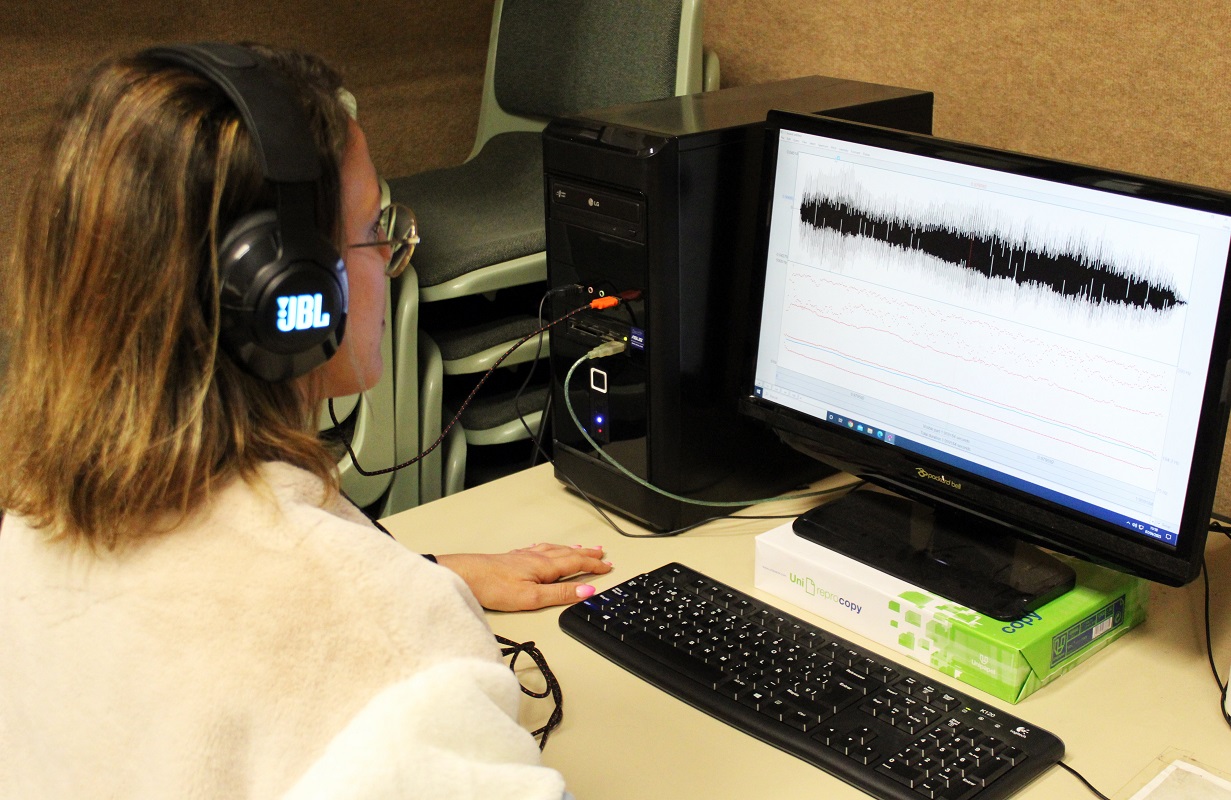 Equipment
This service boasts state-of-the-art, highly specialized equipment, including a Visi-Pitch, designed for the specific analysis of voice intonation and intensity, and a Glottograph 6103, a non-invasive analysis method that allows observation of phonation—that is, the functioning of the vocal cords during voice production—using an oscillogram. However, in recent years, much of this equipment has been replaced by highly specialized software that enables analyses for medical research (BioMetroPhon), expert assessment of the speaker's voice (BioMetroFore), and general acoustic analysis (Praat).
However, Dorta emphasizes the importance, along with specialized software and hardware, of a trained ear when performing any type of voice analysis on audio recordings that are not always of the highest quality. Therefore, he states that "there is no one-size-fits-all approach for every study.".
“The important thing regarding the instruments, whether programs or tools, is to offer an expert service, capable of understanding the analysis options and combining different methodologies,» she points out. This is especially relevant in forensic investigations, where new software tools help identify uses of artificial intelligence to imitate an individual's voice, although, the lab experts note, never their actual speech.
Applications
The Phonetics Laboratory collaborates with research groups in disciplines such as linguistics, sociolinguistics, psychology, and speech therapy, conducting speech and voice analyses. These collaborations have resulted in several doctoral theses in these areas of study.
Another key area of research in which this service participates is clinical linguistics, especially in studies on speech impairments in neurodegenerative diseases, developed in collaboration with medical researchers at the University Hospital of the Canary Islands. The analyses can support a preliminary diagnosis or evaluate changes after treatment or intervention. It has been shown that disorders such as Alzheimer's and Parkinson's are reflected in speech, so the laboratory studies timbre patterns (formantic aspect), among other factors, to aid in diagnosis. They also conduct research on the effects of prescribed treatments for certain illnesses, detecting possible speech sequelae.
In recent years, one of the most prominent areas of work within the Phonetics Laboratory has been forensic voice and speech analysis, as well as textual analysis for this purpose. In this field, they collaborate with various external entities, including the Canary Islands Institute of Criminalistics, providing certified phonetic studies that are used in legal proceedings. According to Jennifer Corujo, a technician at the laboratory, this work has significant social relevance, as it brings the service's work and the importance of precise and expert linguistic analysis closer to the public.
A third aspect is the dissemination and teaching of the methodology and application of these analyses. In this regard, the Phonetics Laboratory organizes an annual seminar or specialized course, which addresses a specific area of linguistic analysis, such as applied linguistics or forensic phonetics. In line with its commitment to knowledge dissemination, the laboratory also offers internships to university students, giving them the opportunity to learn how to use the advanced tools and software available and explore their multiple applications in the field of research.
This service is kept operational through the budget that the University of La Laguna allocates to SEGAI, as well as thanks to subsidies from organizations such as the Government of the Canary Islands, through the international project AMPERCAN 042005/184, and the Ministry of Science, Innovation and Universities, with competitive projects at the national level.

 Spanish
 English
 French