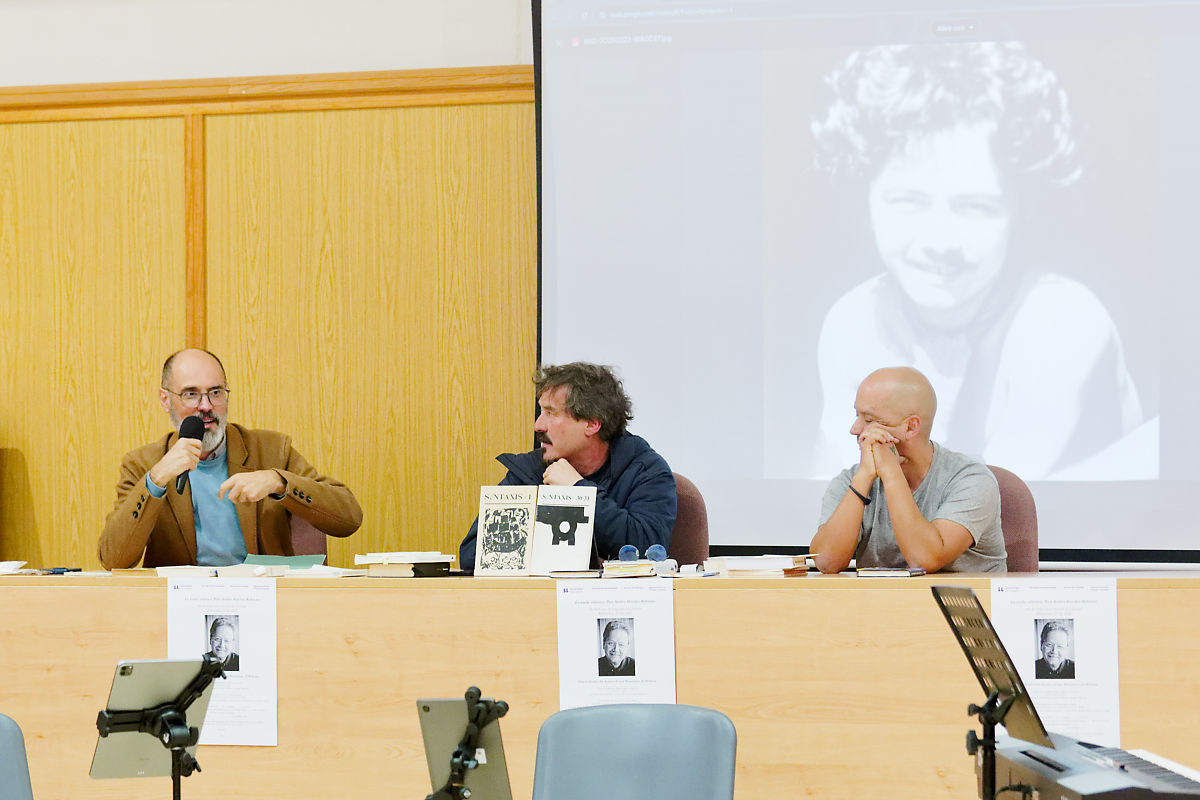
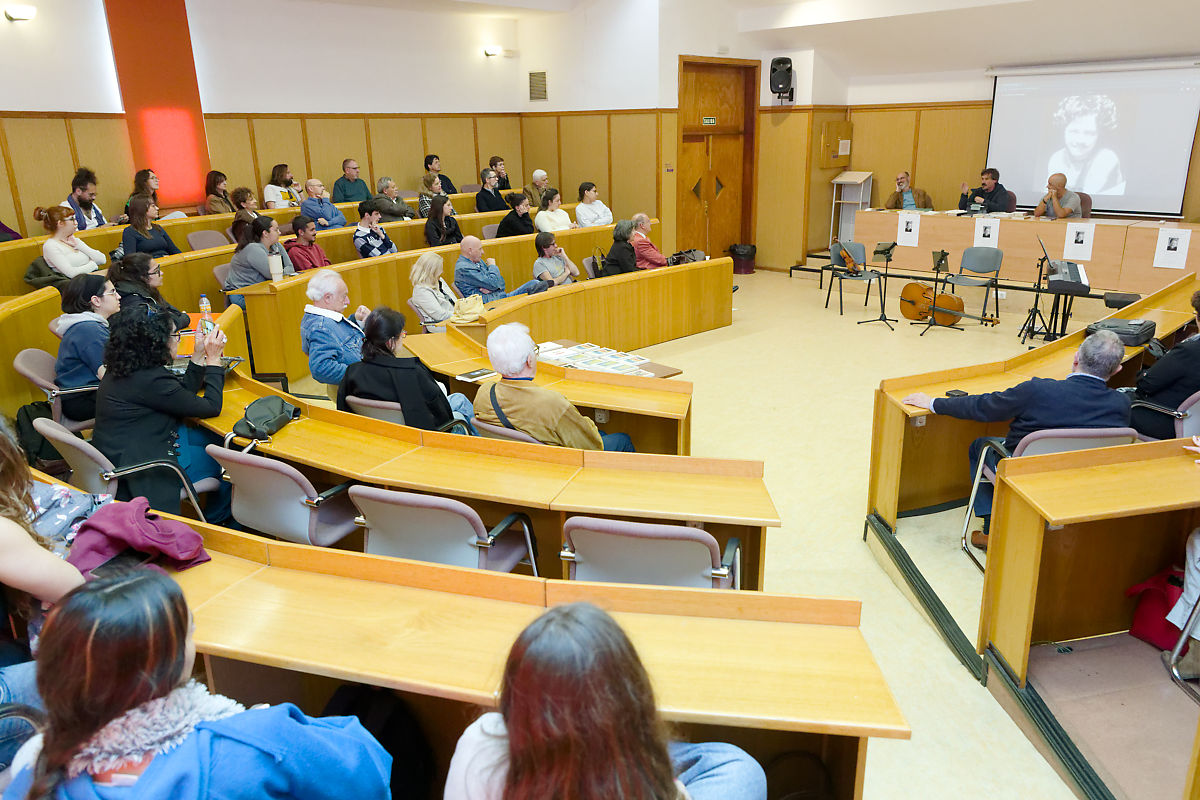
The writers Alejandro Krawietz, Iván Cabrera, and Francisco León have been the protagonists of the first half of the tribute to Andrés Sánchez Robayna The event, organized by the Philology Section of the Faculty of Humanities and the Department of Spanish Philology at the University of La Laguna to commemorate Book Day, honors a figure who was not only a prestigious academic but also a fundamental name in Spanish poetry. The three speakers, all former students of the honoree, recalled his inspiring presence both in his teaching and his poetic work.
The session began after a brief presentation by the Vice Dean of Teaching Organization of the Faculty of Humanities, Carlos Brito, Alejandro Krawietz moderated a three-way dialogue in which various facets of Sánchez Robayna's life were discussed, although some other planned topics, such as his philological work and his diary writing, could not be addressed due to time constraints. The tribute took place on the same day that the regional government announced that, among the Gold Medals of the Canary Islands to be awarded on May 30th, the Day of the Autonomous Community, one will be posthumously awarded to the poet who was the focus of this moving event.
Regarding his teaching, Francisco León acknowledged that, when he was Sánchez Robayna's student around 1992, his classes initially struck him as "very academic, strict, and structured, but at the same time, very precise and profound." In his opinion, the honoree had the ability to explain ideas that at the time might have seemed complicated with "crystal-clear clarity." He also appreciated that his exploration of Canarian literature, from the Golden Age to the avant-garde, was a "very precise systematization," and that his classes were "lively, in which poetic language always appeared.".
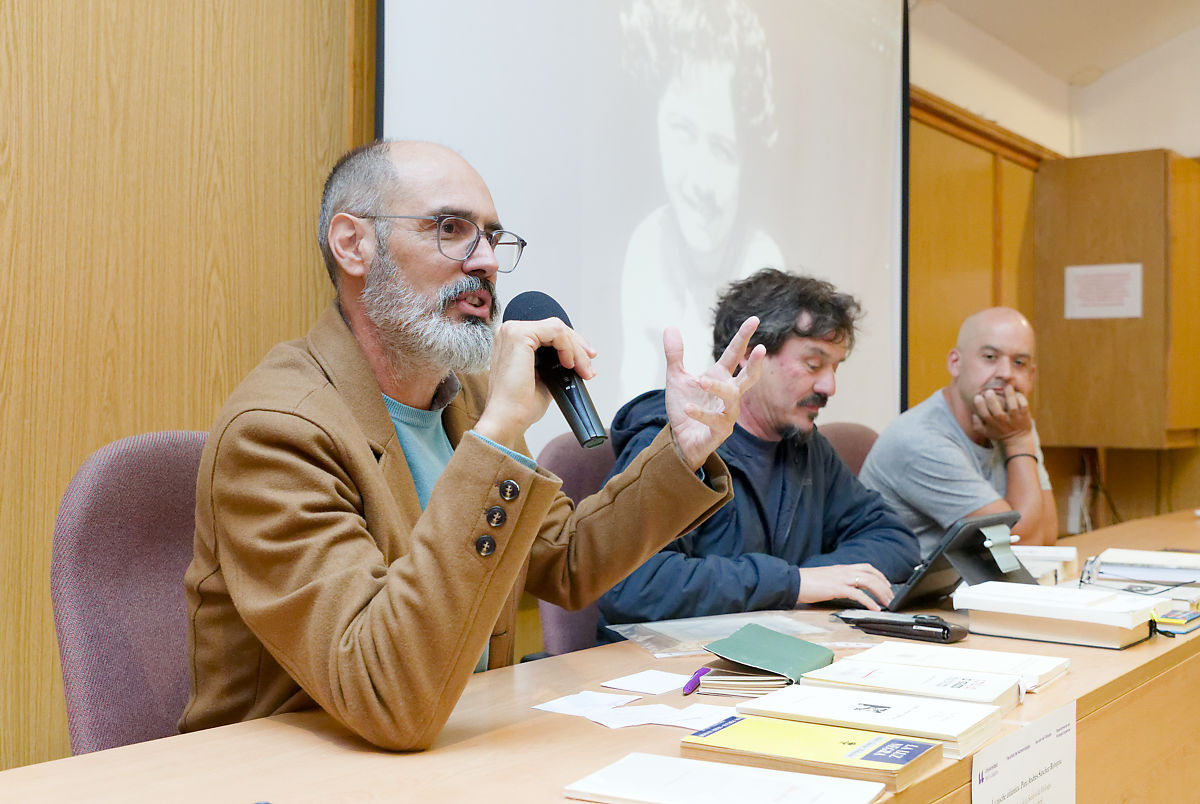 Iván Cabrera had known Sánchez Robayna's work since high school, when he had access to the magazine he edited, "Sintaxis." He confessed he didn't understand much about it at that age, but already sensed that there was "something valuable" within its pages. Therefore, as a university student, he was nervous knowing that he was being taught by a major figure in Spanish poetry. He highlighted how well Robayna selected the texts used in class and his generosity in lending copies from his personal library if a student needed access to less readily available material, as was the case for Cabrera.,
For his part, Krawietz recalled a particular feature of his classes, in which there was always a “descent into the text” where one of the students had to read aloud and was interrupted by the professor if the intonation or pauses were not appropriate. “In that way I was also teaching rhetoric and making you appreciate the carnality, the physical dimension of the poem.”.
The journal Sintaxis was another topic discussed by the three speakers, a publication that reflects Sánchez Robayna's intellectual interests and his rigorous approach to poetry. Thanks to it, Krawietz had the revelation that "poetry is not written to be understood," meaning that literature reflects a complexity present in reality, but which must be unraveled with the effort of an explorer.
León noted that the magazine “filled his literary imagination with a special light” and taught him to embrace complexity. He explained that the publication was a faithful reflection of what Sánchez Robayna called “the literature of exceptions,” by pointing to very specific examples from each period of the literary tradition, and it had a clear aspiration: to free Spanish literature from the old patterns of pre-democratic times.
For Cabrera, discovering “Sintaxis” at such a young age allowed him to realize how much he still had to learn, and he believes it was the best literary magazine of its time for promoting an intellectual curiosity “that is in decline today and is even criticized.”.
 There was also time to discuss the translation workshop that Sánchez Robayna launched in 1995, which ran for 25 uninterrupted years. Held every Tuesday without fail, the workshops involved hours of debate over a single verse or even a single word, with the aim of transforming what was initially a rudimentary literal translation in Spanish into true poetry. All three speakers participated in this workshop to varying degrees and acknowledged that it provided invaluable learning in terms of rigor in their own writing.
Regarding his poetry, it was noted that Sánchez Robayna defined it as “an expansion of human experience,” and, for Francisco León, reading it transformed his own vision of the island. Cabrera recalled how the author aligned himself with Rilke in defending the poet's total commitment to their literary work, something he demonstrated throughout a career in which he also highlighted the rigor of its different stages and how it evolved from a “topography of the landscape” to a more metaphysical vision.

 Spanish
 English
 French