
Antique cutlery, crockery, kitchen utensils from bygone eras, condiments, and recipe books from wealthy families are part of the bibliographic exhibition.‘From the kitchen to the books. Food that tells our story’', inaugurated today, April 23, on the occasion of Book Day, at the Library Service of the University of La Laguna.
This exhibition also highlights the scientific collaborations carried out by the researchers in the Nutrition and Food Science area of the academic institution, whose scientific work has enhanced the value of local products and obtained quality certificates that attest to their reliability.
The exhibition, which will remain open until June 20th at the General and Humanities Library, displays a selection of documents from various special collections of this service, such as the Rare Books Collection, the Canary Islands Collection, and several donated personal archives. This invaluable documentation examines the eating habits of previous centuries, with original accounts that describe, for example, the revolutionary appearance of the fork at the table in the 15th century, thus banishing the barbaric medieval practice of eating with one's hands. It also includes other texts on table manners, deeming the custom of throwing bones at other diners inappropriate, and outlines basic hygiene rules.
The underlying idea is to review the history of food, and particularly the food of the islands, with a chapter focused on the diet of the aboriginal people, based on gofio and livestock products, as well as dates and figs. The exhibition also includes more recent bibliographic sources, with a selection of books on fruit trees, travelogues, designations of origin, Canarian recipes, others on fish and salt flats, and a final section on cereals, legumes, gofio, and cheese.
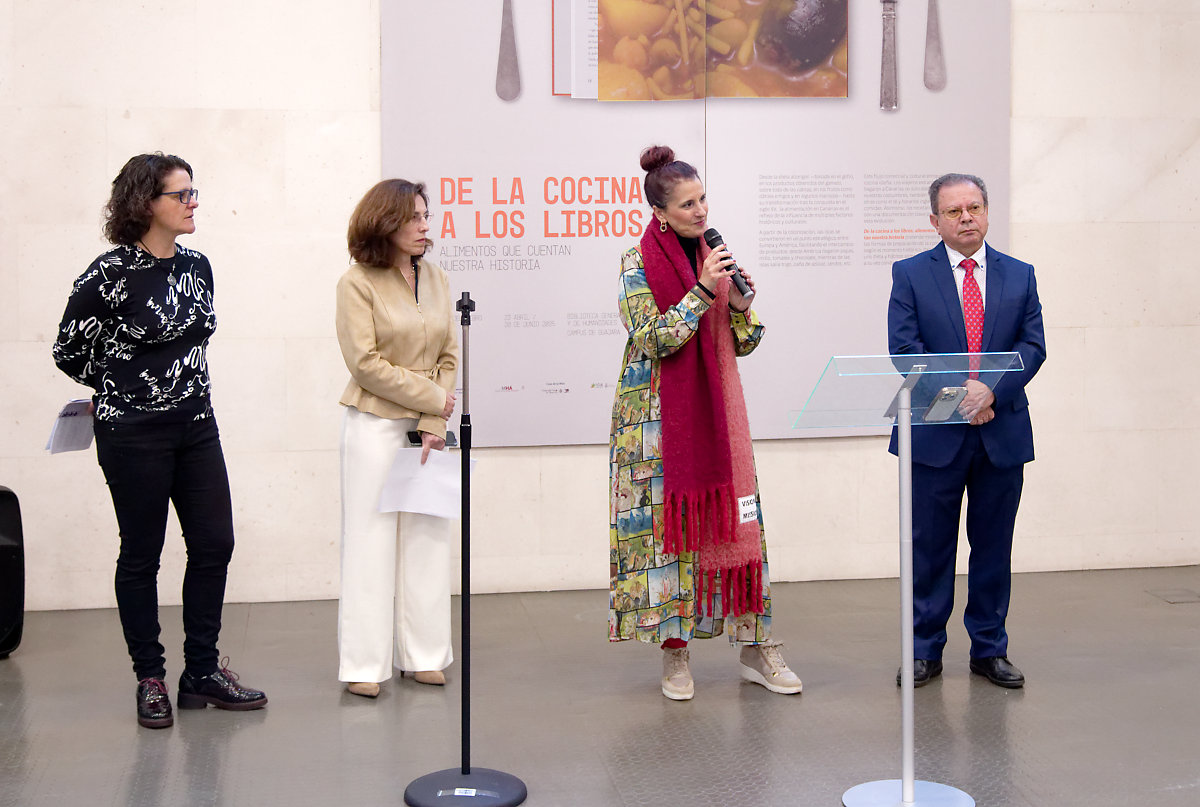
From left to right, Elena Rodríguez, Sonia García, Isabel León and Gonzalo Rey.
Without generational replacement
The tenured professor Elena Rodríguez, A researcher from the Nutrition and Food Science department, and part of the team that curated the exhibition, also highlighted that this exhibition uses documentary sources to illustrate the diet of the Canary Island population before (beef, sheep, mackerel, gofio, figs) and after (potatoes, grapes, sweet potatoes, onions, wine, chickens) the Conquest. She emphasized that diets varied between islands and depended on each family's economic status. With the arrival of tourism in the mid-20th century and the exodus from rural life to larger cities, diets were drastically influenced, a process that has accelerated in the last 25 years, she said.
The researcher belongs to the group of Food science and technology, as well as to that of Nutrition, food and health. In both cases, they have worked to characterize some varieties of local products and have collaborated on analyses of products that have achieved quality designations, such as honey, potatoes, avocados, and tomatoes. They have also contributed to increasing the value of local products, differentiating them from imported ones, which also extends to garlic, sweet potatoes, watercress, and gofio (a type of roasted grain flour). Elena Rodríguez warned of the danger of abandoning agriculture and the lack of generational succession, placing her hope in young people to become involved in local production and prevent the abandonment of agriculture.
Sonia García, from the Library Service, added that this initiative demonstrates how food preparation methods have changed over time, giving rise to new uses and diets. She referred to the first volume on vegetarian food, dating from 1912, by Doménech, and to another cookbook written by Luis Contreras in 1915 under the pseudonym Señora Martín. This exhibition, which is complemented by a series of workshops, is a collaborative effort between the Museum of History and Anthropology, the House of Honey, the House of Wine, the ICIA (Institute of Culture and Arts of Tenerife), Tenerife Espacio de las Artes (Tenerife Arts Space), the Cayetano Gómez Felipe House Museum, and the Faculty of Pharmacy.
Bibliographical delicacies
The director of the Library Service, Gonzalo Rey, pointed out that the celebration of Book Day is always a time for gathering at the university, highlighting the enthusiasm for reading and for the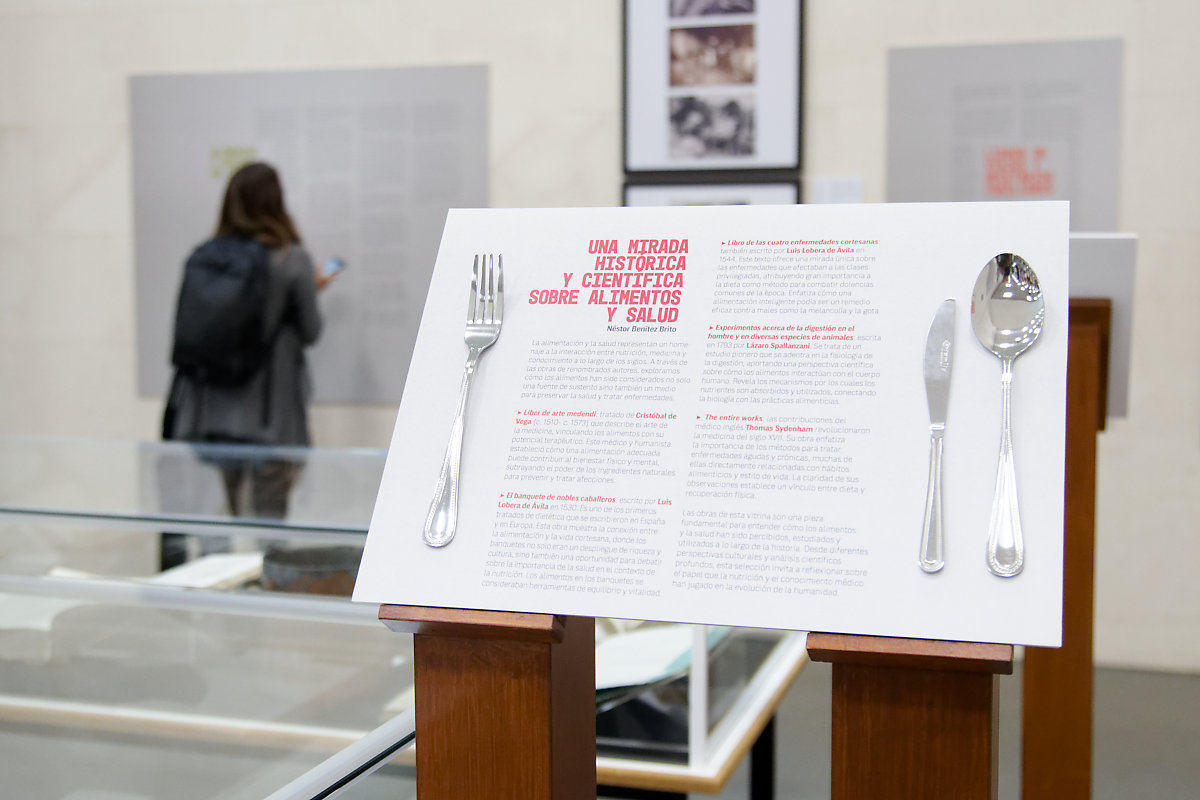 Open access science. He also announced that part of the library hosting this exhibition will be named after Marta Ouviña, a section head who passed away a few years ago.
The Vice-Rector for Culture and University Extension, Isabel León, pointed out at the end of the session that libraries are today “spaces for human and humanistic learning.” She also noted that when we travel we connect with new cultures and experiences through food and praised the excellent work of the Library Service staff who have put together an exhibition of the “finest bibliographic delicacies” from our islands.
The Philology Theatre Group, as usual, staged a short play at the end of the session.

 Spanish
 English
 French