
The plenary session of Social Council The first meeting of the University of La Laguna's faculty was held in Fuerteventura today, April 30th, with most of its members in attendance. The purpose of this visit is to explore avenues of collaboration between the island's governing body and the university, particularly focusing on joint research projects and the promotion of entrepreneurship.
The meeting addressed management issues such as the approval of the modification to the budget implementation guidelines for the university institution for 2025. The public prices for accommodation in university halls and residences for the 2025/26 academic year were also approved, adjusted to reflect the 2.21% CPI increase.
The Social Council has approved the call for nominations for its awards this year, which includes several categories. The University-Society Relations category is aimed at entities that have developed projects in 2024 promoting knowledge transfer, facilitating participation, or fostering relationships between the University of La Laguna and society. Three awards will be granted, each on a competitive basis, corresponding to three subcategories: micro-enterprises, SMEs, and other entities (large companies, public entities, foundations, etc.).
The Sustainable Development category recognizes social commitment initiatives promoted by any group within the university community that contribute to the ecological transition or the reduction of the digital divide. The third category, meanwhile, highlights excellence in the academic careers of university PhDs, awarding one prize in each field of knowledge.
The plenary session of the Social Council took note of the Annual Report of Activities for the year 2024 and of the resolutions of the president regarding the appointment of members representing the Social Council in the delegated committees of the Governing Council, incorporating the vice-president, Mª Reyes Henríquez Escuela.
In the opinion of the plenary session, patronage actions require a specific strategy, and therefore the creation of a working group on the Patronage Master Plan, chaired by councilor Carlos González Delgado, was approved.
Finally, the Social Council approved in its plenary session a resolution Presented by the president of the collegiate body, Almeida Ossa, and the representative member of the Fuerteventura Island Council, Víctor Alonso, on collaborative actions between the University of La Laguna and the Fuerteventura Island Council, which responds to the demands made by the island's representatives and productive sectors.
After the plenary session, all participants traveled to the Fuerteventura Technology Park to learn about this innovation hub, home to companies and startups, and the latest projects underway. One of these is the Canarias Geo Innovation Program 2030, which involves the installation of various security and emergency infrastructure using unmanned aerial vehicles (UAVs).
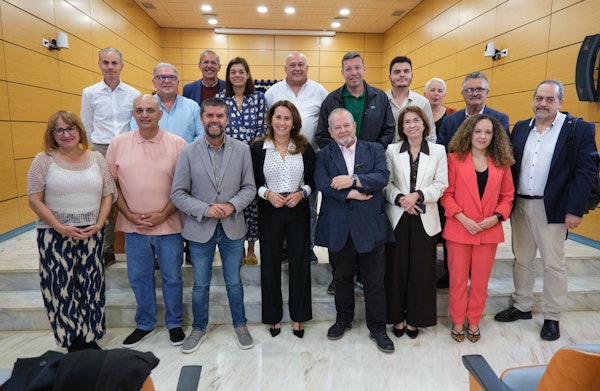 Meeting with the City Council
Before the plenary session, an institutional meeting took place, headed by the president of the Island Council, Lola García; the rector of the academic center, Francisco García; and the president of its Social Council, Francisco Almeida, as well as Víctor Alonso as a member of the Social Council of the ULL.
The island president took advantage of the presence of the university representatives to further explore the possibility of implementing university training from the university institution on the island, in a meeting that also included the presence of Adargoma Hernández as island councilor of Education, and the manager of the university, Lidia Pereira, and the vice-rector of Teaching, José Manuel Fraga.
The island president noted that universities are regional educational institutions, "and therefore can establish campuses on any of the islands. This opens up possibilities for implementing undergraduate programs in Fuerteventura to further improve education and retain talent, highlighting the need for a greater presence of the University of La Laguna (ULL) in Fuerteventura." García also emphasized the importance of students being able to complete curricular internships there.
The president of the Social Council, Francisco Almeida, stressed the importance of holding regular meetings on all the islands, in order to understand the island reality "and establish a strategy for the university's contribution as a social and economic driver.".
“We are a regional university, deeply connected to the Canary Islands as a whole,» the rector pointed out. This year, more than 500 students from Fuerteventura are enrolled in various degree programs. «This number has been increasing in recent years. We feel a responsibility to serve the island of Fuerteventura, and therefore we must promote our educational offerings.”.
Both the president of the Cabildo and the representatives of the ULL also highlighted the possibility of extending the training offer with the development of micro-credentials and the implementation of postgraduate training, as a way to reduce the consequences of double insularity.
Other proposals include fostering research to achieve greater economic diversification, promoting the Fuerteventura Technology Park within the university community, and incentivizing the development of startups to retain talent on the island. This extends beyond the technological field to encompass other potential initiatives focused, for example, on the effects of climate change or desertification—threats that are already evident. Fuerteventura could lead this type of research to develop specific solutions applicable to other regions, a topic relevant across multiple areas of knowledge.

 Spanish
 English
 French