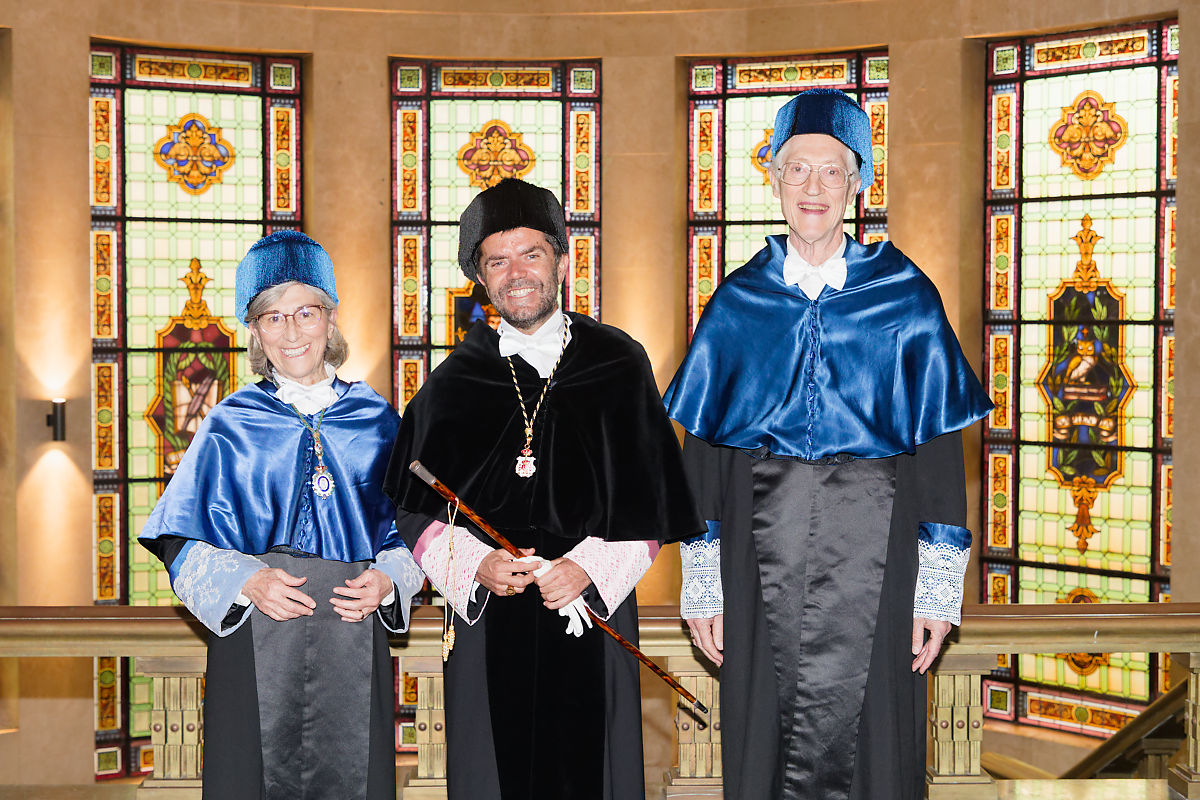
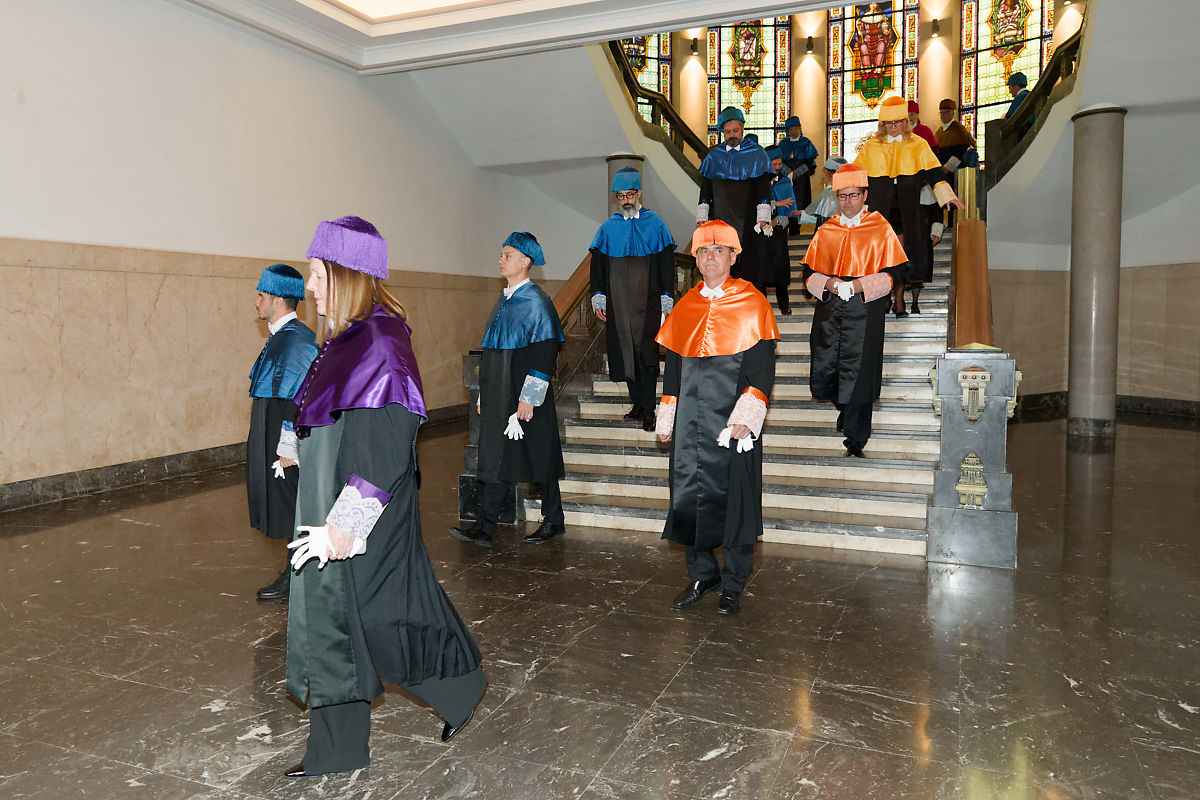
A moment from the academic entourage.
The University of La Laguna has added two new names to its list of honorary doctorates today, May 6th. They are the biologist Ana María Crespo, president of the Royal Academy of Exact, Physical and Natural Sciences of Spain, and John C. Mather, astrophysicist and Nobel Prize winner in Physics in 2006.
The auditorium of the educational center was the setting for a ceremony laden with symbolism representing the value of knowledge and scientific advancement. “In times like these, when the ephemeral is so prevalent, we especially feel the need for role models,” the rector, Francisco García, asserted in his closing remarks.
The honorees' careers, although quite different, are characterized by constant and rigorous work, and,
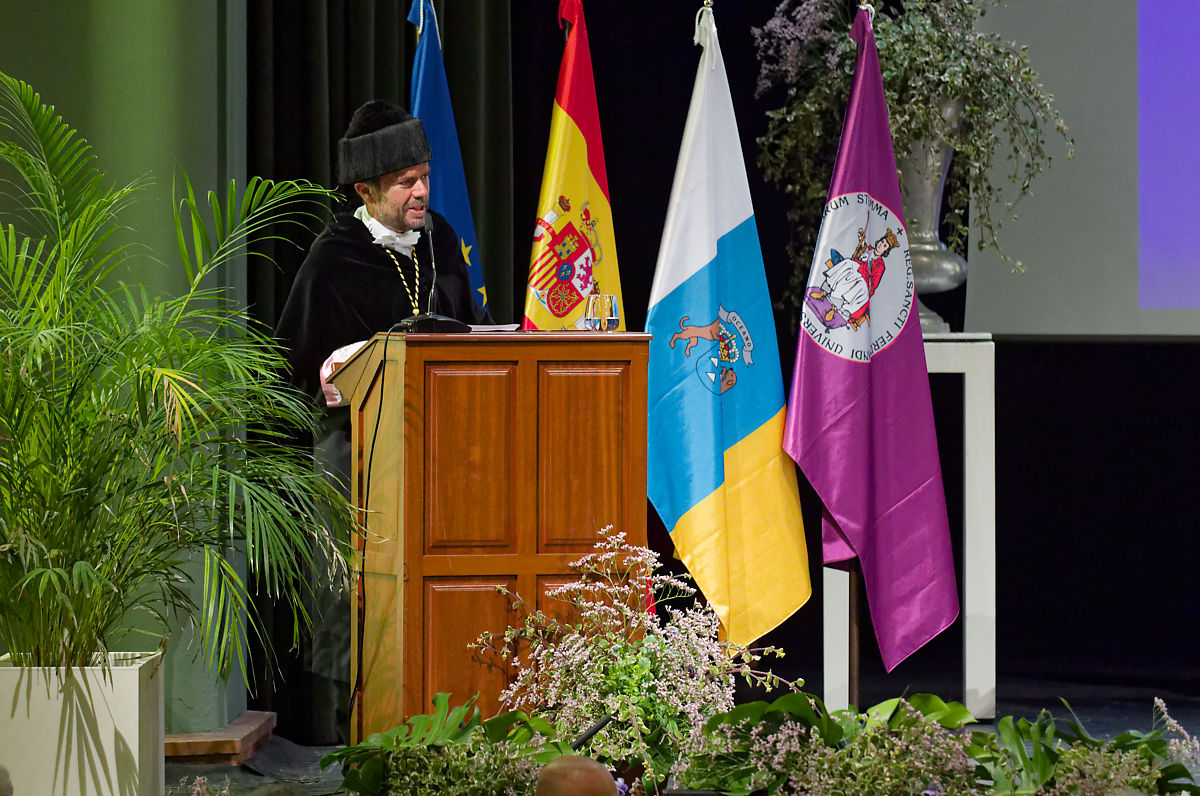
The rector of the ULL, Francisco García.
For this, “they need the tranquility of time free from urgency,” García stated. “We will increasingly need the growing presence of science to make sound decisions, both to improve the well-being of our society as a whole, and, at times, to guarantee its survival.”.
Therefore, the rector considered it essential “that women and men of science deepen their constant search for understanding the world, since that is the driving force behind scientific work.” He pointed out that “it might seem that what happens in laboratories and spaces for scientific experimentation has little to do with what is happening around us… Nothing could be further from the truth,” he replied, explaining in detail the advances of both in their respective disciplines. In fact, he maintained that Crespo de las Casas and Mather are proof that progress in the search for truth through science and knowledge “is the best antidote to fear.”.
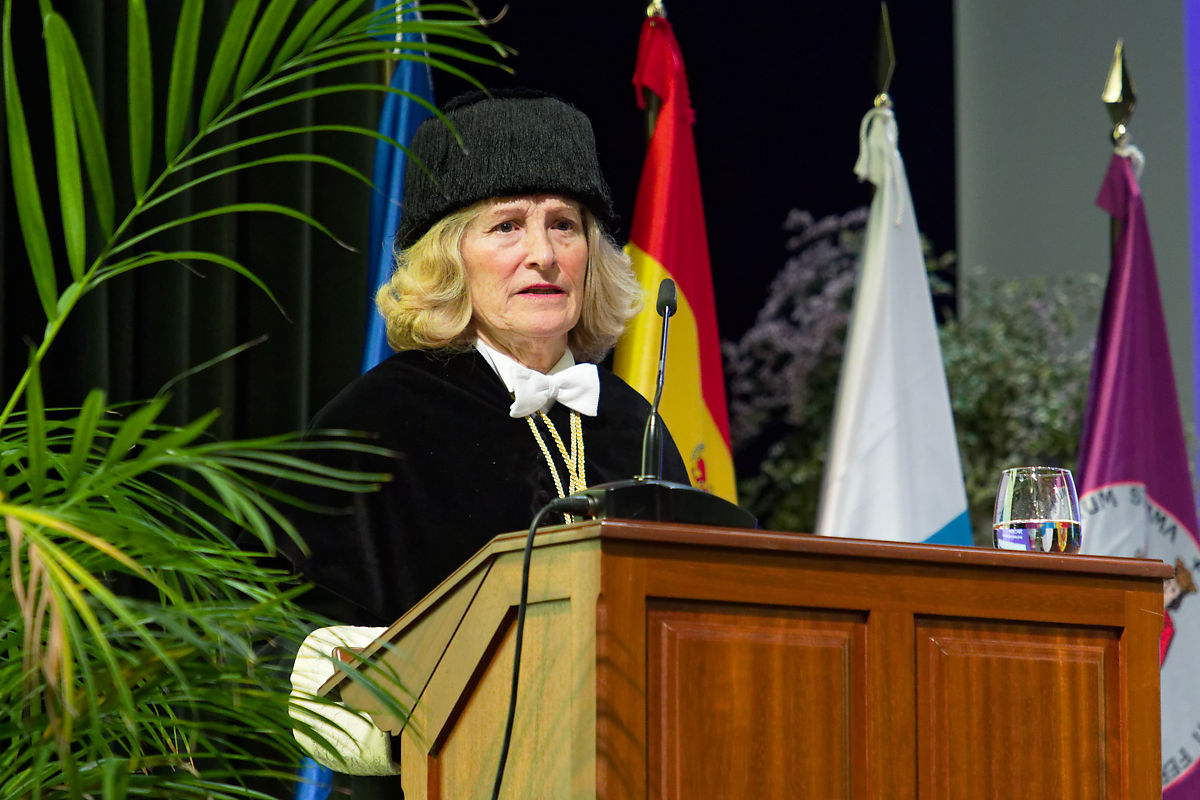
Marisa Tejedor, during the reading of Crespo's laudatio.
A passion for the study of lichens
The session opened with the customary reading by the Secretary General, Juan Antonio García, of the agreements appointing the two new doctors. Following the symbolic roll call of the recipients and their entrance into the Paraninfo (Great Hall) accompanied by their sponsors, the Dean of Sciences and the Secretary General, the session proper commenced with the laudatio Presented by Mª Luisa Tejedor to defend Crespo's candidacy. She recalled that Crespo took up the chair of Botany at the Complutense University of Madrid in 1983, becoming professor emerita in 2018.
Crespo de las Casas specialized in the study of lichens, “a group of organisms she worked on from the beginning and never abandoned.” Bibliometric data place her among the most recognized scientists in national and international series in her field. Her work has been so highly regarded that specialists in systematics and biodiversity have dedicated three genera to her (Crepe, Cresporaphis y Crespoaand seven new species, all names already included in international literature. Scientific publications and international awards mark her academic career, which was complemented by management positions.
In 2012, she joined the Royal Academy of Exact, Physical and Natural Sciences, taking charge of the Natural Sciences Section two years later and subsequently becoming its secretary general. In June 2024, she was elected president, the first woman to hold this position since its founding in 1847. According to her sponsor, Crespo fulfills all the requirements for this appointment.
The biologist received the appointment with an emotional acceptance speech, in which she intertwined science and memory.
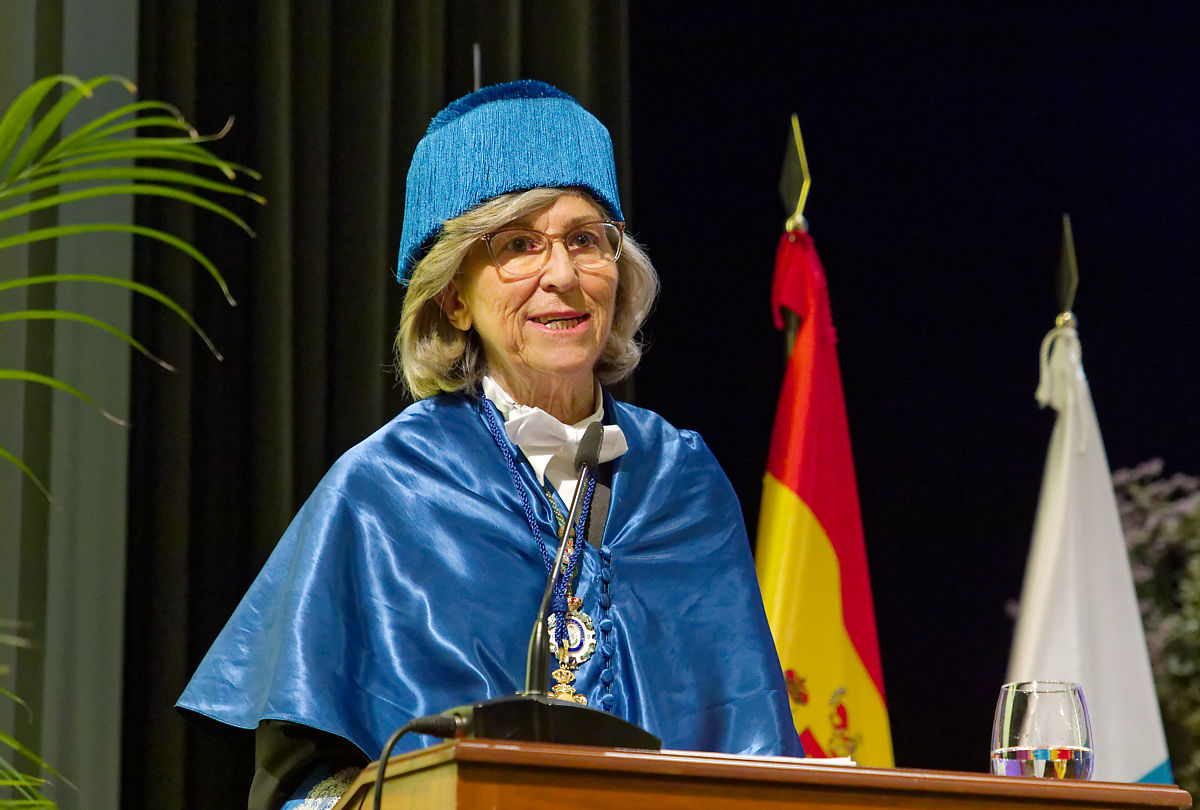
Ana María Crespo, during her acceptance speech.
She expressed personal gratitude to the public university. She fondly recalled her first steps as a student at the institution in 1965, in the same building where she was honored, and the excitement of receiving instruction from figures like Antonio González. “Childhood is one’s homeland,” she said, alluding to that deep connection with the university that was the seed of her scientific vocation.
Throughout her presentation, she shared the challenges of a career focused on the study of lichens, fascinating but complex organisms to classify. She spoke of the frustrations of traditional taxonomy and the radical shift brought about by the introduction of genetic techniques in the 1990s, when molecular biology made it possible to read the DNA of these organisms and trace their evolution with greater precision. She emphasized the value of international collaboration and the passion for discovery as essential drivers of science.
Ana María Crespo concluded her speech by referring to her current role at the institution, highlighting the new statutes that guarantee generational renewal and gender balance. She expressed her pride in being part of an institution where great scientists have left their mark, and especially in occupying the same seat as an emblematic figure like Blas Cabrera. “I hope to prove myself worthy of this honor,” she stated, pledging her commitment to science and the University of La Laguna (ULL).
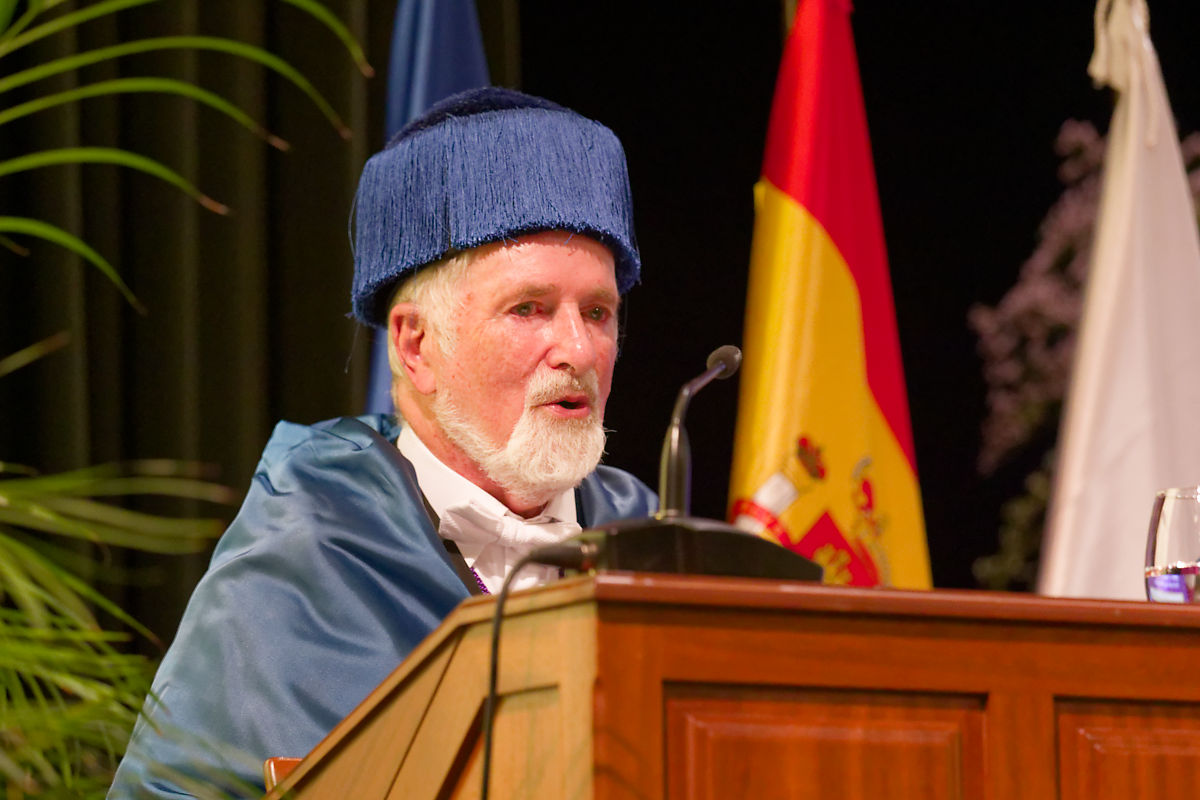
John Beckman defended Mather's merits as an honorary doctorate from the ULL.
Astrophysics, a collective contribution
The importance of publishing scientific results and the internationalization of science were two aspects highlighted by John Mather's mentor, fellow astrophysicist and honorary doctorate recipient from this university, John Beckman. Beckman emphasized that the success of the James Webb Space Telescope is due to "Mather's skill and composure in overcoming the great complexities of operating a telescope in space with a 6.5-meter primary mirror," at temperatures below 50 Kelvin, or -223 degrees Celsius.
“The James Webb Telescope is more of an observatory than just a telescope. My colleagues and their doctoral students at La Laguna have used it in many projects,‘ which has resulted in nearly 50 research articles, he emphasized. ’At La Laguna, astrophysicists have greatly benefited from the tools provided by Mather and his team.”.
In his acceptance speech, the American astrophysicist expressed the profound honor of receiving this award, which he accepted on behalf of the thousands of people who have contributed to the great successes of NASA projects and modern science. He described how his career, from its beginnings, became intertwined with Beckman's, with whom he maintains a close friendship. Both researchers contributed to the empirical search for the Cosmic Microwave Background, the cosmic heat that existed in the first few seconds of the universe.
Beckman's team, then based in the UK, built instruments to test its existence, which were then tested by Mather's thesis supervisors in California. After earning his doctorate and starting work at NASA, Mather proposed the creation of the Cosmic Background Explorer (COBE) in 1974, the first satellite built for cosmology studies, completed 15 years later. And just weeks after its launch, they were able to confirm the theory of the expanding universe, which earned him the Nobel Prize in Physics in 2006, shared with George Smoot.
Throughout his presentation, he explained the major findings of COBE, which led to the design of the experiment.
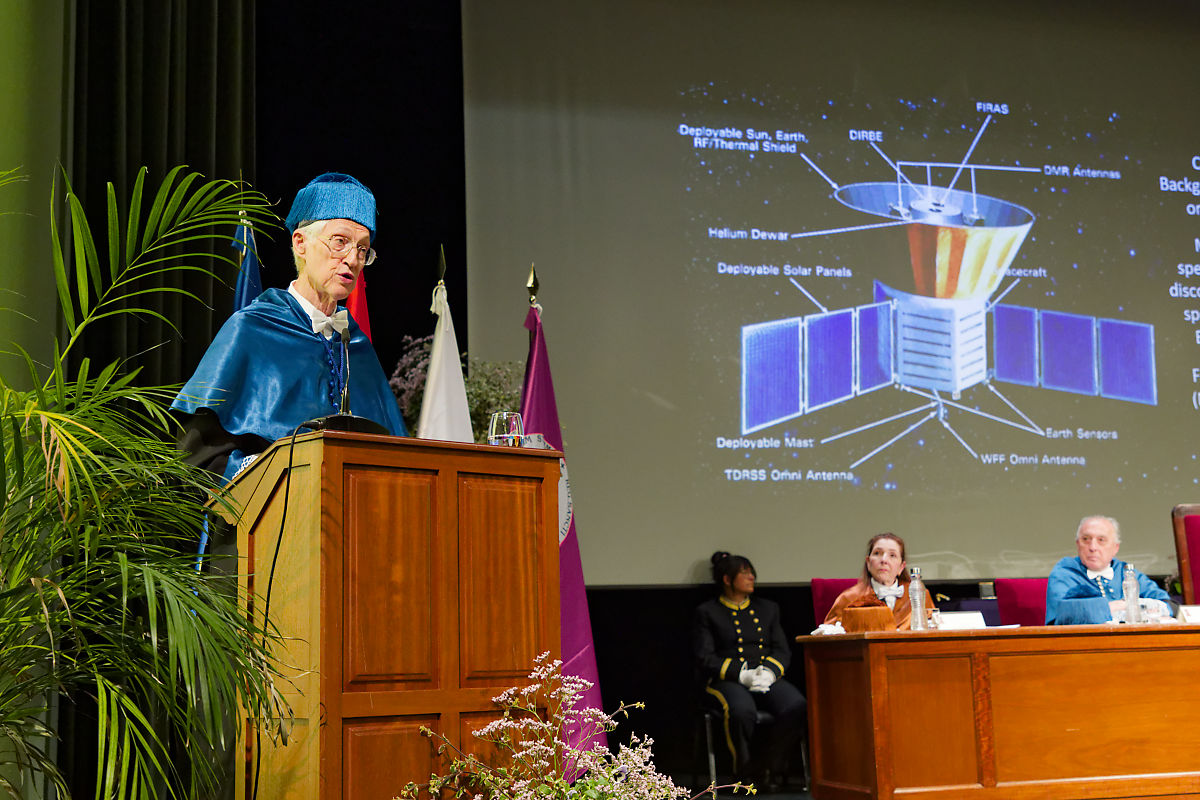
Nobel Prize in Physics winner John Mather, during his speech at the ULL.
Tenerife, at the Teide Observatory, in which researchers from the IAC participated. They also paved the way for the Euclid space mission, of the European Space Agency, and the James Webb Telescope, the largest and most complex space telescope to date, and in fact Mather showed in the session images of the most distant galaxy detected, when the universe was only 290 million years old, out of its 13.8 billion years that are calculated at the present.
With these great collective contributions across time and space, the astrophysicist anticipated "a glorious future, in which scientific discoveries will continue thanks to international collaborations." For Mather, discovering signs of life on another planet does not seem impossible. He also considered that artificial intelligence could become "a powerful tool for science and for everyday life," although he warned of the dangers it may entail. The Nobel laureate thanked the University of La Laguna for its work in educating and preparing young people for the exciting times ahead.
(*) Rector's speech.

 Spanish
 English
 French