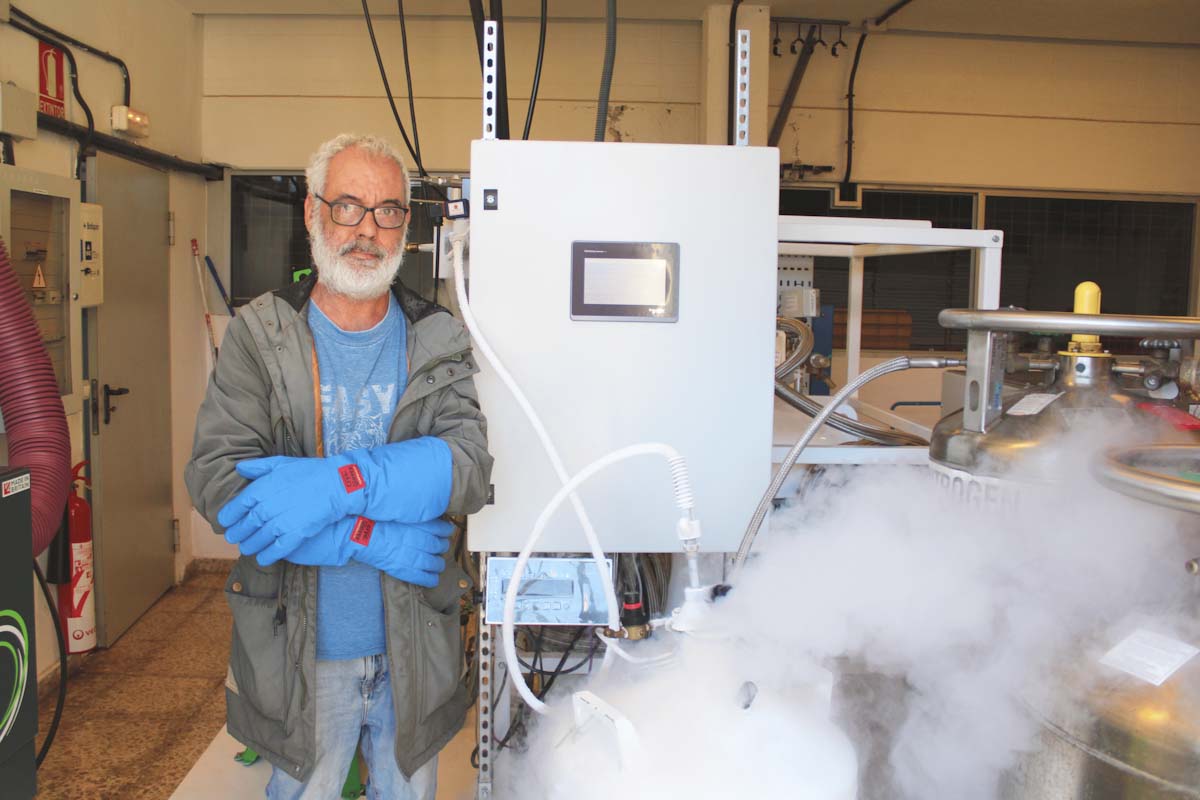
He General Research Support Service (SEGAI) The University of La Laguna provides scientific, instrumental, and technical support to research within the institution and in collaboration with external entities. This service is fundamental to the operation of other laboratories. Liquid nitrogen, a basic asset within the field of research that requires the use of cryogenic liquids, especially for the preservation of biological samples, both for carrying out tests and for the operation of a large number of laboratory equipment that require refrigeration at very low temperatures.
Besides the uses already mentioned, liquid nitrogen—which is at a temperature of -198.5 °C or lower and is colorless, odorless, and non-flammable—is also used in various other fields. In livestock farming, for example, it is used for freezing semen and eggs. In the biotechnology and medical sectors, it is used to preserve blood samples, tissues, and other biological materials, while in dermatology it is used to remove diseased tissue through cryotherapy.
In the food industry, it is used as a rapid method for freezing food, as well as for pressurizing cans and bottles of non-carbonated beverages by adding a few drops before sealing the container. Finally, in the restaurant sector, liquid nitrogen is used for cold cooking, eliminating bacterial growth, creating new textures and flavors, and producing more innovative presentations.
This service, unlike others available in Tenerife, stands out for its proximity, as it's located near the Anchieta Campus, at the Antonio González University Institute of Bio-Organic Engineering, making liquid nitrogen transport much easier. Furthermore, the service is friendly and the prices are competitive compared to the market.
The vast majority of users are from the institution, although there are also some external users. Its technician, Fernando Otamendi Burgui, explains that the laboratories in the SEGAI building usually take a large supply and share it among several departments. Researchers from the university institutes of Bio-Organic Chemistry, Tropical Diseases, and Biomedical Technologies, among others, also use this service.
Equipment
The liquid nitrogen generating plant, renovated approximately two years ago, works similarly to human lungs, Otamendi points out. It has a fairly powerful compressor that compresses the air to ensure a good flow.
Next, the air passes through membranes that separate the oxygen from the other components. Since oxygen molecules are smaller than nitrogen molecules, they pass through these membranes, resulting in high-purity nitrogen. This nitrogen is then cooled, compressed again, and thus transformed into a liquid.
“We have a 500-liter tank for storage, and we also have several Dewar-type containers for internal transport within the university,” explains Otamendi. These Dewar containers are insulated with a vacuum chamber that facilitates maintaining the nitrogen in a liquid state.
The main limitation regarding supply is determined by the plant's physical capacity. During periods of high demand, it is necessary to organize orders and establish a delivery schedule to serve all users. However, a reserve quantity is always maintained to allow for some flexibility in the event of unforeseen requests. In general, the quantities requested are not excessive, with an average volume of 240 liters, and are usually destined for the SEGAI building.

 Spanish
 English
 French