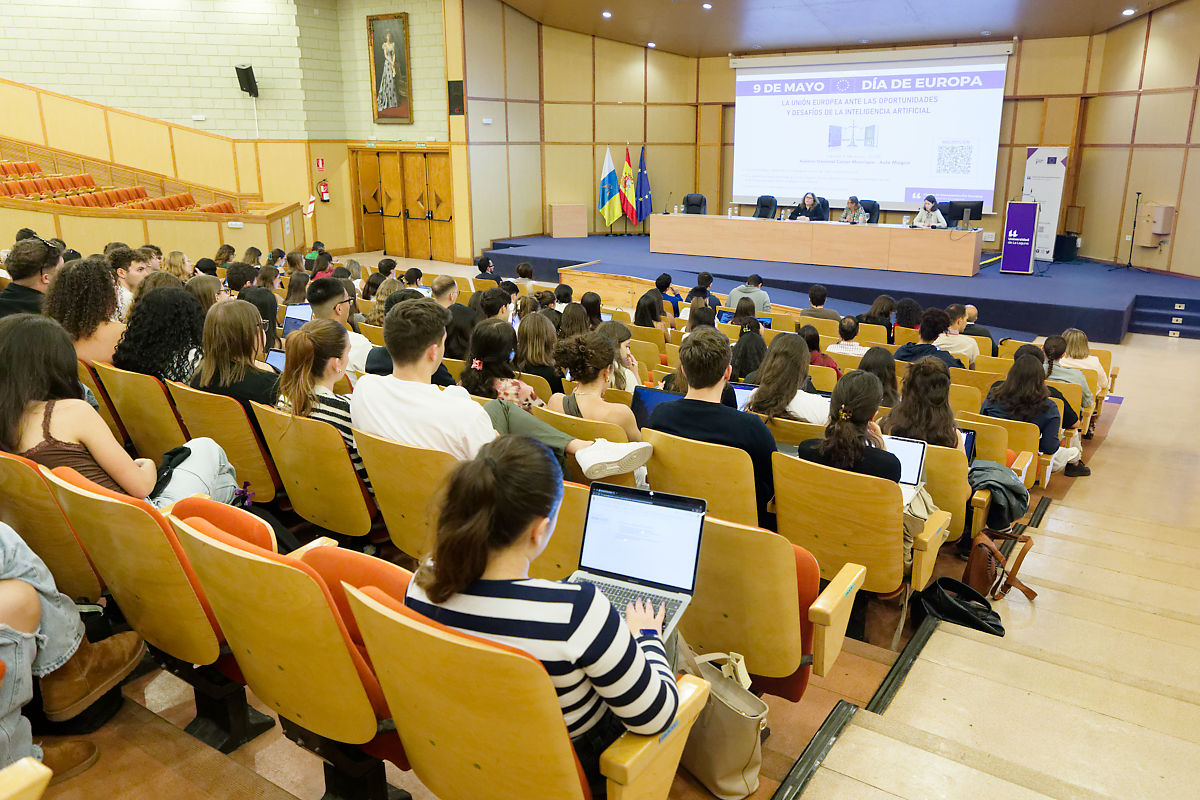
The University of La Laguna commemorated the Europe Day with an event that addressed the impact of artificial intelligence on the regulatory and social context facing the EU today. The event, held this Friday, May 9, in the Aula Magna of the César Manrique General Lecture Hall and organized by the European Documentation Centre The university featured various experts in computing, law, and philosophy who delved into the challenges and opportunities presented by this technology.
During the session, three presentations were given that offered a multidisciplinary approach to AI from various academic perspectives, with the aim of delving into the regulatory, ethical and operational challenges, moderated by Ruth Martinón, academic director of the European Documentation Centre.
Inmaculada González, Vice-Rector for Internationalization and Cooperation, opened the conference, highlighting the enormous importance of this tool as a transformative element, especially regarding international cooperation and its social and cultural implications. “The European Union is a privileged framework for developing humanistic technology centered on people, sustainability, and fundamental rights,” she noted, particularly given international trends that threaten democracy, dialogue, and peace. In this regard, she emphasized the important role of the University of La Laguna as an active agent in this challenge, promoting a critical citizenry aware of the ethical and social implications.
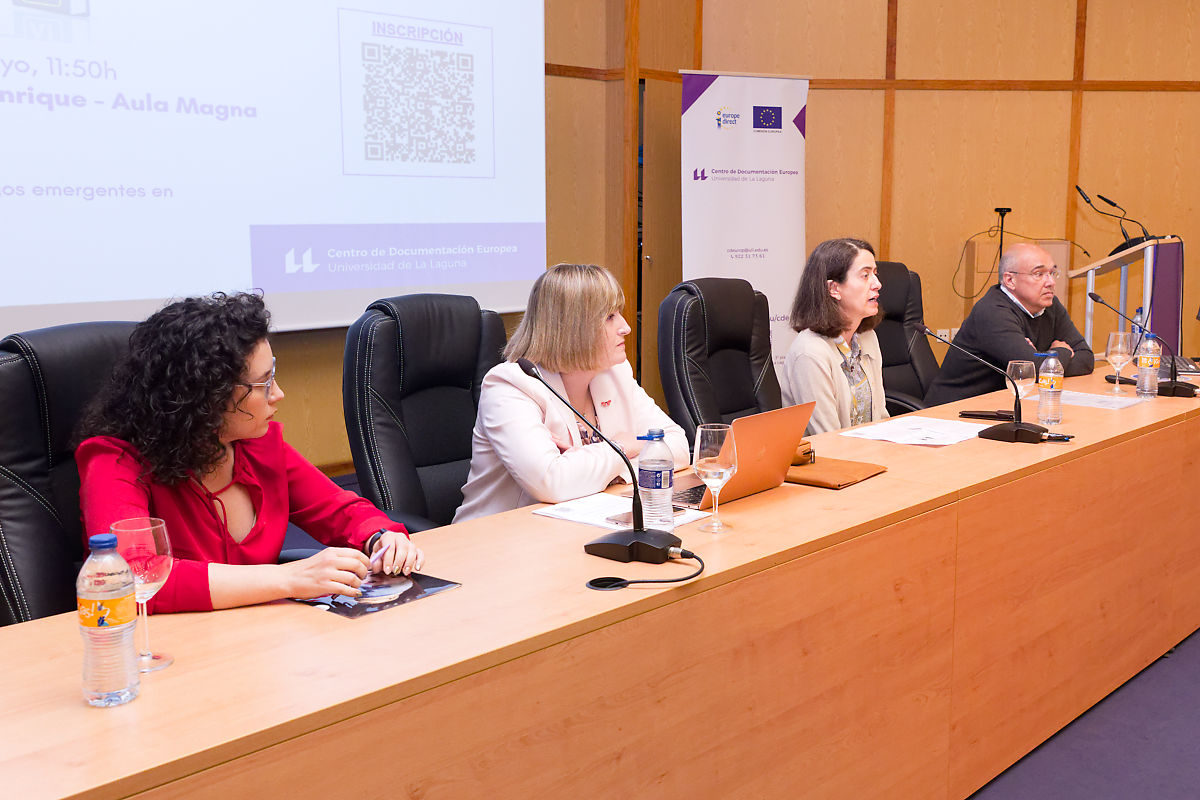
Image of the participants: Andrea Padrón, Teresa García-Berrio, Ruth Martión and Francisco Almeida.
Next, Dulce María Cairós, Dean of the Faculty of Law, noted that this year marks the seventy-fifth anniversary of the Schuman Declaration, the origin of the European project. In a complex global geopolitical context marked by technological advancement, she appealed to the need to strengthen the European social pillar and maintain its role as a “moral beacon for the world.” Echoing Schuman’s founding words, she affirmed the enduring relevance of its spirit for the present and future of the European project.
Francisco Almeida, Professor of Computer Languages and Systems at the University of La Laguna, focused on the opportunities and challenges of AI from a computational perspective, analyzing the uncertain consequences it presents in terms of secure and efficient development. Almeida highlighted the energy cost of computing as one of the major problems: “Just training a model like ChatGPT 4 used one hundred times the energy consumption of Santa Cruz de Tenerife.”.
Teresa García-Berrio, Professor of Philosophy of Law at the Complutense University of Madrid, also participated in the session to discuss fundamental rights in the digital age and emerging risks in the European approach to AI. The expert explained that one of the major challenges in creating an effective legislative framework is the lack of ethical awareness surrounding artificial intelligence, hindering the guarantee of a trustworthy technological environment that respects fundamental rights within the European Union. In general, she emphasized the importance of preserving fundamental rights, such as privacy and non-discrimination.
For her part, Andrea Padrón Villalba, assistant professor of Commercial Law at the University of La Laguna, wondered if a robot can be a subject of law for the European Union.,
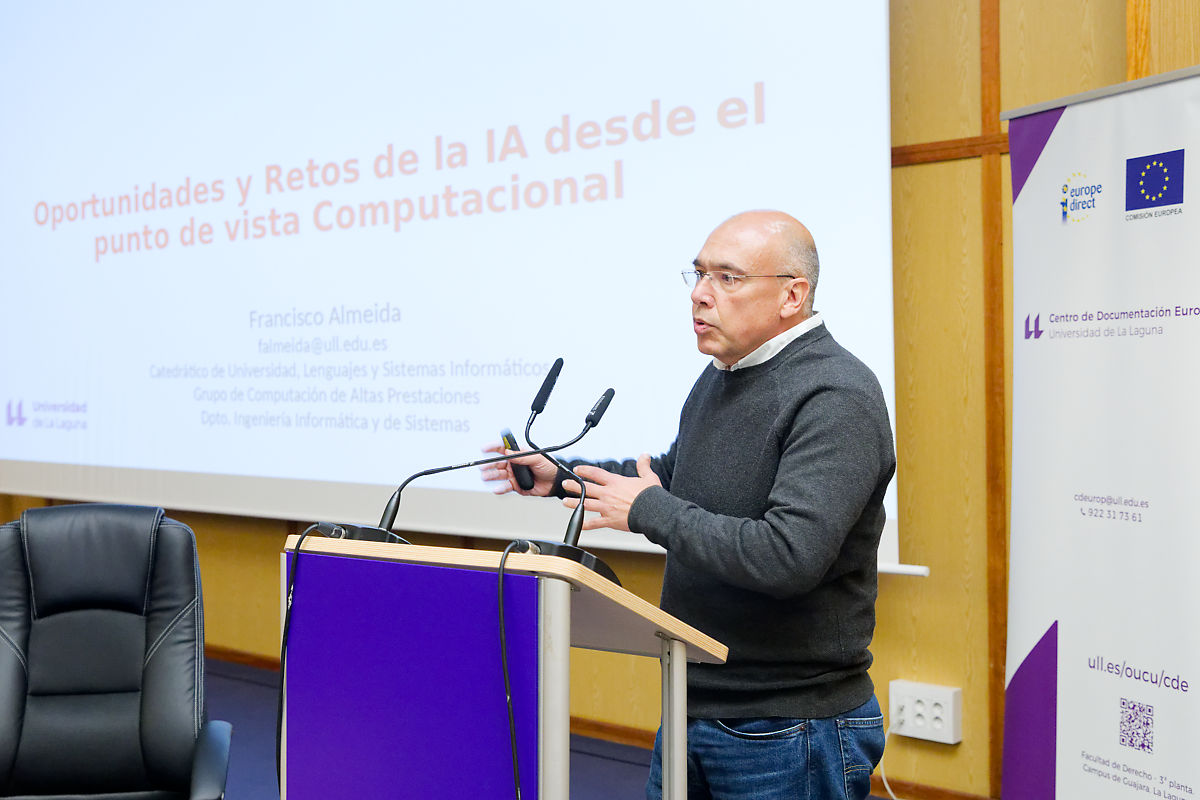
Francisco Almeida, professor at the ULL, during his speech.
addressing the legal dilemmas surrounding the possibility of granting legal personhood to these systems. This would imply the creation of specific rights for artificial intelligence, for example, in the event of an accident or if a person suffers harm as a result of its use. However, this is still an emerging issue in the European debate, given the uncertain outlook regarding the future scope of this technology.
The event concluded with a question and answer session open to the public, followed by an official closing, which provided a relaxed space for the exchange of ideas between attendees and speakers.

 Spanish
 English
 French