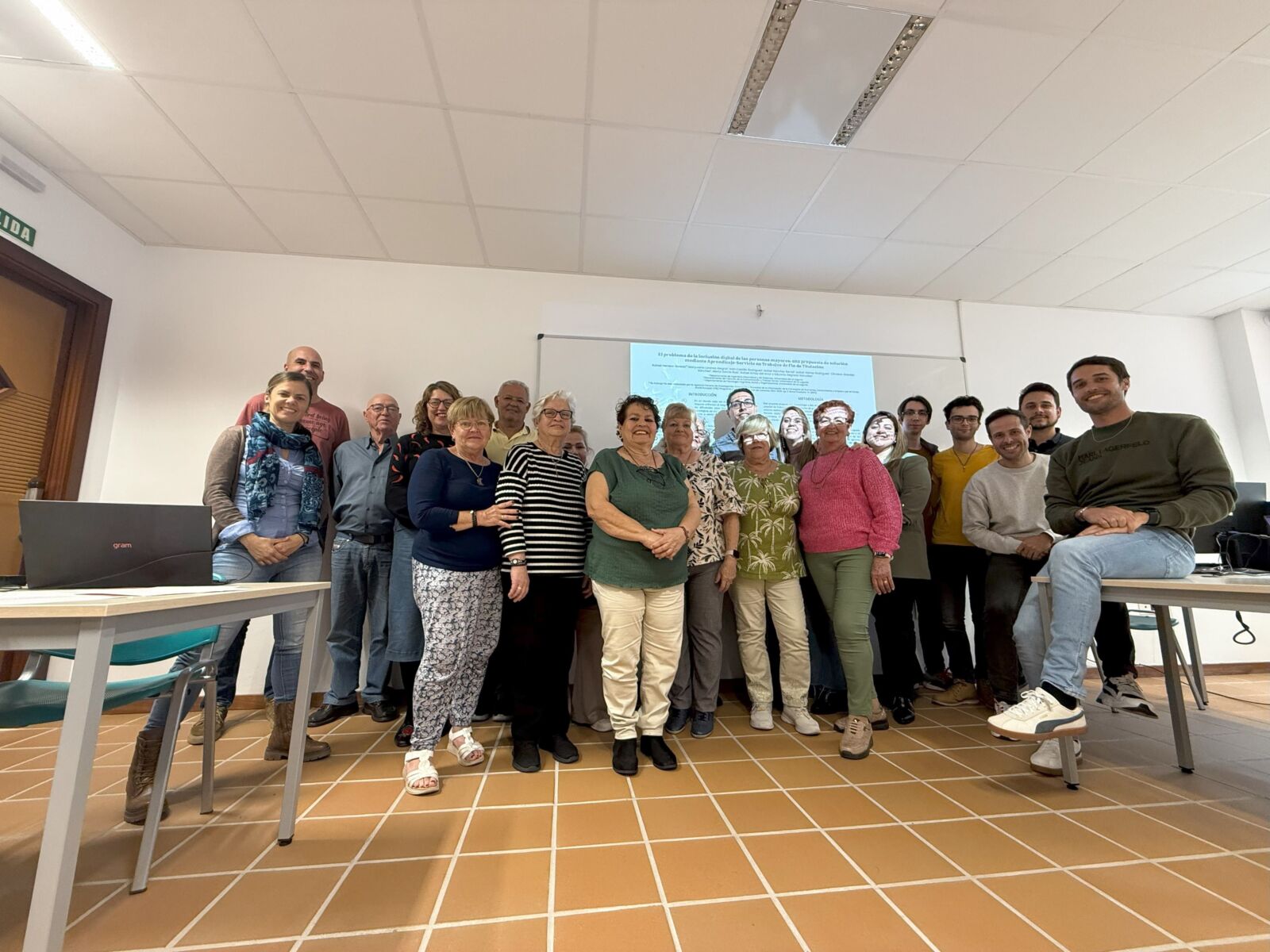
A prototype chatbot based on Artificial Intelligence, and created by the students, was tested in the Higher School of Engineering and Technology With the participation of senior citizens from the Nuestra Ilusión Association, faculty and students from the Computer Engineering, Social Work, Psychology, and Education programs welcomed a group of seniors to the university this week. The objective of the session was to evaluate a new virtual assistant (“chatbot”) based on Artificial Intelligence, designed and developed by Aday Cuesta Correa, a Computer Engineering student, to guide and provide digital support to senior citizens in their internet navigation.
During the activity, the group visited one of the school's computer labs, where Aday Cuesta Correa himself gave an introduction to computer use and safe internet browsing. Afterwards, the group participated in a series of hands-on challenges to assess the ease of use and overall experience with the virtual assistant.
The initiative is part of the Educational Innovation and Transfer Project “Final Degree Projects as Catalysts for Service-Learning Methodology: A Battle for the Inclusion of Older Adults.” The project, conceived by Rafael Herrero Álvarez, a researcher in the Department of Computer Engineering, is led by Maryurena Lorenzo Alegría, a professor in the Department of Communication Sciences and Social Work, and Iván Castilla Rodríguez, also from the Department of Computer Engineering. Nearly a dozen professors from the aforementioned departments, as well as from Cognitive, Social, and Organizational Psychology and Didactics and Educational Research, are participating, working in a multidisciplinary manner to reduce the digital divide and promote the active inclusion of older adults in the digital society.
The proposed lines of work are based on the Service-Learning methodology, which allows students to enhance their professional development through participation in projects with social impact. The Final Degree Projects include the analysis of barriers that hinder older adults' access to digital applications, which are increasingly essential for daily life, and the development of technological tools to facilitate their use, employing the latest advances in Artificial Intelligence and conducting usability tests such as the one carried out during this workshop.
The session provided a valuable opportunity to validate the prototype from a human and practical perspective, reinforcing the importance of actively listening to older adults and considering their real needs in technological development. This type of initiative reaffirms the university's commitment to inclusion, meaningful learning, and community service.

 Spanish
 English
 French