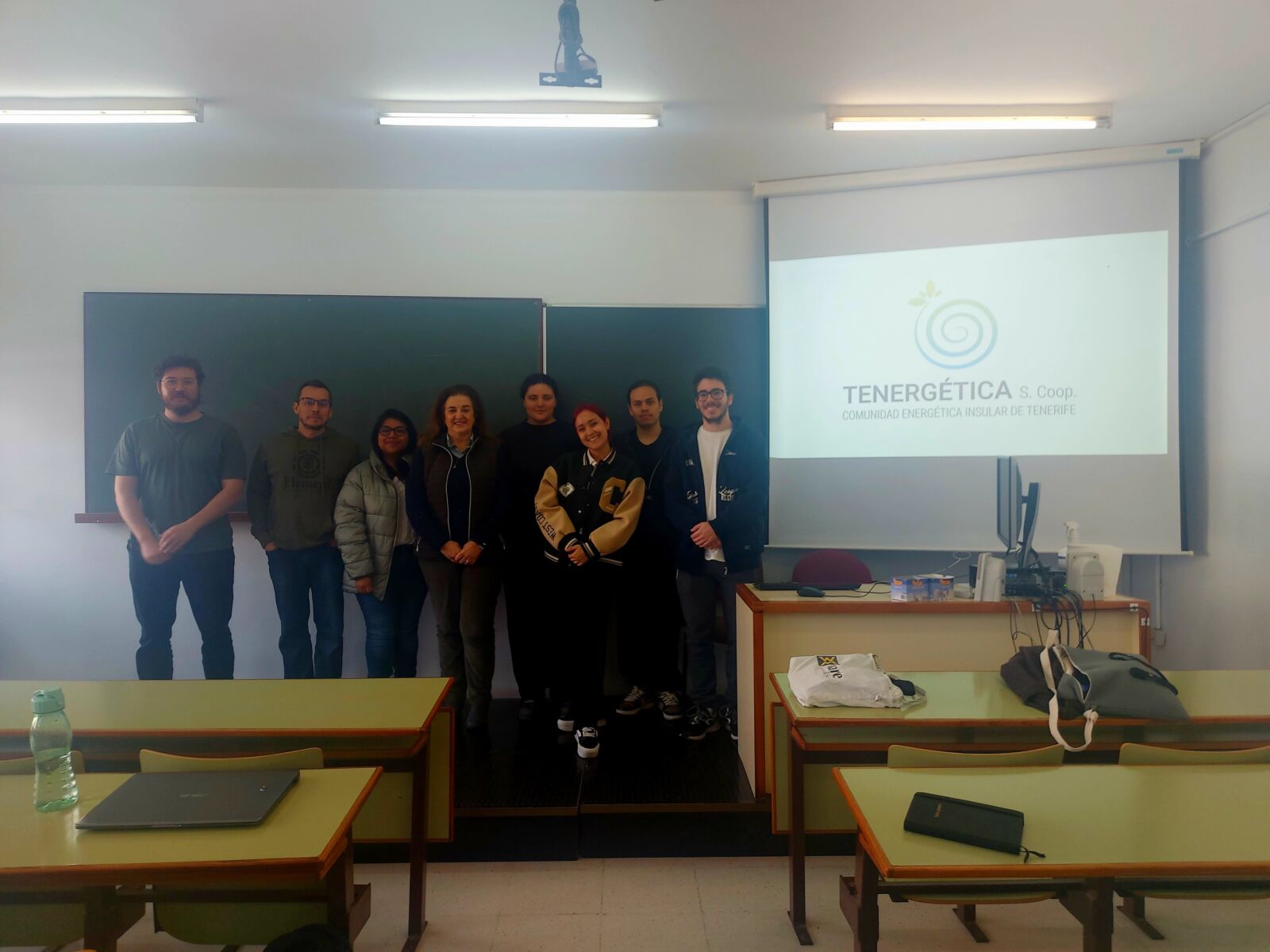
On May 2nd, as part of the training activities of the Master's Degree in Renewable Energies at the University of La Laguna, the students of the Accounting and Financial Analysis course, along with their professor María Victoria Pérez Monteverde, received a talk on Tenergética S. Coop., The organization promotes the energy transition in the Canary Islands from a citizen-led and democratic perspective. The presentation included explanations from the president, Rubén Fuentes Beltrán, and the vice president, Federico Ghijs Mora.
During the session, the specific characteristics of the energy community model were addressed, highlighting its nature as a non-profit citizen initiative driven by the active participation of individuals, organizations, and local governments. Particular emphasis was placed on its legal structure as a consumer cooperative, a model that allows for democratic participation and decision-making.
The second part of the talk focused on the economic model of energy communities. Key elements underpinning their economic viability were presented, from crowdfunding methods to the development of a business model based on criteria of economic sustainability, energy independence, and social return. Students learned how resources are managed in these types of initiatives, what factors are considered in the design of collective renewable energy installations, and the active role of citizens in their operation and governance. The accounting specifics associated with this emerging model were also addressed, highlighting the fact that the cooperative's members themselves assume the investment in the infrastructure, which implies financial management adapted to the participatory and democratic nature of the project.
Tenergética S. Coop. highly valued the activity, which allows students to engage with real-world experiences of social innovation and energy transition developed in the Canary Islands. They also emphasized the importance of creating educational spaces that promote a comprehensive view of the energy transition, incorporating technical, economic, and community aspects, as well as the need to ensure the success of these initiatives through citizen involvement.
These types of initiatives strengthen the connection between the academic field and the eco-social transformation processes underway in the Canary Islands, generating new opportunities for professional and citizen involvement in the challenges of our time.

 Spanish
 English
 French