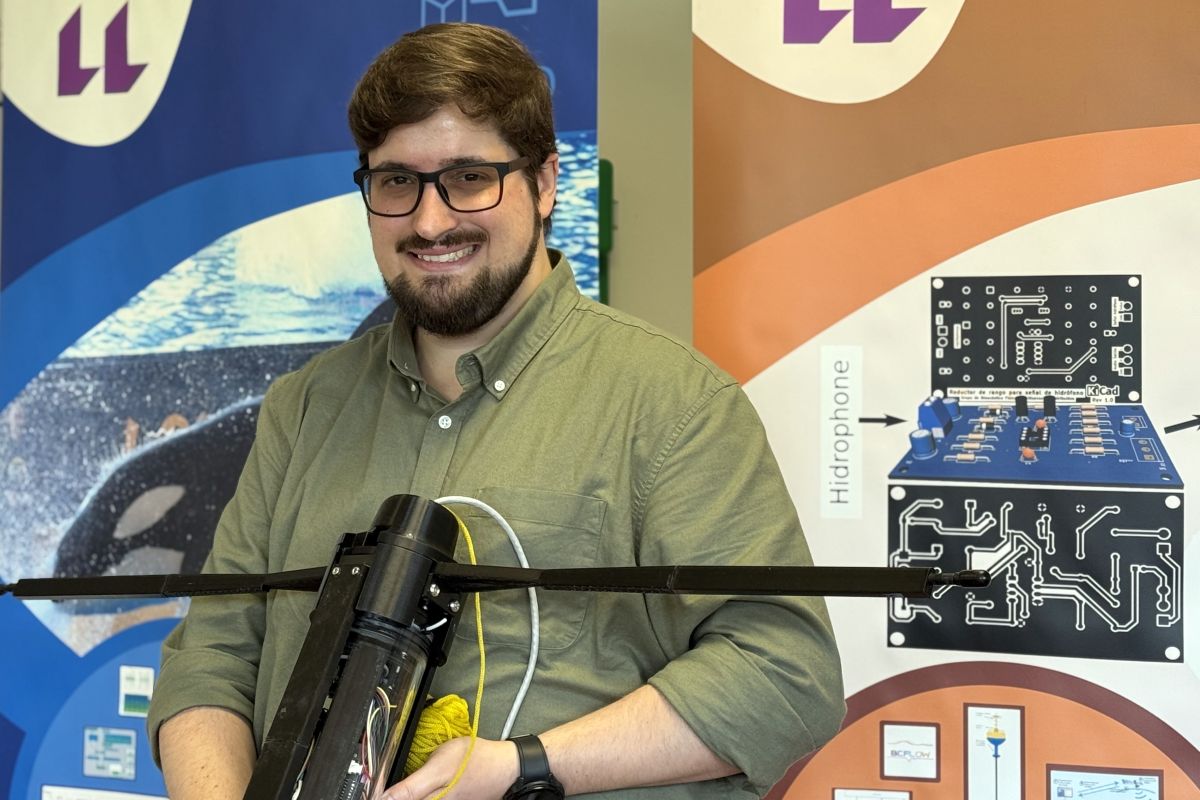
In a new step towards the protection and conservation of the marine environment, the University of La Laguna, in collaboration with the Loro Parque Foundation and the Government of the Canary Islands through the project CanBio, has developed a new tool that records the soundscape of the marine environment: the Modular Platform for Underwater Acoustic Monitoring (PMMAS). This initiative originated as part of the Master's Thesis project of student Sergio García Beitia, from Master's Degree in Industrial Engineering, and is presented as a low-cost, sustainable and highly adaptable technological solution.
The PMMAS has been designed to record and analyze underwater sounds in real time—both those of natural and biological origin and those generated by human activity—with a particular focus on open ocean areas. Unlike traditional systems, which are typically expensive and complex, this new platform offers a modular, wired, and easy-to-maintain approach, facilitating its deployment in diverse environments and making it an accessible alternative for marine research.
One of the platform's most outstanding advances is its ability to perform acoustic processing directly on the underwater nodes, which allows it to automatically detect relevant sound events and transmit them immediately to external servers for analysis, a capability that opens up new possibilities in the location and study of sound sources underwater in the deep sea.
“I began developing this work motivated by the desire to solve the problem of noise pollution in our oceans,” the engineer emphasizes. “Our seas need to be heard,” he adds, highlighting the need for tools that allow us to better understand the marine environment. He found support for this project in the Research Group of Physical Bioacoustics and Distributed Multi-sensors, to which the researchers belong Fernando Rosa González y Jonah Philipp Luke.
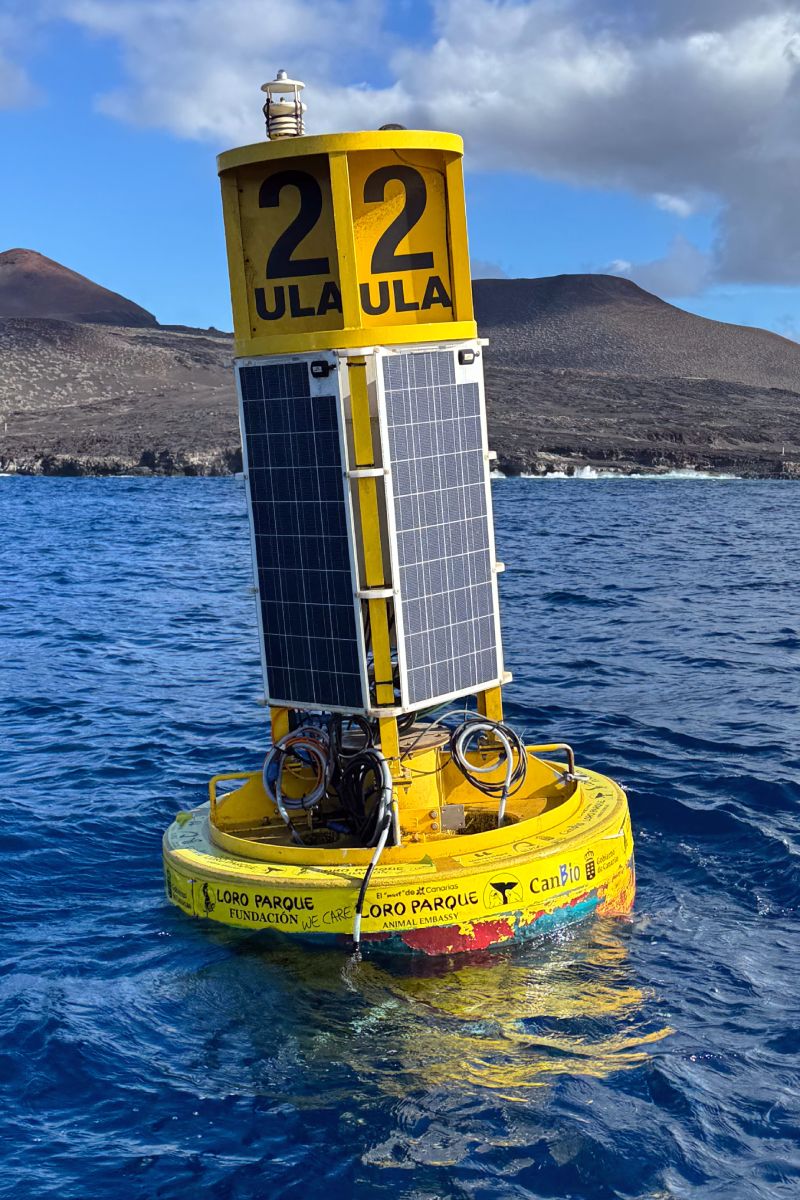
Project buoy.
The student faced several challenges in developing the platform, especially in ensuring it was watertight, modular, and easy to manufacture and maintain. He also emphasized the challenge of maintaining a low-cost design without compromising functionality or technical reliability, an important aspect for its replicability in other research settings.
Furthermore, the project embraces an open technology philosophy: the PMMAS has been developed using free software, open source tools, custom-designed components and 3D printing, allowing its reproduction, adaptation and scalability in other scientific, educational and conservation contexts.
About CanBio
CanBio is an environmental research program funded equally by the Government of the Canary Islands and the Loro Parque Foundation, with an investment of three million euros over its five years of operation. Its objective is to study climate change, ocean acidification, and their effects on the marine and terrestrial biodiversity of the archipelago.
This project involves various research groups from the University of La Laguna and the University of Las Palmas de Gran Canaria, as well as environmental volunteer groups. Since its inception in 2019, CanBio has worked to establish a monitoring network for key parameters related to climate change, underwater noise pollution, and its impact on biodiversity. Furthermore, it has become an essential data source for climate models in the Macaronesian region and a benchmark for the protection of marine and terrestrial species in the face of the challenges of global change.
The sub-projects that make up CanBio include BuoyPAM, MacPAM, CanOA, BioACU, BioMAR, BioTER, SonMAR and BioModClim, each of them focused on different aspects of research on the impact of climate change on the ecosystems of the Canary Islands.

 Spanish
 English
 French