The Canary Islands' proximity to Africa is more than geographical, with centuries of history of social, economic, environmental, cultural, and scientific ties. This last aspect is evident in the research and dissemination carried out in the Center for African Studies from the University of La Laguna, which has organized a new edition of Africa Day. The annual event, which has become established as a space for dialogue, reflection and coexistence between cultures, took place throughout the day yesterday, May 28, from 10:00 a.m. to 7:00 p.m. at the Guajara Campus.
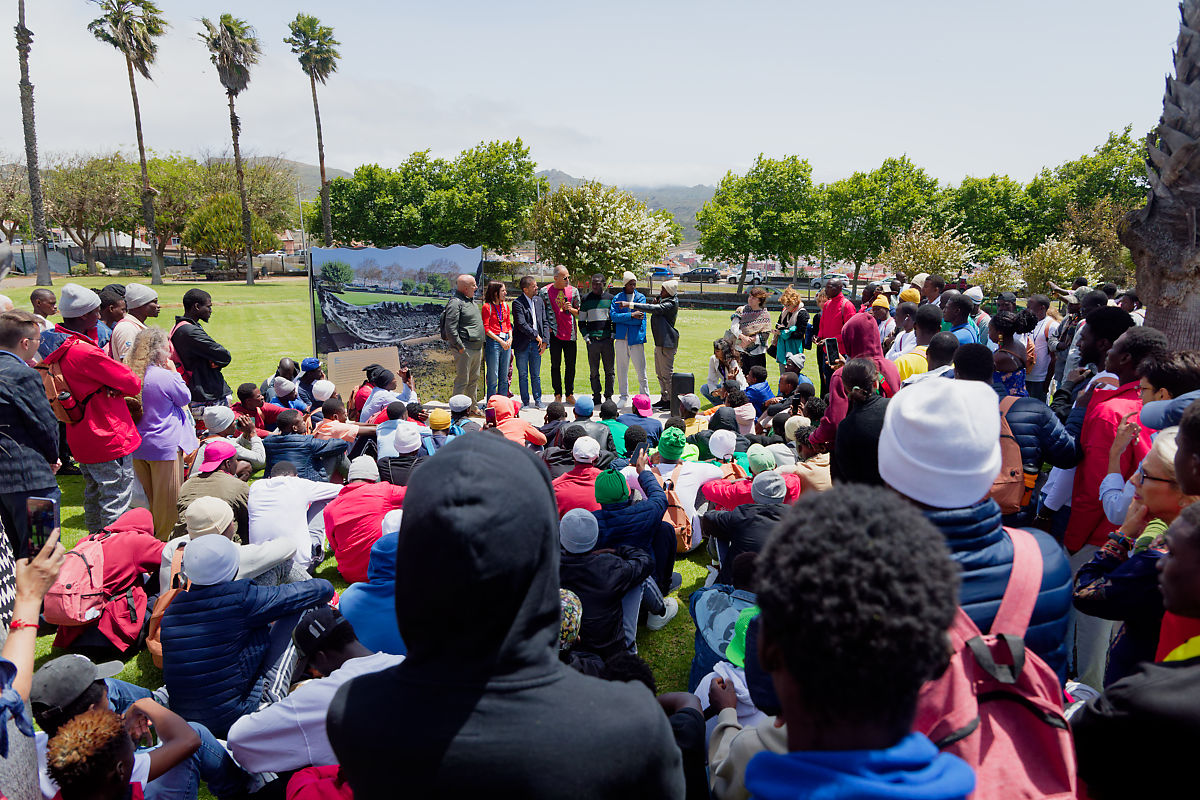
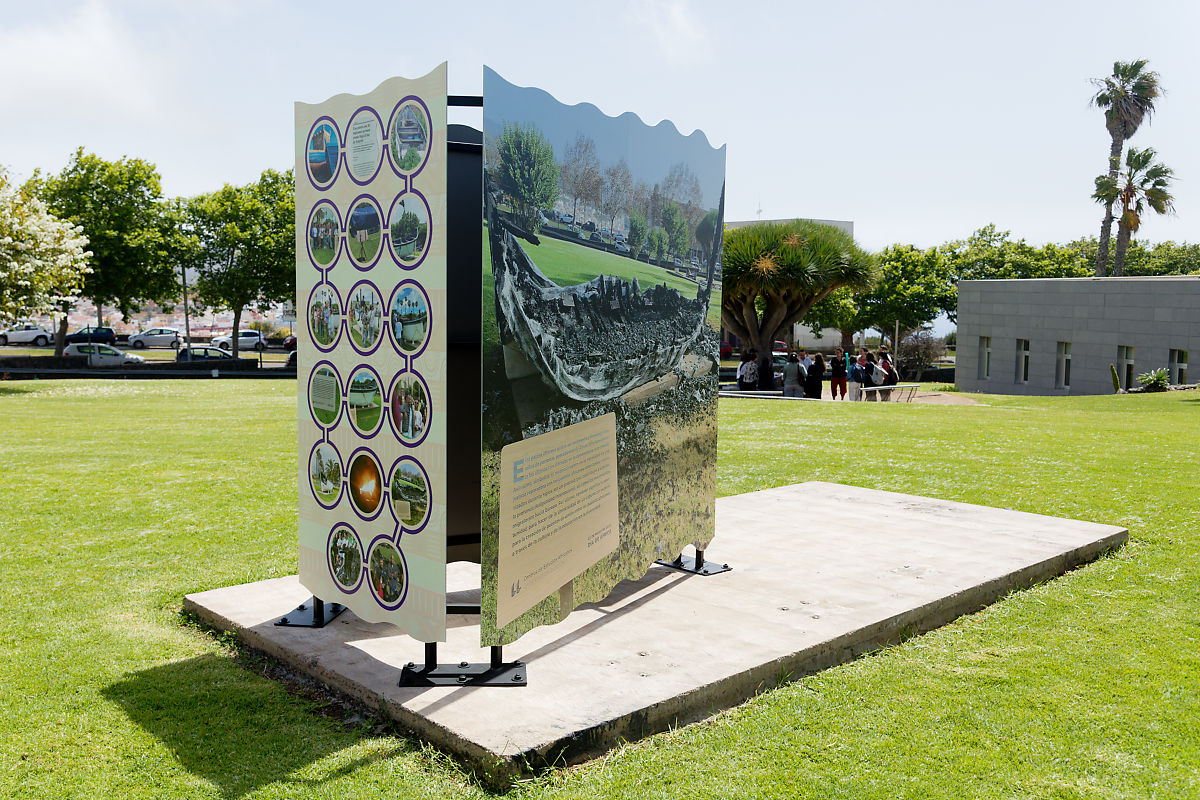
One of the most symbolic events of the day was the inauguration of the "Canary Islands Migration Route" memorial in front of the General and Humanities Library building, precisely where, more than a year ago, an act of vandalism destroyed the migrant boat on display in that public space. This new monument, a vinyl-covered monolith bearing photographs of the boat before and after it was burned, serves as an emblem of resilience and the stories of those who have undertaken the Canary Islands migration route.
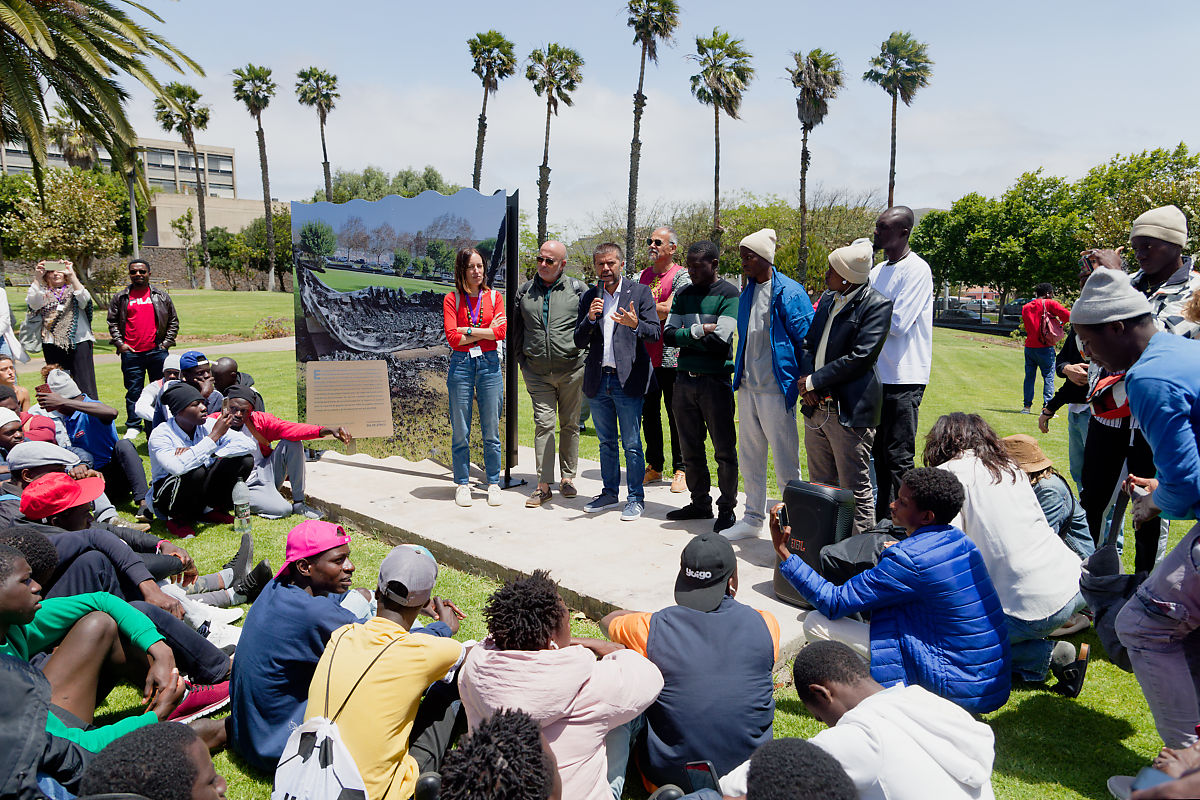 At the inauguration, alongside dozens of young migrants from the Las Raíces camp, were the Rector of the University of La Laguna, Francisco García; the Dean of the Faculty of Humanities, Javier Medina; and the Director of the Center for African Studies, Víctor Martín, who expressed his gratitude for the Rector's personal commitment to making this monument a reality. “Today we want to tell those responsible that if they burn it down a hundred times, we will rebuild it a hundred times over,” Martín declared. The speeches were translated into French, Wolof, Bambara, and Pular by young people from “La Escuelita” (The Little School) at the Las Raíces camp, an educational project for young migrants supported by the NGO “Aquí estamos migrando” (Here We Are Migrating).
“Africa Day is our day, because we feel part of this continent, of the same reality, not only from a geographical point of view,” the rector stated. “This gathering we see here today is what we truly are: a welcoming, inclusive, and tolerant society that defends peace, dialogue, and understanding with all cultures.” García emphasized that this is the true image of the public academic institution and of Canarian society, not the one conveyed by the tragedy of the migrant boat. He also acknowledged the important work of the Center for African Studies and initiatives such as the Informa Project, “La Escuelita” (The Little School), with its Spanish classes taught by volunteer teachers at the University of La Laguna, and the Tenerife Immigration Observatory (OBITen), directed by Geography Professor Vicente Zapata.
For his part, Javier Medina highlighted the honor of being able to welcome the young migrants to the Faculty of Humanities, and thanked Francisco García and Víctor Martín for opening the doors of the university, hoping that it will generate “a link for a better world” with Africa.
 The event concluded with a minute of silence in remembrance of those who have lost their lives on their migration journey, following the tragic news of a canoe capsizing in the Port of La Restinga (El Huierro) that same morning, in which four women and three girls perished. To close this moment of unity, the young migrant Abdulay sang a song in homage to migration and Africa, a rap he had written himself in French and Pular.
Following the inauguration, the "Ubuntu" gathering took place, an open space for dialogue and reflection on community and solidarity. The morning culminated with a lunch featuring African cuisine in the Plaza of the Philology Building, where attendees enjoyed a selection of typical African dishes.
Women and Africa
The day began with the Meeting on Women and Africa, held in the Equality Space of the General and Humanities Library, organized in collaboration with the Vice-Rectorate for Internationalization and Cooperation and the Library Service. Under the theme "Citizens of a Place Called World," this roundtable discussion among women of African origin addressed issues such as identity, migration, feminism, and resilience.
The conversation was opened by Víctor Martín, director of the Center for African Studies, who emphasized the fundamental role of universities, with the contribution of this specialized center, and defined the day as an annual celebration “of diversity and coexistence, fundamentally, as well as of the knowledge and unity of African peoples.” He was accompanied by Fátima Sainz, coordinator of the Humanities and Arts section of the university's Library Service.
Tania Expósito, a student of Social and Cultural Anthropology, moderated a panel discussion in which Dunia Zarioh, a Social Work student; Basmala Morabet, a Law student, as well as Danise Moura; and Mary Sylva, an immigrant, translator and collaborator of the Center for African Studies, participated.
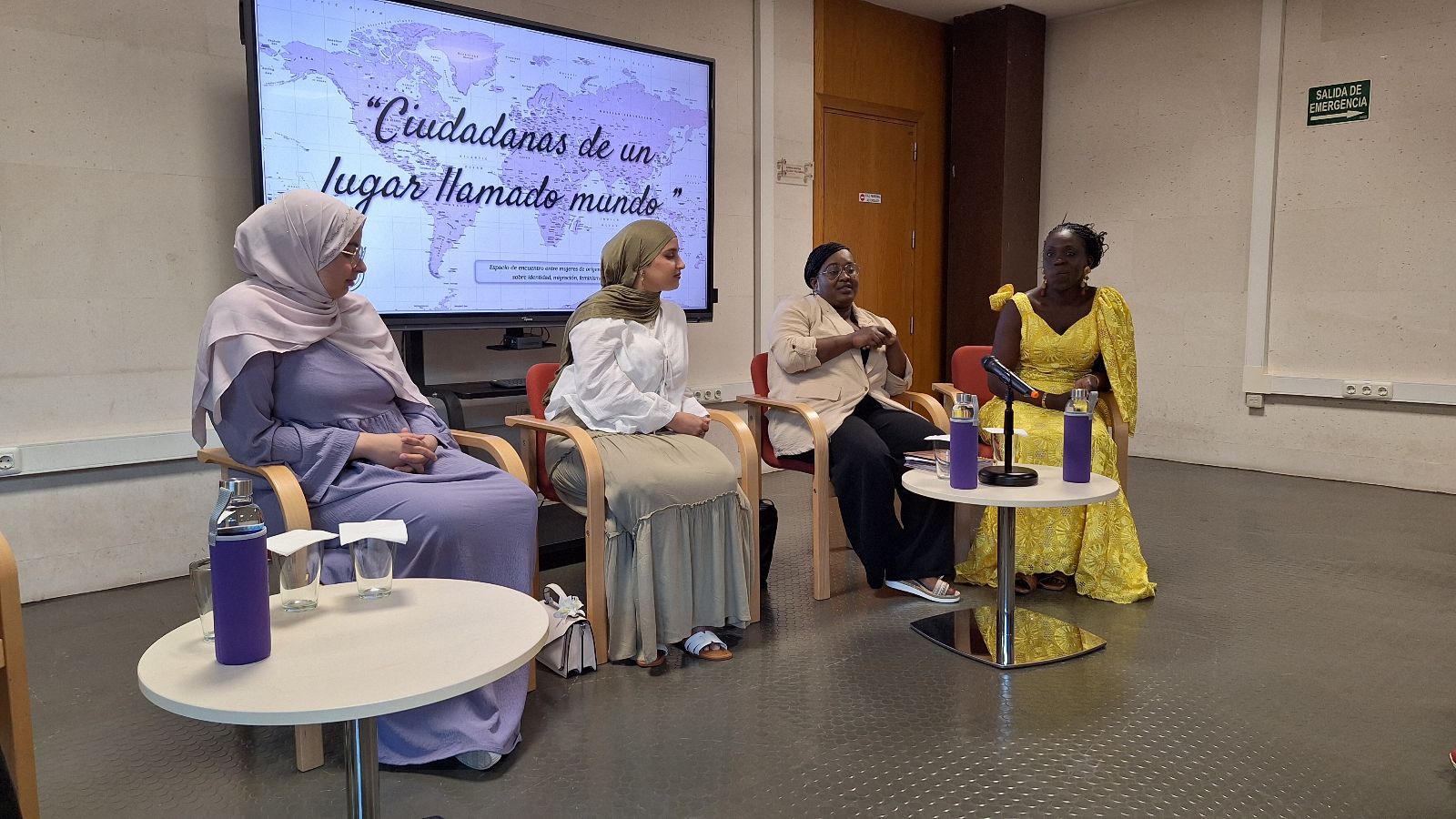 Both Basmala Morabet and Dunia Zarioh emphasized that they feel fully Canarian and Moroccan, although they have faced difficulties in constructing their identities due to their dual citizenship. In Tenerife, their lives were marked by prejudice and rejection of their hijabs, including bullying at school. Whenever they visit their families in Morocco, they also feel somewhat excluded because of their more European way of thinking and living. Today, they embrace the rich cultural diversity of their hometown, Tenerife, and the cultural heritage they inherited from their parents: Morabet's parents are from the Rif region, while Zarioh's mother is from the Rif and her father is from Melilla.
The story of Denise Moura, from Cape Verde, differs from that of her peers. Born in Russia to a Cape Verdean mother and an Angolan father, she arrived on the island fifteen years ago, at the age of 19, to study. Shortly afterward, her life was disrupted for eight years as she lived in an irregular situation because she had to abandon her studies when her father lost his job. For this reason, Moura does not consider herself a citizen of any place and states that, being a woman and a migrant, she has started out at an even greater disadvantage.
“The attempts to regularize my status were endless and frustrating. I even told the Immigration Office that I didn't know what else to do to get my status regularized, since I couldn't study, work, or even receive healthcare. I prayed I wouldn't get so sick that I'd have to be hospitalized,” Moura confessed. When she was finally able to regularize her status, she recalls that the first thing she did was call the Law School to ask how she could resume her studies.
Mary Sylva came to Tenerife from Gambia at the age of 21. She spoke about being a very young mother, raising her three children, who were born on the island, mostly on her own, including Basmala Morabet. She acknowledged having to leave her family and dreams behind to build those of her children. “They are the ones who give me strength. What I haven't been able to have, I want for them, and I try to make sure they don't suffer as I have,” she revealed, while also emphasizing the importance of a firm upbringing at home to build a better society.
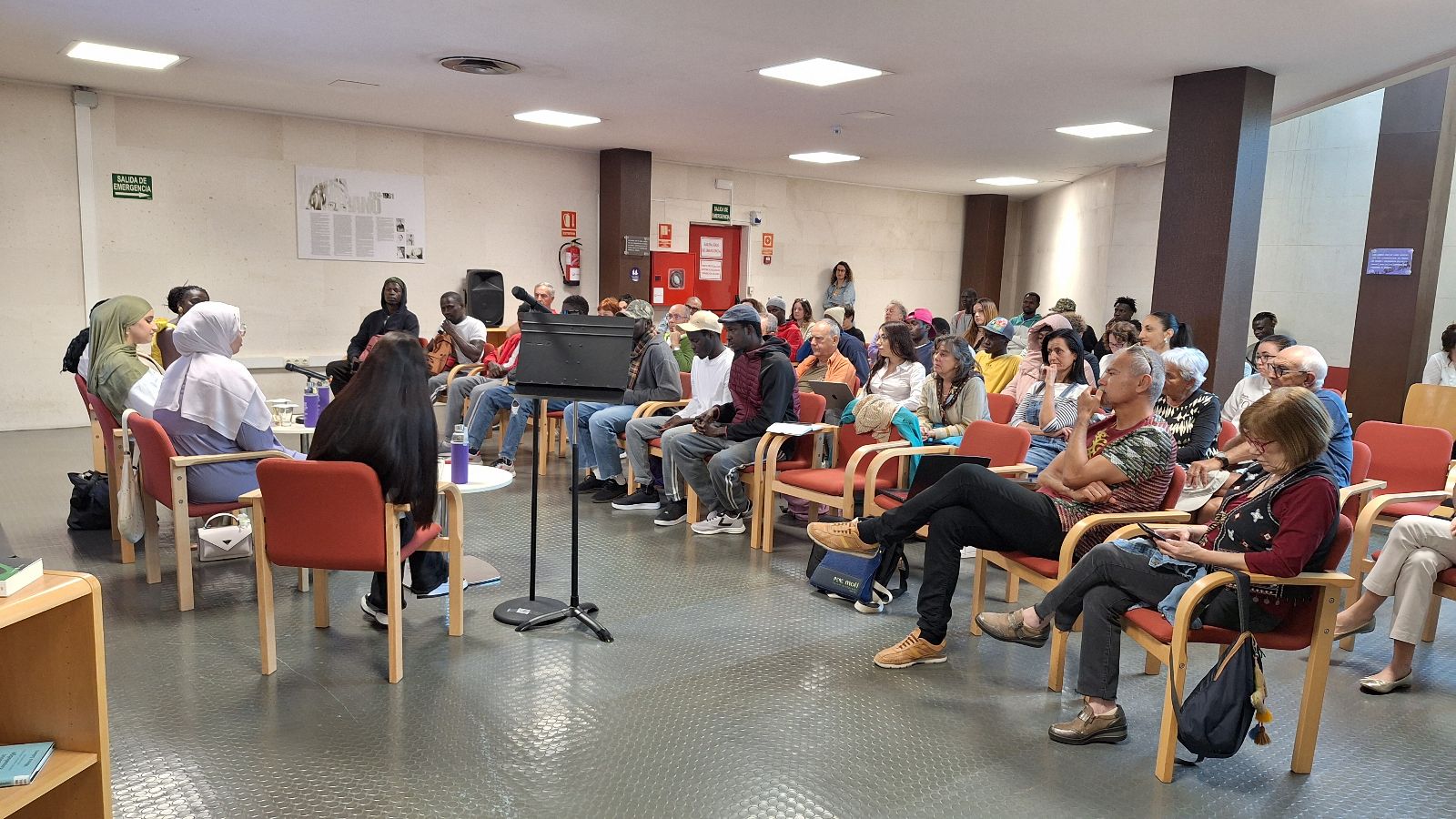 Despite the difficulties, these four women spoke of resilience, of how their strength and survival instinct led them to mature and reach where they are today, fulfilling their dreams and those of their families. They all express deep gratitude for the example set by their parents, especially their mothers, who played the role of caregivers during their childhood and adolescence. Closing the discussion, with input from the audience, they reflected on how they and other women of their generation are changing the cultures of African countries, achieving greater freedom and independence than their predecessors. They acknowledged that many women now attend university thanks in part to the support of their mothers and grandmothers.
Afternoon session
The program continued in the afternoon at 4:00 p.m. with the academic session “Secrets of Africa” in the Audiovisual Room of the Philology Department building, which addressed the past and present of African slavery in the Canary Islands, offering a glimpse into the unknown Africa.
This session featured an opening address by historian and former rector of the University of Las Palmas de Gran Canaria, Manuel Lobo Cabrera, entitled “Slavery in the Canary Islands.” It consisted of four short presentations on different topics: “The Canary Islands as a European Imperial Frontier in Northwest Africa,” by Roberto Gil Hernández; “The Adinkra Symbols: Silent Messages,” by Violeta Jojo Verge; “Migrations, Economy, and Possible 'Errors' of Perception,‘ by Francisco José Ledesma Rodríguez; and ’Murdered for Thinking and Practicing the Struggle Against Imperialism and Semi-Feudalism? Mondlane, Machel, Cabral, Lumumba, Ben Barca, Fanon, Cubillo,” by Víctor Onésimo Martín Martín.
Simultaneously, outside in front of the Central Library, a workshop on African languages was held to introduce the public to the linguistic richness of the neighboring continent. The day culminated from 6:00 to 7:00 p.m. with a festive commemoration of Africa Day, where African music and dance invited all attendees to participate and celebrate cultural diversity in a festive and inclusive atmosphere.

 Spanish
 English
 French