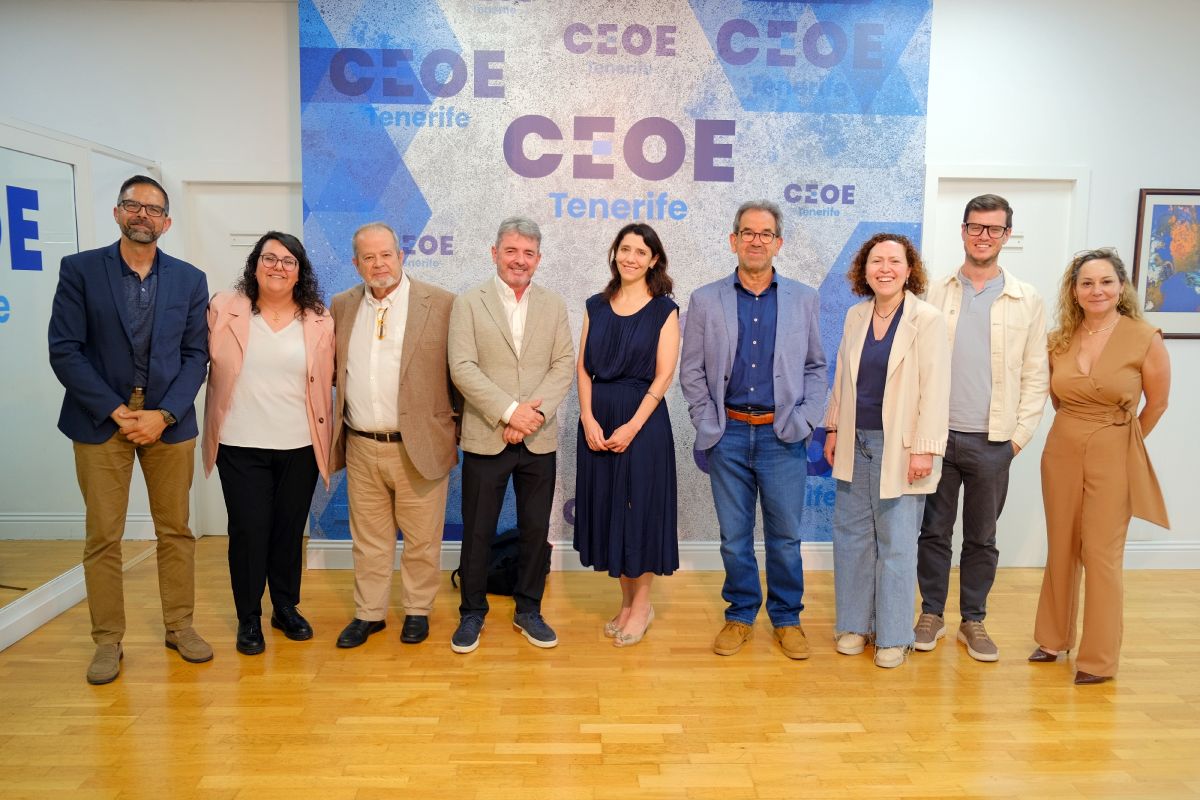
Competition and constant changes in the job market require better-prepared professionals with ongoing training and greater flexibility. Therefore, the CEOE-Tenerife Chair of Business and Labor Relations The University of La Laguna has organized the meeting “University and business: The importance of practical training”The event, held yesterday, June 11, at the CEOE Tenerife headquarters, featured several guest speakers. During the event, the academic institution presented its new micro-credential model, which aims to expand its lifelong learning offerings.
The event was opened by the general manager of CEOE-Tenerife, Eduardo Bezares, who emphasized the importance of collaboration between the university and the island's business community. The director of the university chair, Julio Brito He expressed his gratitude for the interest in this joint university-business work, mentioned the intention of the University of La Laguna to soon implement the dual training model, responding to the social demand for qualified talent, and emphasized the training adaptability that the micro-credentials will bring to the workplace.
The director of Center for Continuing Education from the University of La Laguna, Isabel González Díaz, This new training model for the academic institution was presented, created with the intention of giving priority to the continuing education of those already working in the field. It originated from a European Union mandate that has been extended to universities and, in Spain, is managed through the Ministry of Science, Innovation and Universities, with the involvement of the CRUE (Conference of Rectors of Spanish Universities) and ANECA (National Agency for Quality Assessment and Accreditation).
It consists of short learning experiences of up to 15 ECTS credits—a maximum of 150 hours of instruction—although it is recommended that they not exceed 3 credits due to the time commitment required. Its aim is the acquisition, expansion, and updating of specific knowledge and skills connected to the needs of the productive sectors. Therefore, expert instruction is provided both from within the university (at least 20% of the faculty) and from outside the university.
Designed as flexible, agile, and stackable learning pathways, each training course “can be taken independently and, at the same time, build upon broader credentials within the framework of personalized learning pathways,” González noted. The courses focus on achieving a learning outcome: the qualification and requalification acquired by individuals who have passed an individualized assessment based on measurable learning results. Furthermore, they are supported by an Internal Quality Assurance System (IQAS), endorsed by the Center for Continuing Education.
González clarified that the micro-credentials will follow a primarily blended or online format to allow for greater scheduling flexibility. The target student body comprises adults of diverse ages who may or may not hold a university degree, and who are either professionals or unemployed.
Following the action plan for the development of university micro-credentials in Spain, approved in June 2023 and included in the new Regulations for Continuing Education at the University of La Laguna in February 2024, this teaching model is designed with the possibility of “international portability.” This means that “each professional’s curriculum will be accessible through an application integrated with Europass, allowing competencies to be shared with employers and educational institutions outside of Spain as well,” González emphasized.
Company tutor microcredential
Pedro Álvarez, Professor [Name], a tenured professor in the Department of Didactics and Educational Research at the University of La Laguna specializing in career guidance, announced the first of the training programs of this model: “Microcredential in Company Tutor Training MicroC_Temp”Designed to promote continuous training in the business field, it is understood as "comprehensive and skills-based, professionalizing training," said Álvarez, who also serves as academic director.
He emphasized that quality practical training requires close collaboration, support, and shared responsibility between educational institutions and businesses. “The result will be a society with more prepared and competent professionals.” Therefore, he considers the company mentor a key figure, jointly responsible and a link in the students' training within a professional field. “The company mentor must possess not only technical skills but also diverse social and professional competencies, playing an essential role in professional development.”.
This first edition, lasting 50 hours, will be held online across five modules from September 1st to October 31st. It has 84 places available and is free of charge, subsidized by the "Integrate Dual Vocational Training in Your Company" Project, funded by the Canary Islands Employment Service and implemented by CEOE Tenerife.
University-business pact
This meeting also benefited from the expertise of Raquel Alonso, who has nearly twenty years of experience leading high-impact initiatives in public, private, and academic institutions. The discussion focused on talent, practical training, and university-business collaboration, with a view to transforming people's futures and responding to the needs of the region. In her presentation, she provided several real-world national and international examples of current initiatives to illustrate a comprehensive strategy for a new university-business partnership.
The speaker described a shift from being “transmitters of knowledge to co-creators of knowledge.” Thus, internships will become “comprehensive learning experiences with objectives and joint evaluation.” Instead of employability, the focus will shift to “a shared purpose with professionals who create and lead a new context, engaging in new future scenarios and acting as agents of transformation in their workplaces.” And bureaucracy will be transformed into “experimental agility, designing training in specific skills with stakeholders and the relevant entities, responding quickly to real needs.” She also spoke of adapting to the labor market based on “anticipating change, creating frameworks to get ahead of future needs and scenarios.”.
To close the session, a discussion was held between representatives of companies from different sectors, the speaker, members of CEOE-Tenerife, and the team from the Center for Continuing Education at the University of La Laguna, with the intention of initiating future collaborations towards the development of new micro-credentials and bringing this change in the training paradigm closer to becoming a reality.

 Spanish
 English
 French