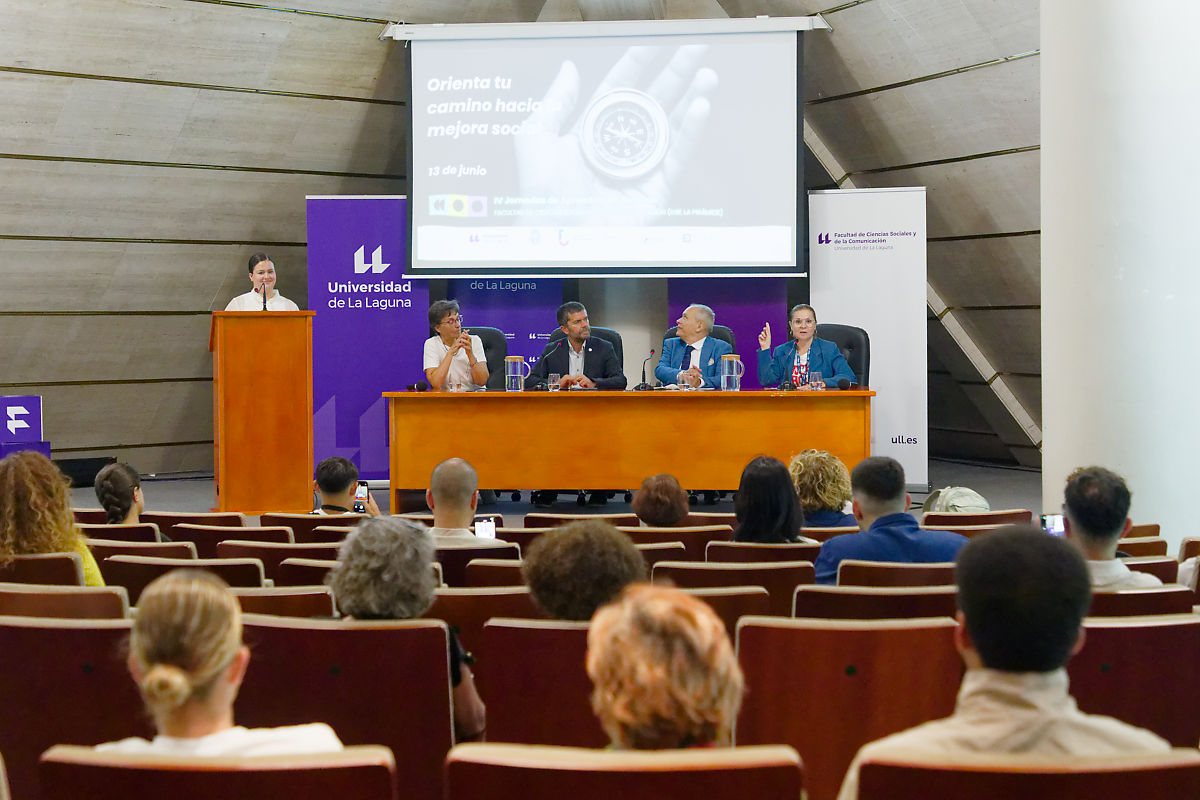
Sustainability has always been linked to the idea of the environment and the color green, but it can also focus on all kinds of activities, such as learning and improving communities and the planet. This was the central theme of the 4th Service-Learning Conference at the University of La Laguna, held today on the Guajara campus.
The rector of the University of La Laguna, Francisco García, was in charge of inaugurating the conference, accompanied by Efraín Medina, Councilor for Employment, Education and Youth of the Tenerife Island Council; Yolanda Ortega, president of the Canary Islands Service Learning Association and María Auxiliadora Gabino, academic director of this program at the University of La Laguna.
“The service-learning program is an example of the ongoing collaboration between both entities, the Island Council and the University,” the rector emphasized, highlighting that this program impacts different educational levels that are also connected to the third sector. “It is a magnificent model in which students learn practically, collaborating with society and solving challenges,” he added.
Efraín Medina, for his part, maintained that this initiative is fundamental for the community development of the island, "because today more than ever the community needs this social responsibility from the students and for them to put their knowledge into practice by betting on this methodology that benefits society.".
María Gabino, academic director of the Service-Learning Program, emphasized that this methodology changes the way we view teaching. “To carry out a project, we first have to identify a need, a social problem, and the students have to create a project that solves or helps to address that problem. And at the heart of the entire methodology, we are generating agents of change, values for society, and citizens committed to the future.”.
For the past four years, faculty at the University of La Laguna have offered two courses annually on service-learning to primary, secondary, and vocational school teachers, as well as institutional staff. The first course is an introduction to service-learning, and the second focuses on project design. These projects can be implemented by university students, who can submit PITE projects (educational innovation projects), as well as by teachers at any level.
María Gloria Solís, from the Extremadura Group of the National Service-Learning Network, gave a presentation on the connection between service-learning, the educational framework, and sustainability at the opening of this event. In her presentation, Solís emphasized the importance of educational social responsibility, sustainable development, and citizenship. She began by pointing out that service-learning is a highly useful methodology for transforming the lives of individuals and communities, and for improving the planet across generations. "It addresses social needs in a real-world way, with the goal of improving our environment, but focusing on specific problems." The speaker affirmed that service-learning should not be confused with volunteering or field work. Its added value lies in being project-based learning with a social purpose.
Following the presentation, the ten projects carried out this year using the service-learning methodology were showcased. These projects were undertaken by students from the University of La Laguna, as well as by primary and secondary school students from Tenerife. A gala will be held in September to award prizes to the best projects selected from these submissions. Among the highlights are “Young Hands, Shared Hearts,” created by students of the Tourism and Psychology degrees; “Activa2: Active Aging and Group Participation,” developed by Social Work students; and “Public Opinion and Documentation for the Common Good: Challenge-Based Learning and Community Service,” by Journalism students from the University of La Laguna.

 Spanish
 English
 French