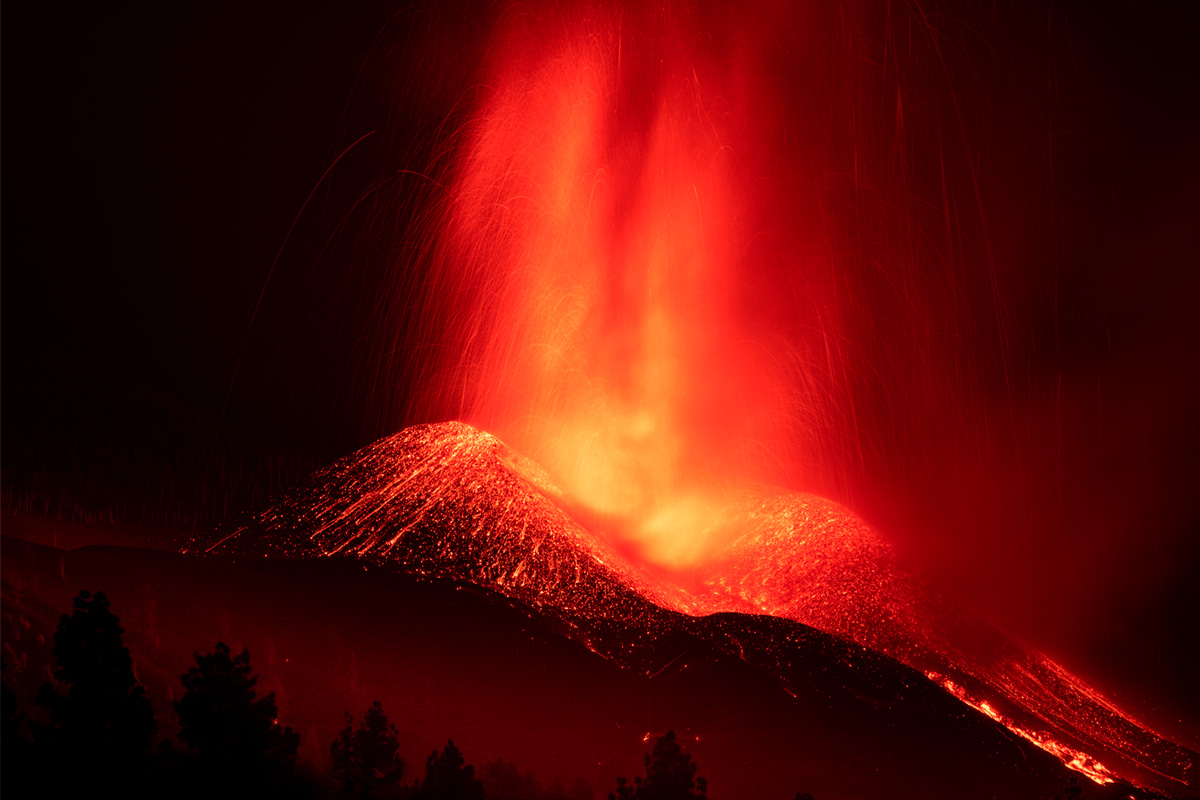
A study reveals that installing hydrophones in shallow waters around volcanic islands like the Canary Islands could improve monitoring and analysis of seismic activity in these areas. The research, published in the magazine Scientific Reports from the publisher Nature, The study, conducted by scientists from the University of La Laguna, the Spanish Institute of Oceanography (IEO-CSIC), the National Geographic Institute (IGN), and the University of Concepción in Chile, highlights that this method would provide key data to support authorities in their decision-making. This would facilitate early and organized responses to potential eruptions, as well as allow for a more detailed subsequent study of the magnitude of these events.
Volcanic archipelagos like the Canary Islands often experience seismic activity associated with magmatic movements and eruptive processes. However, in these oceanic islands, terrestrial seismic networks have a limited distribution, confined to the landmass, which can affect the accuracy of earthquake location. Passive acoustic monitoring using hydrophones floating near the seabed offers a promising alternative for detecting seismicity in remote or difficult-to-access areas, and is also more economical and easier to install and maintain than ocean seismometers on the seabed. Following this approach, a hydrophone was deployed during the eruption of the Tajogaite volcano to analyze potential changes in the marine soundscape near the volcanic influence zone.
The study, in which the postdoctoral researcher from the University of La Laguna participates Jesus Alcázar-Treviño, The underwater acoustic sensor was installed at a depth of 77 meters and 7 km from the volcanic vent to monitor seismic activity during the 2021 subaerial eruption on La Palma. Data obtained during and after the eruption were compared with the terrestrial seismic network and the IGN database, allowing the identification of 712 impulsive acoustic signals consistent with seismic events recorded at a terrestrial seismic station located 12 km away.
Thus, by comparing two independent datasets obtained from land-based and underwater sensors, it was demonstrated that hydrophones floating a few meters above the seabed capture volcano-tectonic seismic signals similar to those recorded by land-based seismometers. Furthermore, these signals, characterized by double pulses, correspond to volcano-tectonic earthquakes, and it was possible to establish a direct correlation between the sound pressure level of each acoustic pulse and the seismic magnitudes calculated from the land-based data. This confirms the hypothesis that the sound pressure levels of acoustic signals transmitted through water reflect the magnitude of the associated seismic events.
The data analyzed indicate, according to experts, that hydroacoustics in shallow waters is an effective tool for detecting and estimating the magnitude of volcano-tectonic earthquakes in these types of areas. Therefore, they propose integrating passive marine acoustic monitoring with land-based seismic stations to optimize the comprehensive monitoring of seismic activity in the studied volcanic zones.
Scientists conclude that an integrated monitoring system like this could significantly enhance the understanding and management of volcanic and seismic risks in island and coastal ocean environments.
This study has been funded at the regional, national and European levels, through the Catalina Ruiz Program of the Government of the Canary Islands and the Ministry of Science and Innovation, as well as through collaboration between organizations thanks to the agreement established between PROMOTUR Turismo de Canarias with the Higher Council for Scientific Research, the University of La Laguna, the General Foundation of the ULL and the University of Las Palmas de Gran Canaria.
Unit of Culture and Scientific Dissemination (Cienci@ull)

 Spanish
 English
 French