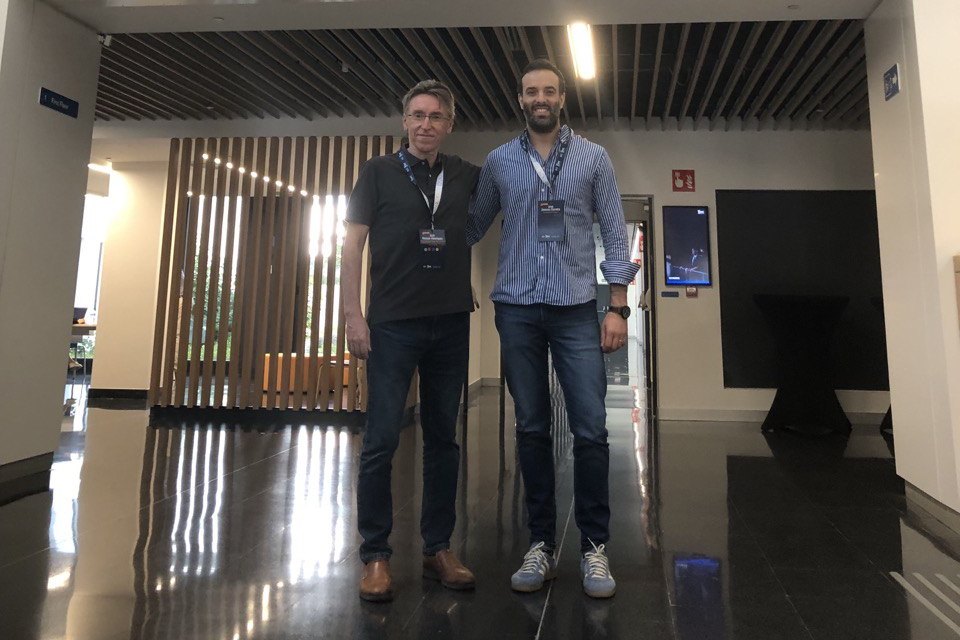
Professors Jano Jiménez Barreto and Jose Manuel Ramos Henríquez, from the Marketing Area of the Department of Business Administration and Economic History at the University of La Laguna, recently presented their accepted research at the European Marketing Conference EMAC2025. The EMAC conference is more than just an academic exchange of ideas and a European conference; it's an incredible experience of connection, collaboration, and contribution to shaping the future of marketing research. Both professors were very fortunate to present their ongoing work among more than 1,300 registered speakers from 50 countries and 600 accepted papers.
Jano Jiménez presented the paper “Empathic Mirroring Responses to Compensate for AI Chatbot Failures” in the Digital Marketing & Social Media conference track, co-authored by Corné Dijkmans, Grzegorz Kapuscinski, and Natalia Rubio (Breda University, Oxford Brookes University, and the Autonomous University of Madrid, respectively). The main idea of this paper is that companies can protect their reputation from AI chatbot failures by combining disclaimer of responsibility with empathy towards users. This new study reveals that technology companies can significantly minimize reputational damage caused by errors in their artificial intelligence systems through a specific communication strategy. The research demonstrates that the so-called «mirroring strategy»—which consists of denying direct responsibility by attributing failures to external factors such as misuse by consumers—is effective in protecting the corporate image, especially when combined with displays of empathy towards those affected. The results indicate that this tactic remains effective regardless of prior media coverage, offering companies a valuable tool for managing crises in a context where determining responsibility for AI failures is becoming increasingly complex.
José Manuel Ramos presented a study combining surveys, neuroscience, and artificial intelligence to more accurately predict tourism preferences. This study, titled “Predicting Tourism Preferences: A Triple-Framework Combining Consumer Surveys, Neurophysiological Data and Multimodal LLMs,” was co-authored by Anett Erdmann and Kathrin Jaszus (from ESIC University and Trier University of Applied Sciences, respectively). The research develops a triple-framework approach that integrates traditional surveys, neurophysiological data, and artificial intelligence models to analyze tourism preferences more accurately than individual methods. The study, conducted with 96 participants from two countries, evaluated reactions to ten images representing different types of tourism by simultaneously collecting self-reported responses, neurophysiological measurements, and analyzing the images using advanced AI systems. The results reveal distinctive patterns in data variation and significant correlations between the different measurement methods and the preferences reported by the participants. The research demonstrates that this integrated approach significantly improves predictive capacity regarding tourism type preferences compared to measurements based on a single method, contributing to the advancement of the application of artificial intelligence and neuroscience in the evaluation of tourism preferences.

 Spanish
 English
 French