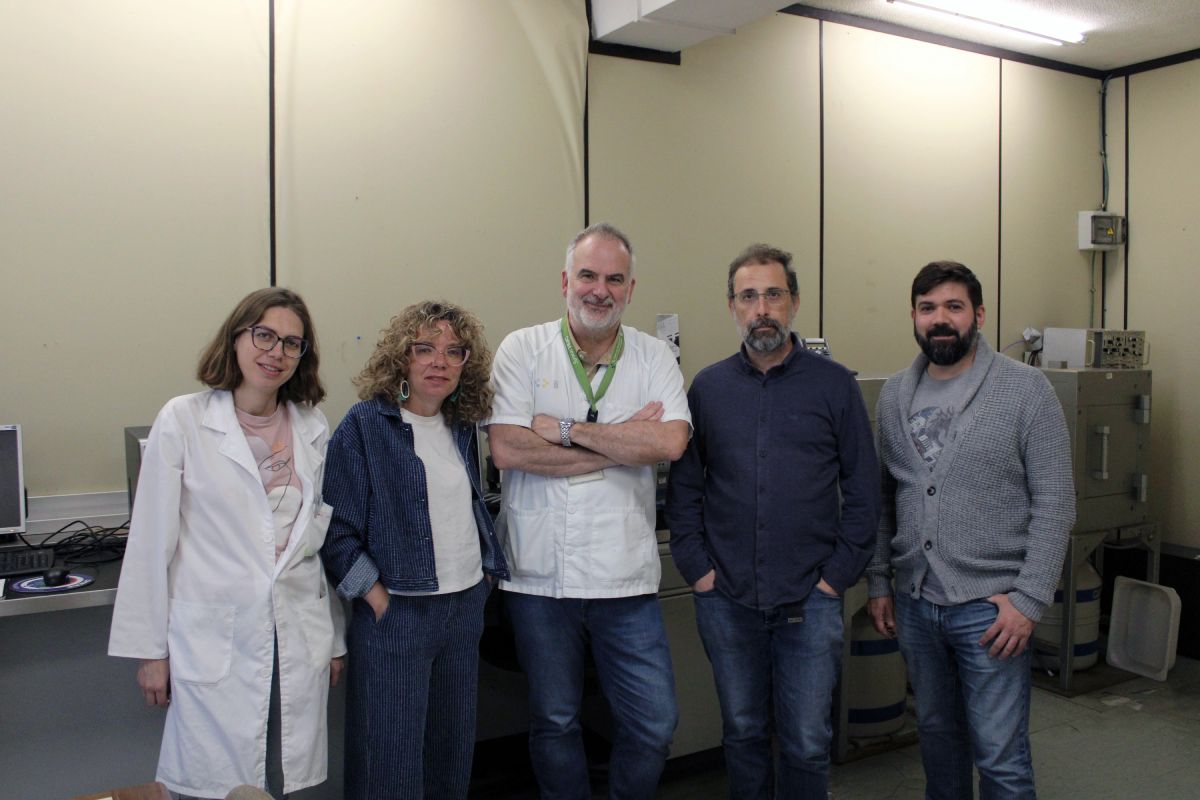
He General Research Support Service (SEGAI) The University of La Laguna provides scientific, instrumental, and technical support to research conducted both within the university and in collaboration with other entities. In this regard, the Laboratory of Medical Physics and Environmental Radioactivity FIMERALL, located within the Faculty of Health Sciences, has established itself as a leading scientific and technical center in the Canary Islands in the field of environmental radioactivity. Furthermore, it regularly publishes scientific articles based on the data it collects and analyzes.
In 2024 alone, the laboratory carried out more than 950 radiological determinations, encompassing analyses of water (150 samples), air (500), radon gas (300) and electromagnetic fields, the latter related to telecommunications infrastructure and power lines.
Since its creation in the late 1980s, and with its full integration into SEGAI in 2016, FIMERALL has served both the university research community and public and private organizations, maintaining close collaboration with the Nuclear Safety Council (CSN). As María López Pérez, FIMERALL's technical director, explains: “Since the 1990s, we have maintained an agreement with the CSN, which is the competent body for radiological protection of humans and the environment.”.
Antonio Dámaso Catalán Acosta, A researcher in the Department of Physical Medicine and Pharmacology and head of Radiation Protection at the University Hospital of the Canary Islands, recalls that, following Spain's accession to the European Union, it became necessary to create national networks to collect data on environmental radioactivity. "This led to the creation of a nationwide monitoring network and another high-sensitivity network, in which FIMERALL participates as a sampling station in the Canary Islands," he explains. These measurements cover environmental matrices such as water, soil, food, and air, with different types of radionuclides.
Unique accreditation in the Canary Islands
One of FIMERALL's most notable features is being the only laboratory in the Canary Islands accredited by the National Accreditation Entity (ENAC) to perform radioactivity tests on drinking water, in accordance with Royal Decree 3/2023. This regulation requires the characterization of drinking water from a physicochemical, microbiological, and radiological perspective. Furthermore, the laboratory maintains its operations under the UNE-EN ISO/IEC 17025 standard, with regular audits that guarantee its technical competence and traceability.
The service not only caters to water suppliers but also responds to requests from individuals or companies seeking to assess the radiological quality of their surroundings. One area of activity that has gained significant importance in recent years is radon monitoring. Radon is a naturally occurring radioactive gas that, according to the World Health Organization (WHO), is the leading cause of lung cancer in non-smokers. “It poses a risk because radon is naturally released from the ground and can accumulate in enclosed or poorly ventilated spaces,” explains Eduardo Pérez González, a technician at FIMERALL.
In compliance with current labor regulations, the laboratory carries out radon measurements in workplaces located in priority areas identified by the CSN (Nuclear Safety Council), such as several municipalities in Tenerife and Gran Canaria. “If radon concentrations exceed 300 Bq/m³3 (bacquerels/cubic meter of air, the unit of measurement for ambient radon), corrective measures are recommended, and even adjustments to working hours or work shifts if necessary,” he explains. Pedro Ángel Salazar Carballo, professor in the Department of Physical Medicine and Pharmacology and co-responsible for the service.
Equipment
Since 2024, the laboratory has had a radon trace detection system (RadoMeter 2000 model), in addition to several continuous measurement instruments with hourly resolution. FIMERALL is currently working to have this test accredited in its next external audit.
The laboratory's equipment includes high-resolution gamma spectrometers, scintillation detectors, alpha chambers, low-background counters, zinc sulfide detectors, portable meters, and systems for radiological characterization of soil and water, as well as devices for electromagnetic field analysis. Besides Pérez González, this equipment is also operated by technicians Xiomara Duarte Rodríguez and María Pilar González Gil.
FIMERALL not only operates as a technical service center but also has a strong research focus. “We regularly publish papers based on our own data,” says its technical director. Among the most notable studies are the analysis of the radiological impact of the calima episode during the 2020 Carnival, radon levels in the Cueva del Viento (Cave of the Wind), and dosimetric calculations and research on the decrease in ambient radioactivity following the closure of the Santa Cruz de Tenerife refinery, which correlated data collected between 2000 and 2019.
Financing
This service remains operational thanks to the budget that the University of La Laguna provides to SEGAI, to the CSN, as well as support grants from organizations such as the Government of the Canary Islands, through the Canary Islands Development Fund (FDCAN).

 Spanish
 English
 French