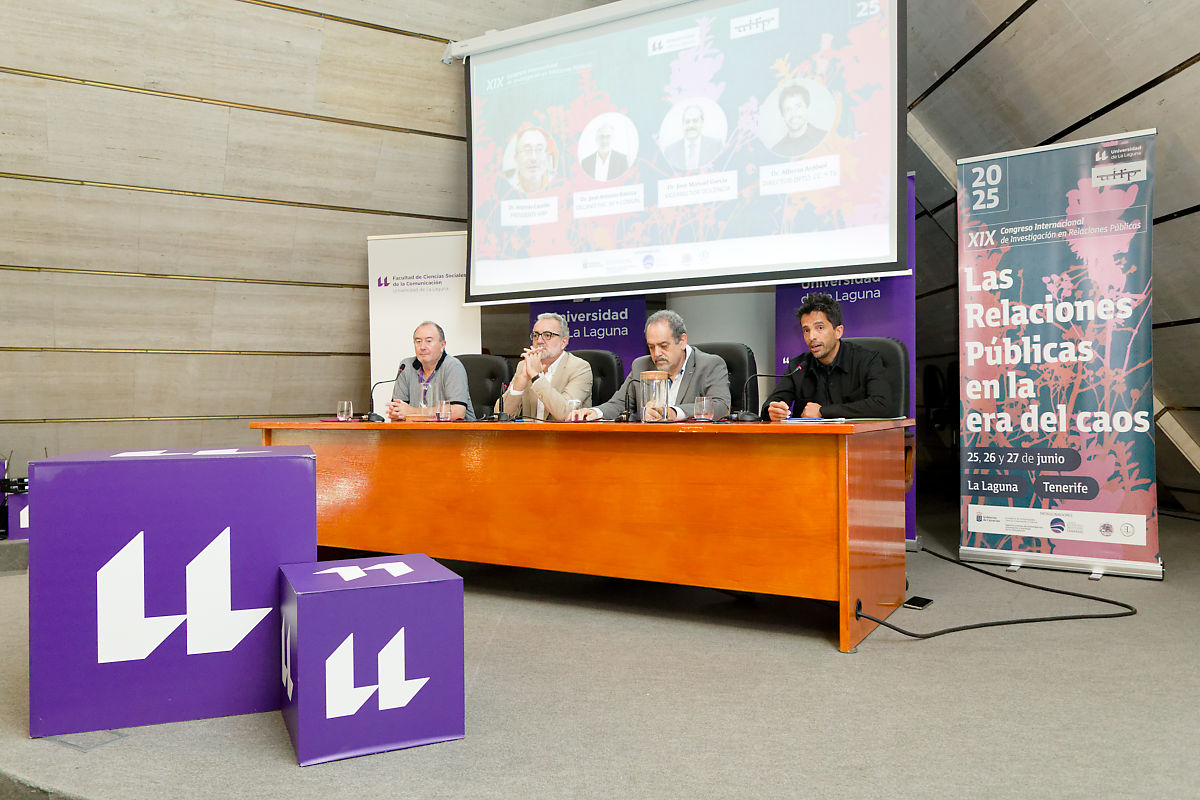
The Public Relations Research Association (AIRP) has chosen the University of La Laguna as the venue for its nineteenth international congress, The conference, held from June 25th to 27th in the La Pirámide building of the Faculty of Social Sciences and Communication, will address the role of communication in "the age of chaos." In keeping with this theme, the opening address was given by Miguel Ángel Morcuende, Director General of Natural Spaces and Biodiversity for the Government of the Canary Islands, who was the technical director of PEVOLCA during the eruption of the Tajogaite volcano in La Palma. He explained how that emergency was managed, placing particular emphasis on communication.
The opening ceremony was held earlier, presided over by the Vice-Rector for Teaching at the University of La Laguna, José Manuel García Fraga, who shared the stage with the Dean of the host faculty, José Antonio Batista Medina. Both expressed their appreciation for the center hosting an event of this nature, which will facilitate the exchange of knowledge and experiences. They also highlighted the value of public relations in society, a profession that requires qualities such as communication, empathy, active listening, adaptability, ethics, credibility, and the ability to work in crisis situations.
Both the vice-rector and the dean acknowledged that public relations is a highly sought-after discipline among communication professionals, making it highly beneficial to expand the University of La Laguna's educational offerings in this field. While the possibility of creating a specific undergraduate degree seems remote, they agreed on the value of exploring the development of specialized micro-credentials.
The president of AIRP, Antonio Castillo Esparcia, explained that during its two decades of activity, the association has tried to raise awareness of this branch of communication, which is not as well-known as others and is burdened by many frivolous stereotypes. In his opinion, some of these prejudices stem from the poor translation of the Anglo-Saxon term “Public relations”This term shouldn't be taken literally; rather, it should be used to refer to "public relations," because that's what it's about: ensuring that organizations interact effectively with people and other entities. Another important aspect of their work is crisis management, which will be the focus of this meeting.
For his part, the director of the Department of Communication Sciences and Social Work, Alberto Ardèvol Abreu, pointed out that public relations had experienced a golden age in the past, but now requires reflection, strategy, and debate to face the challenges posed by Artificial Intelligence, disinformation, sustainability, and purposeful communication. Seeing the room full for the start of the conference, he fondly remembered José Manuel de Pablos, Professor of Communication at the University of La Laguna, who had recently passed away and who was a driving force behind the scientific meetings at the faculty hosting the event. “I’m sure he would be very pleased to have an academic community gathered here today.”.
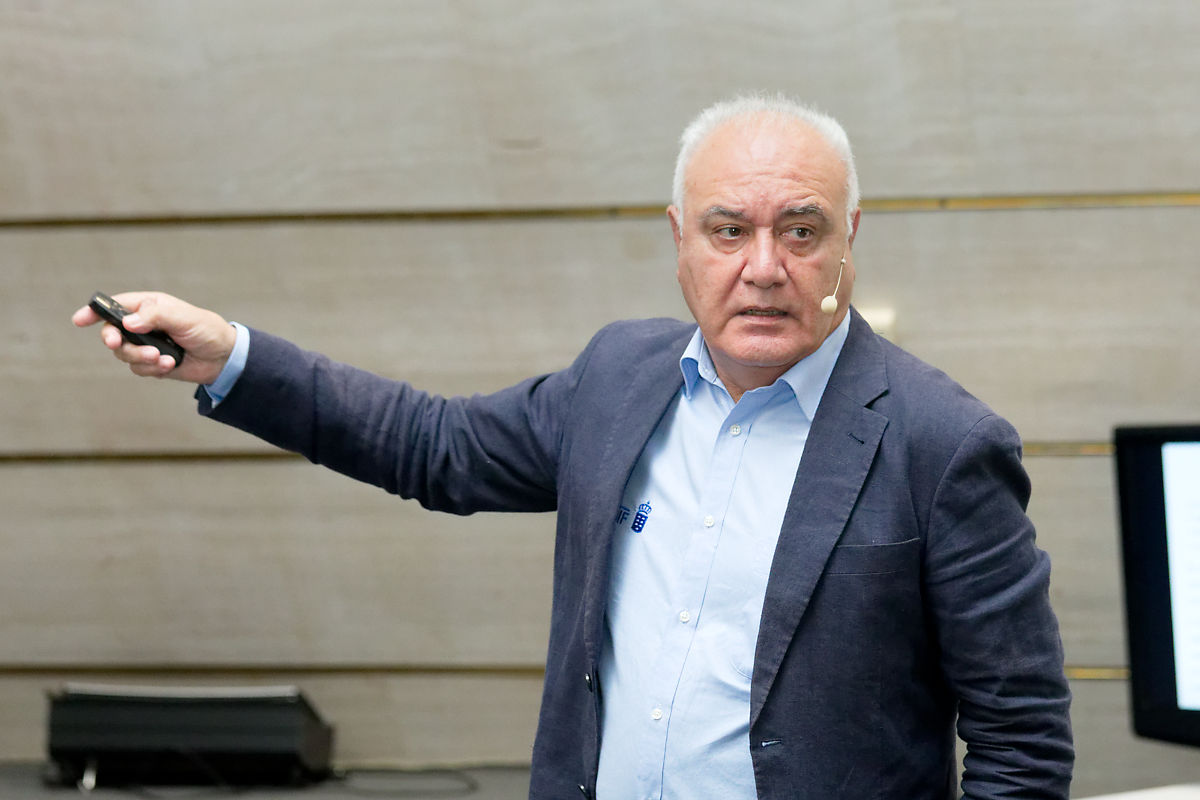
Miguel Ángel Morcuende.
The Tajogaite crisis
In his opening presentation, Miguel Ángel Morcuende detailed how the response was handled during the eruption of the Tajogaite volcano between September and December 2021. The session was moderated by Mayer Trujillo, director of the Canary Islands public radio and lecturer at the University of La Laguna, and María del Carmen Carretón Ballester, professor of Public Relations at the University of Alicante and vice-president of AIRP.
One of the points the speaker clarified is that the PEVOLCA (Canary Islands Volcanic Emergency Plan) is a national, not just Canary Islands, volcanic emergency action plan. It exists for all of Spain, but the fact is that there are only active volcanoes in the archipelago, since those in other mainland areas like Ciudad Real or Olot (Girona) are completely extinct. This national scope explains why, for example, the National Geographic Institute is legally responsible for overseeing the scientific aspects of this plan, rather than regional bodies like Involcan (Canary Islands Volcanological Institute).
Morcuende explained that risk is defined as the product of hazard, vulnerability, and exposure experienced by populations in relation to a risk, such as, in this case, a volcano. Thus, the combination of these factors is what led to the 1971 eruption of Teneguía being considered low risk, while the eruption of Tajogaite 50 years later was classified as high risk, resulting in the evacuation of some 7,000 people and the loss of homes and basic infrastructure. This volcanic risk is something that must always be considered in urban planning in the Canary Islands.
He explained that an emergency management system like PEVOLCA is an organized and standardized management structure that adapts to the complexities and demands of specific incidents. While the implementation of the volcano plan is not as common, in other types of emergencies, such as forest fires, search and rescue operations, and severe frosts in high mountain areas, these are well-oiled machines that function in a very similar way, even though the nature of the hazard in each case differs.
It is important to have a unified command system and to consult with scientists and other external experts to have all the information available before making decisions. Cooperation between institutions is also essential, and in the case of the La Palma eruption, the speaker noted that it was flawless, with coordinated work between the central, regional, and island governments, as well as the affected municipalities.
Regarding information for the public, he explained that the first level is the classic emergency traffic light system, which has four levels ranging from green to red. In the case of Tajogaite, it went from yellow to red in a single day without passing through orange, as the eruption was more sudden than anticipated: unlike events such as Teneguía or the Mar de las Calmas eruption off El Hierro, where the preceding seismic activity lasted several months before the eruption, the 2012 eruption was preceded by only a few days of activity.
Regarding communication with the public, the expert pointed out that it was crucial, first and foremost, to decide which information should be disseminated and which should not, since in such moments of heightened tension it is sometimes inappropriate to provide all the information to avoid confusion. Once the message has been decided, it must be delivered clearly, with clear pronunciation, thanking the audience to show empathy, and acknowledging that some people are suffering.

 Spanish
 English
 French