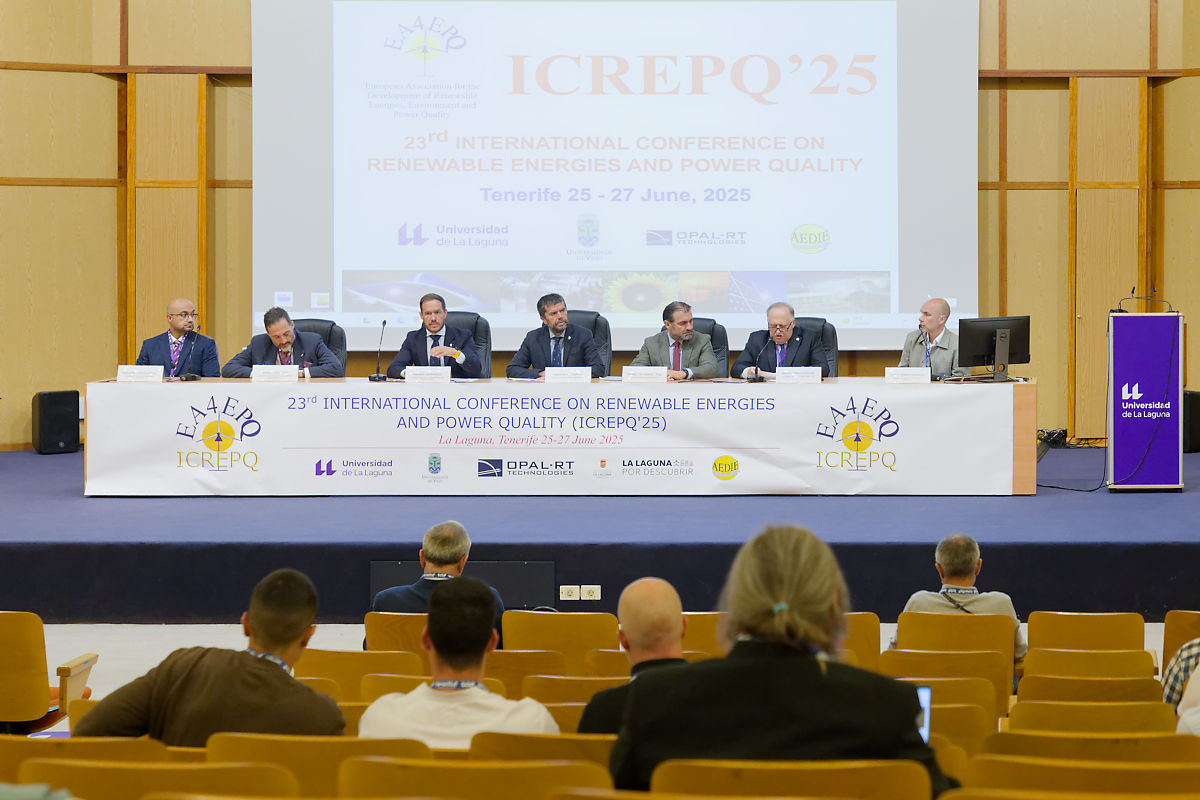
The General Cesar Manrique Lecture Hall at the Guajara Campus of the University of La Laguna hosted this morning, Wednesday, June 25, the inauguration of the International Conference on Renewable Energies and Power Quality (ICREPQ'25The conference, which is attended by leading specialists from several continents, will feature 139 presentations, including papers and posters, from researchers in 45 countries. Over the next three days, various topics related to renewable energy, energy storage, and energy quality will be discussed.
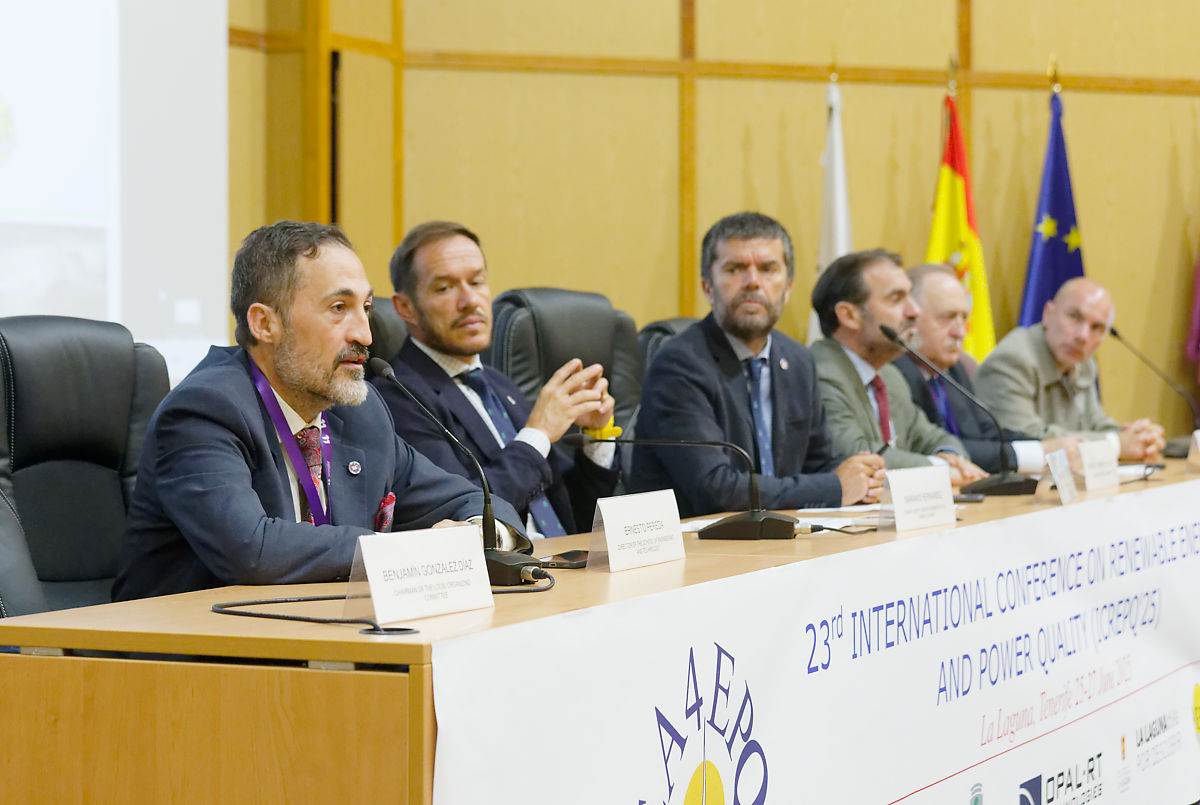
The opening ceremony was presided over by the Rector of the University of La Laguna, Francisco García, who emphasized the timeliness of the meeting in light of recent events, including power outages on the Iberian Peninsula and, more recently, on the island of La Palma. He highlighted the importance of renewable energy in island territories. ‘In a region like the Canary Islands, isolated and geographically fragmented, the topics to be addressed at this conference are highly relevant and necessary.’ He also stressed the role of the university in “providing solutions to practical, real, and everyday problems, such as those related to energy generation and storage, the central themes of this conference.”.
Manuel Pérez, the conference's scientific director, emphasized the timeliness of this meeting in a context where society is demanding solutions. “Climate change is becoming increasingly evident, with serious consequences in numerous countries. Therefore, it is urgent to promote policies and strategies based on scientific evidence to achieve climate neutrality, reduce pollution, and decrease our dependence on fossil fuels.”.
For his part, Manuel Fernández Vega, the Island Councillor for Industry, Commerce, Primary Sector, and Animal Welfare of the Tenerife Island Council, took the opportunity to emphasize the role that clean energy should play in a territory like the Canary Islands and expressed his firm commitment to the implementation of alternative energy sources. “Although we are a paradise of sun and wind, we barely have a renewable energy penetration rate of around 201% of total energy. That's why there is still a long way to go, much to be done.”.
For his part, the Minister for Ecological Transition and Energy of the Canary Islands Government, Mariano Fernández Zapata, acknowledged the current complex situation and thanked the experts present for their work. “We have been in a state of energy emergency since 2023, which has accelerated the opportunity for change in the face of the urgent need. We have established a series of actions and worked on a number of concrete changes. You are also essential to achieving the goals we have set for the Canary Islands: improving energy efficiency and guaranteeing cleaner, safer, and more sustainable energy supplies.”.
Finally, representing the local conference committee, Ernesto Pereda, Director of the Higher School of Engineering and Technology at the University of La Laguna, expressed his gratitude to the participants for choosing Tenerife to host the congress for the second time. He emphasized the importance of addressing important and current issues in these forums. “We are at a crucial moment in Spain and Europe, where the ecological transition demands an ambitious political agenda that sometimes conflicts with the technological capabilities of the electricity system. This system always requires a delicate balance between production and consumption, something that is understood from its fundamentals, but whose complexity is not always easily perceived. The difficulties this entails are significant and, as we have seen after the events of April 28, have far-reaching consequences.”.
 Energy storage
The opening lecture was given by Antonio Gómez Expósito, Professor in the Department of Electrical Engineering at the University of Seville and holder of the Endesa Chair. He acknowledged that, although science has been working on energy storage for over a decade, it has only recently become an accessible reality. “We have been working on this for more than 10 years, organizing courses and developing research. However, until recently, investors and those responsible for the sector had not given it the necessary attention. The good news is that the cost of storage has now decreased between five and seven times compared to ten years ago, which represents a key advantage for its widespread deployment in Spain and Europe.”.
During the talk, he showed that energy storage systems already exist, although not on the necessary scale. In countries like Spain and France, pumped-storage hydroelectric plants provide flexibility to the system. “In Spain, some 3.3 gigawatts of pumped-storage capacity have been installed. These facilities allow energy to be stored when generation exceeds demand, especially in contexts of inflexible nuclear power generation.”.
Another factor driving the development of energy storage has been electric mobility. Thanks to the massive deployment of electric vehicles, we now have more technologically mature and much cheaper batteries. “In 2024, there were 70 million electric vehicles on the road, and it is estimated that by 2025 that figure will reach 120 million. This includes electric cars, buses, and trucks. For example, there are more than 800,000 electric buses in operation, mostly in Asia,” he stated.
According to data presented by Professor Gómez Expósito, the share of renewables in the global electricity mix has increased from 181 terawatt-hours (TP3) in 2000, dominated by hydropower, to over 311 TP3 in 2023, more than half of which comes from wind and solar. In Spain, the share of renewables already exceeds 301 TP3 and is expected to increase considerably in the coming years. Furthermore, global electricity consumption has risen from 15,000 terawatt-hours to 30,000 in 23 years, and it is estimated that it will need to double again to achieve the complete decarbonization of the energy system. This implies increasing the electrification of final consumption from the current 211 TP3 to 701 TP3, according to the International Energy Agency.
During his speech, Gómez Expósito highlighted Spain's leading role in this transition, positioning it as an international example. “Traditionally, we used examples like California or Australia to illustrate these trends. But in recent years, Spain has assumed a leading role. For example, in 2025 there were weeks in which renewable energy production exceeded demand for nine consecutive hours.”.
As he explained, the logic of the system has changed: before, storage was needed to adapt generation to demand; now it is needed to adapt demand to an increasingly variable and uncertain generation.

 Spanish
 English
 French