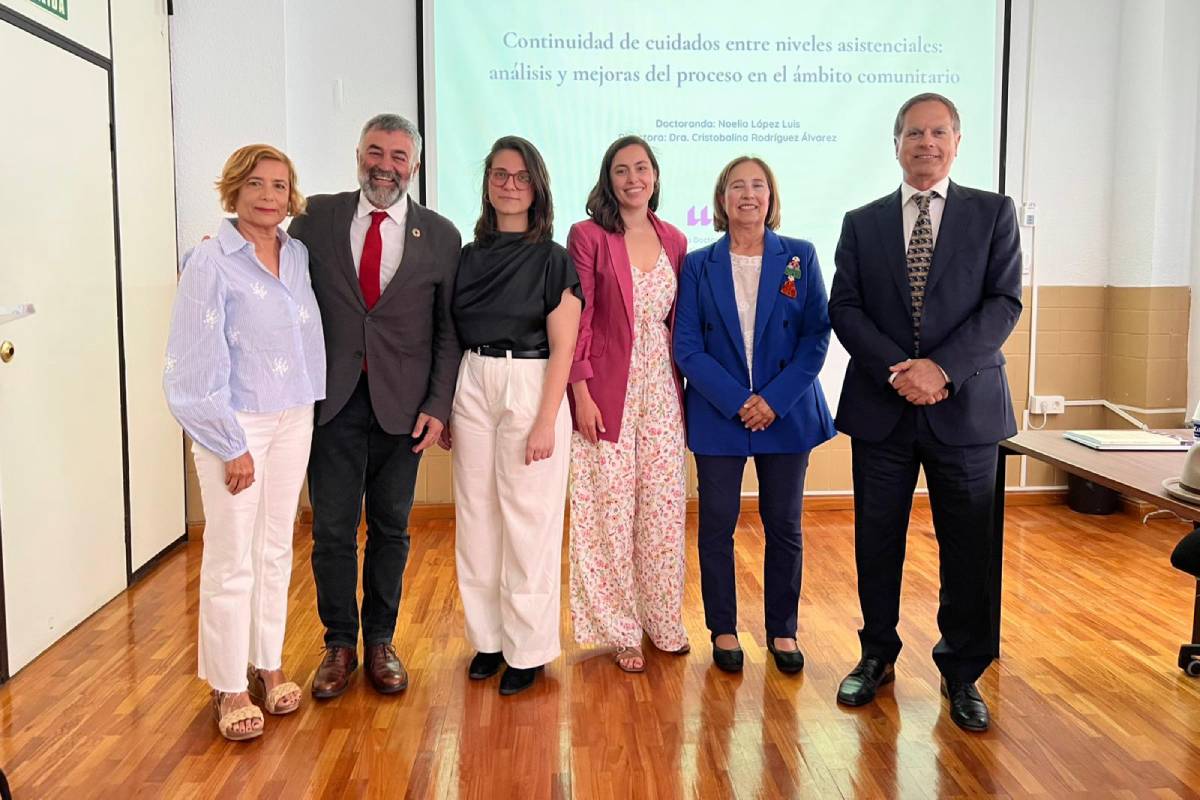
Frail patients are a particularly vulnerable group requiring constant healthcare and monitoring due to their multiple pathologies. Noelia López Luis recently successfully defended her doctoral thesis, entitled “Continuity of Care Between Levels of Care: Analysis and Improvements of the Process in the Community Setting,” which focused on this situation of particular relevance to the healthcare system of the Canary Islands. It was supervised by a professor and researcher in the Department of Preventive Medicine and Public Health at the University of La Laguna., Cristobalina Rodríguez Álvarez.
For Luis López, a community nurse at a primary care center in Tenerife, this work stems from the need to understand the current processes for ensuring continuity of care for frail patients after hospital discharge. In her study, she proposes certain interventions that could improve this process, especially in cases where patients and families face difficulties accessing the personalized follow-up care vital to their recovery.
The thesis was presented as a compilation of publications, consisting of three articles that address continuity of care between different levels of the Canary Islands Health Service, analyzing various phases of the process. According to Rodríguez Álvarez, the thesis supervisor, this compilation format reflects the quality of the research, as each article has been published in high-level (Q1) scientific journals, meaning they have been evaluated by experts in the field of nursing. Furthermore, López Luis highlights another interesting aspect of this approach: the increased visibility of the results as they are obtained throughout the doctoral program, as well as the exchange of opinions generated during the evaluation processes, which provides valuable perspectives for advancing the research.
The thesis focused on continuity of care from a primary care perspective, a particularly relevant approach given that López Luis is a community nurse. The newly minted PhD points out that this is the first study of its kind conducted on the island, which is significant because research of this type relies heavily on the networks that support local health systems. Thus, the research was structured as a data analysis process that progressively transformed into more specific information, offering an in-depth view of the situation within the specific context in which the research was conducted: the island of Tenerife.
Administrative highs and inadequate prioritization
The first article, entitled «Evaluation of Delayed Effective Discharge for Non-Medical Reasons in Patients Admitted to Acute Care Hospitals in Spain: A Scoping Review«This study addresses a comprehensive review of continuity of care. It specifically focused on assessing the circumstances that lead to a certain number of patients remaining in the hospital longer after being discharged, before finally returning home—a phenomenon known as administrative discharge. The research aimed to explore existing research on the causes of this phenomenon and identify potential shortcomings in patient follow-up that contribute to the unnecessary prolongation of their hospital stay.
López Luis highlights the notable scarcity of publications on this issue, especially regarding qualitative research that investigates the patient-related factors influencing this situation. He points out that this phenomenon has a significant impact on the healthcare system, as it implies an inefficient use of hospital beds, generating not only a burden on healthcare resources but also societal concern. The review concludes that it is essential to conduct a thorough evaluation of the personal, familial, and social causes that lead a patient to remain in the hospital longer than stipulated, as well as to analyze how these factors influence their situation.
For this reason, the research that led to the second publication, entitled «Discharge Follow-Up of Patients in Primary Care Does Not Meet Their Care Needs: Results of a Longitudinal Multicentre Study«"The study focused on analyzing the follow-up care provided to complex or frail patients after hospital discharge. The results indicated inadequate prioritization of patients requiring more intensive care after discharge.".
The researcher highlights that the most surprising finding was that, from the perspective of the healthcare professionals at the health centers involved in the study, this problem was not clearly perceived. However, López Luis emphasizes that sharing these results has served as a valuable starting point for analyzing what measures can be taken, through the management of schedules and resources at health centers, to facilitate and improve continuous care for these more vulnerable patients.
Primary Care as a barrier against recurrences to Emergency Departments
As a continuation of this study, the third phase of the research aimed to analyze the number of visits by complex patients to hospital emergency departments after discharge and to evaluate the impact that continuity of care in primary care could have on preventing these recurrences. The main objective was to identify the associated factors that contribute to reducing the return of these frail patients to the emergency department and to explore how to improve care at health centers to avoid this situation.
The resulting article, entitled “Planned nursing visits for newly discharged patients prevent their return to the hospital emergency department: A multicenter longitudinal study in primary care”This revealed a very significant finding. According to López Luis, it was possible to verify that «the fact that a discharged patient has a scheduled appointment with the community nurse after hospital discharge reduces the risk of going to the Emergency Department by up to 12.6 times.» Rodríguez Álvarez emphasizes that the conclusion that such a simple intervention strategy, implemented at the Primary Care level, can have such a high impact confirms the importance of these studies. This is especially true considering the high level of overcrowding currently experienced by the Emergency Departments of the University Hospital of the Canary Islands.
Both specialists agree that this first consultation with the community nurse after hospital discharge is crucial. It allows for initial contact with the patient, an assessment of their overall situation and context, and more personalized follow-up, not only from a health perspective but also tailored to their specific needs. In this way, the foundation is laid for more precise and appropriate follow-up from that point forward.
The importance of socio-family factors
At this point, López Luis highlights a particularly important aspect when conducting these analyses: the inclusion of variables that capture the patient's socio-familial factors, which are rarely considered in more statistical studies. "It is essential to have up-to-date information about the home situation, the patient's level of independence, the number of people living with them, and whether they have caregivers or any type of home assistance," he explains. Assessing clinical characteristics in conjunction with these social and personal factors allows primary care healthcare professionals to obtain a more comprehensive view of the patient, facilitating more personalized care tailored to their needs, he adds.
To carry out these studies, it was necessary to develop a complex and detailed database, conducting a retrospective longitudinal study that involved coordination between twenty-three Health Centers in Tenerife with 387 patients discharged from the University Hospital of the Canary Islands between January 1, 2018 and December 31, 2022.
A wide variety of data was collected from each patient, encompassing both clinical variables (such as pathologies, medical history, and treatments) and demographic information. This process was a significant challenge, as López Luis had to access the non-unified computer systems of the various primary care centers to obtain the necessary information. Nevertheless, the new doctor emphasizes that these two years of data collection open the door to future studies, with particular interest in conducting a more qualitative analysis of frail patients.
López Luis emphasizes that, following the publication of these results in high-impact scientific journals, his main objective now is to disseminate these findings among the various health centers on the island, in order to assess the feasibility of implementing strategies such as scheduling the patient's first follow-up appointment after discharge. He notes that initiatives are already underway within the Canary Islands Health Service to improve continuity of care. The specialists agree that the defended thesis highlights the need for further research on other strategies that can optimize hospital discharge protocols and bed occupancy. Furthermore, they stress the importance of improving patient prioritization in Primary Care, addressing their specific needs and ensuring that planned follow-up is truly effective.
Scientific Culture and Innovation Unit (Cienci@ULL)

 Spanish
 English
 French