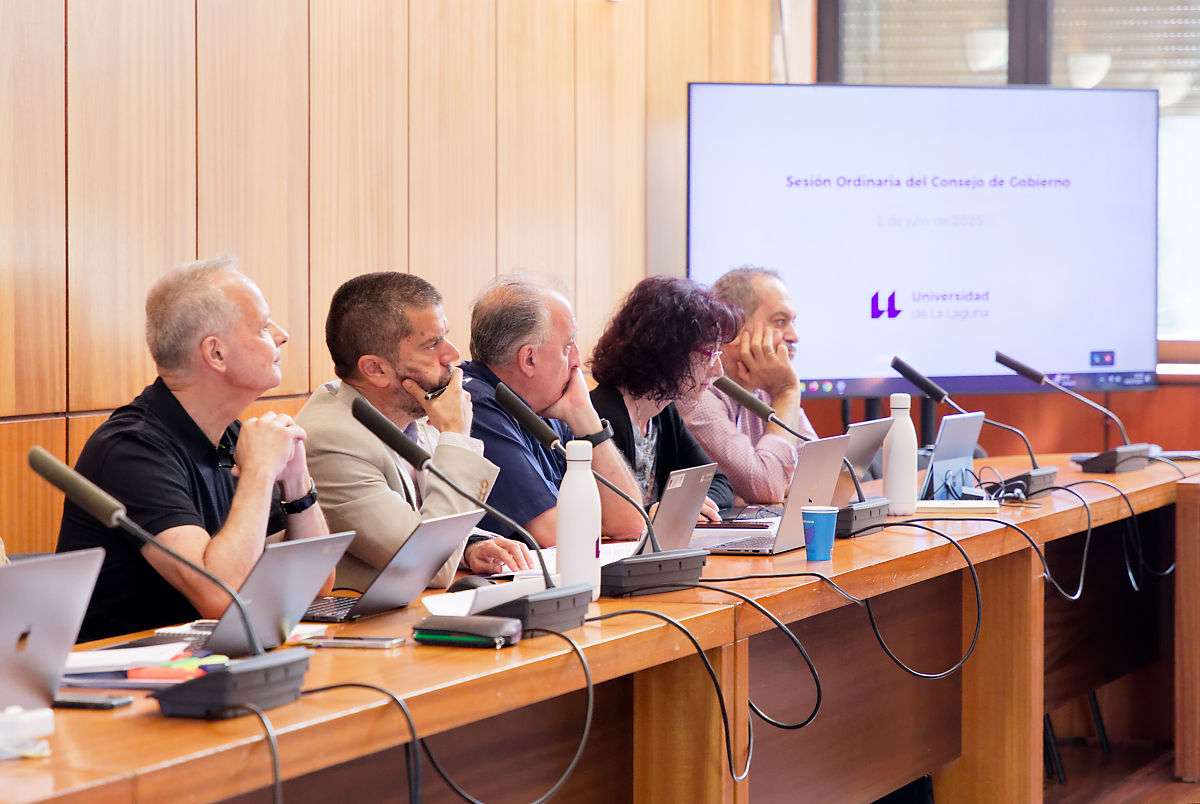
The Governing Council of the University of La Laguna, in its session today, Tuesday, July 1, approved by 31 votes in favor and 2 abstentions, an agreement expressing its profound disagreement with Bill 11L/PPL-0001 on Social Councils, which is currently being processed in the Parliament of the Canary Islands. The document states that its content “contradicts the provisions of Organic Law 2/2023 of the University System (LOSU), seriously alters the governance model of the Canary Islands' public universities, and could violate Article 27.10 of the Spanish Constitution by limiting university autonomy.”.
The agreement approved today urges the Parliament of the Canary Islands to “thoroughly review the text of the proposal, aligning it with state legislation and eliminating any provisions that encroach upon the academic and administrative powers of other university bodies.” More specifically, it requests that any modification to the regulations governing Social Councils be consistent with the basic framework of powers established in the Organic Law on Universities (LOSU) and guarantee the essential content of university autonomy.
The agreement empowers the Rector, as the representative of the University of La Laguna, to take the necessary steps with the relevant institutions to ensure its implementation. This document will be sent to the President of the Parliament of the Canary Islands, the parliamentary groups represented in the Parliament of the Canary Islands, the Ministry of Universities, Science and Innovation and Culture of the Government of the Canary Islands, and the Conference of Rectors of Spanish Universities (CRUE), and will also be disseminated through the university's own media and communication channels.
The agreement begins with a series of considerations that contextualize the proposal, acknowledging the key value of social councils in strengthening the university's connection with society, as outlined in Article 47 of the Organic Law on Universities (LOSU). However, it argues that some of the powers granted to these bodies by the proposed law entail assuming responsibilities that, under current legislation, belong to other entities, such as the Governing Council, creating duplication and establishing a parallel governing body "with powers that contradict basic state legislation and limit university autonomy.".
During the debate on this point, the rector, Francisco García, clarified that this agreement was not “against social councils in general, nor against the Social Council of the University of La Laguna in particular, with which relations are excellent,” but rather opposed to a conception of this body that is not in accordance with the spirit of Article 47 of the Organic Law on Universities (LOSU). He also noted that social councils change with political majorities, making it problematic for them to be responsible for decisions such as approving the creation of degree programs, departments, and university research institutes. “The social council can provide information for these decisions, but they should not be the final decision-makers.”.
The president of the Social Council of the University of La Laguna, Francisco Almeida, expressed his opposition to this agreement, arguing that the proposed law does not seek to undermine university autonomy and enjoys the consensus of the main parliamentary groups. Conversely, other council members not only supported the approval of the proposal but also called for stronger actions to demonstrate the academic institution's disagreement, while others advocated for seeking avenues of negotiation to avoid direct confrontation.
Other matters
The Governing Council has also approved submitting to the Social Council the temporary direct transfer to the Tenerife Island Council of a strip of land in the lower area of the Central Campus for the execution of a project to improve the La Laguna transport interchange. The transfer will have a maximum duration of four years, will affect a strip of 2,174.15 square meters, and will entail a direct financial compensation of approximately €376,000 linked to the works, plus a direct subsidy of €500,000 to help improve the gardens of that location.
The proposal has received favorable reports from the Technical Office, the Contracting Service and the Legal Department, and another from the Information and Communications Technology Service highlighting the necessary actions to ensure that the works do not affect the university's fiber optic line.
The creation of an Association of Public Universities of the Canary Islands was also approved, an initiative that arose during the meeting of the governing teams of both institutions held at the University of La Laguna on June 11. Similar associations already exist in other autonomous communities, and the idea is to have a legally recognized entity that can serve as a spokesperson and support the positions of the archipelago's two public higher education institutions. This new entity will also incorporate the two foundations that serve as the universities' own resources and will be headquartered at the University of Tenerife.
During the session, the creation of a Master's Degree in Continuing Education for University Teaching was approved. Currently, newly appointed university professors can take two expert courses to enhance their skills: one on University Teaching and another on Digital Competencies. The idea is that those who complete both courses, and also complete additional coursework and a final master's thesis to reach 60 ECTS credits, will be able to obtain this new master's degree.
The session also approved the calls for 6 Permanent Labor Professor positions and 42 Assistant Professor positions, the latter attached to the María Goyri Program for the incorporation of teaching and research talent.

 Spanish
 English
 French