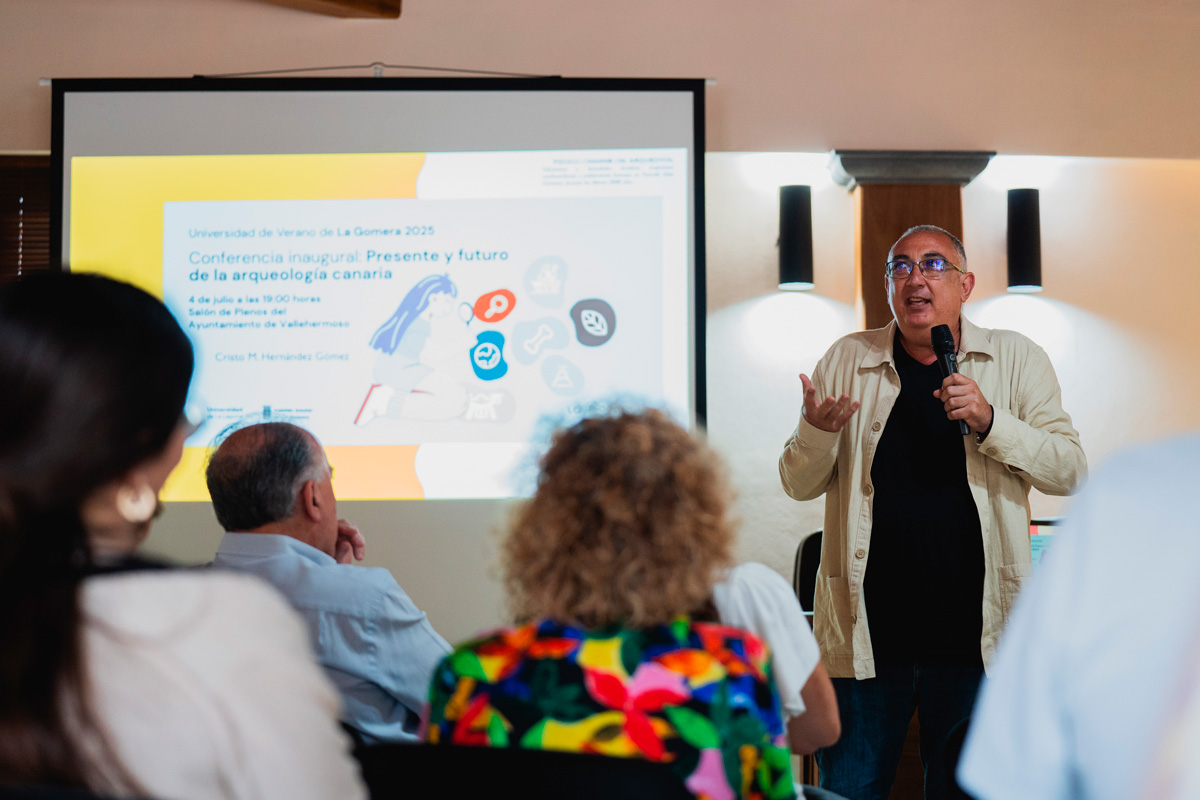
The La Gomera Summer University The 2025 edition of the conference began last Friday, July 4th, with its opening ceremony in the Vallehermoso Town Hall's Plenary Hall. The day started with the lecture "Present and Future of Canarian Archaeology," given by Professor Cristo M. Hernández Gómez, a lecturer and researcher at the University of La Laguna. His vibrant presentation was filled with personal anecdotes, historical data, and reflections on the role archaeology plays today as a tool for social, scientific, and cultural development. The event thus marked the beginning of an academic program that, once again, aims to bring university knowledge to all corners of La Gomera and promote lifelong learning among its citizens.
The meeting brought together institutional representatives from the Vallehermoso Town Hall, the La Gomera Island Council, and the University of La Laguna. Speakers included Emiliano Coello, mayor of the host municipality; Adasat Reyes, first vice president of the Island Council; Rosa Elena García, Island Councilor for Social Services, Education, Culture, and Sports; Antonio Aparicio, vice-rector for Research and Transfer at the University of La Laguna; and Abel López, director of the University Extension Secretariat, who introduced the speaker.
During his speech, the mayor welcomed the attendees and emphasized the importance of inter-institutional collaboration in bringing knowledge to the municipalities. At a particularly significant time for Vallehermoso, as it celebrates its quinquennial festivities, Emiliano Coello highlighted the town's direct connection with the University of La Laguna through projects like this Summer University.
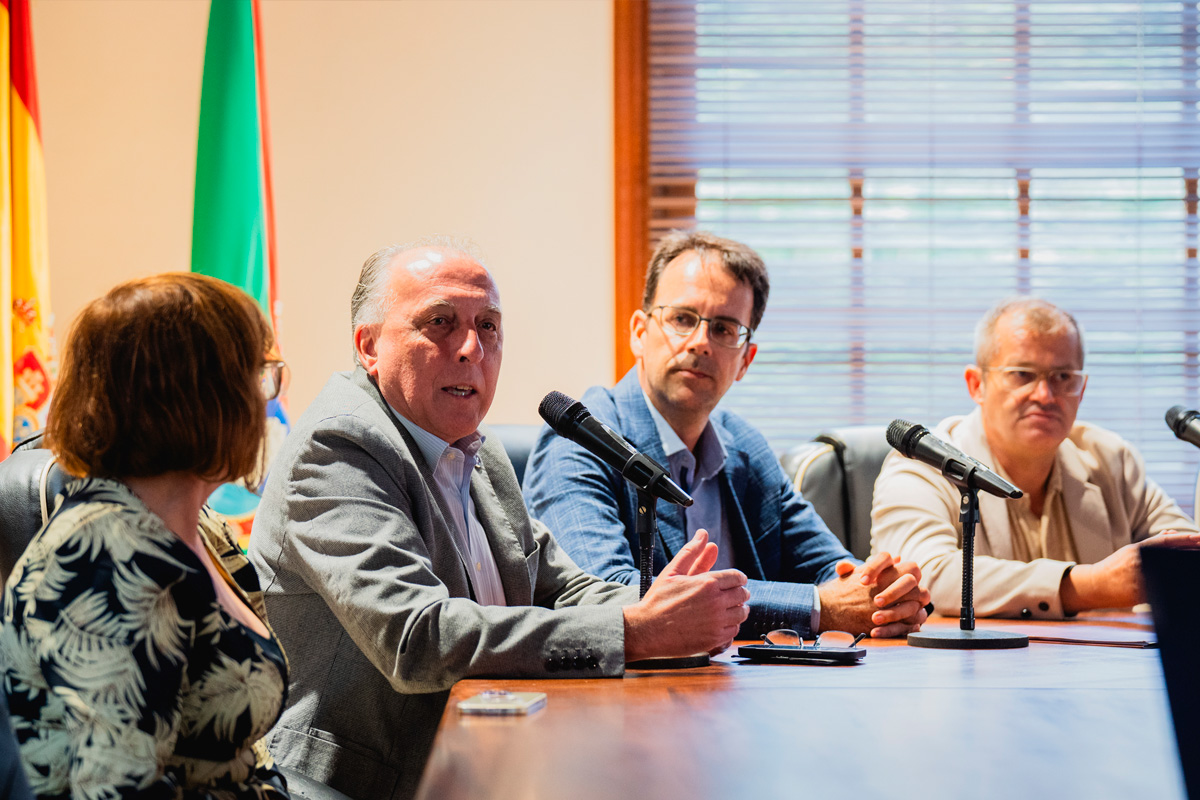
(From left to right) Rosa Elena García, Island Councillor for Social Services, Education, Culture and Sports; Antonio Aparicio, Vice-Rector for Research at the ULL; Adasat Reyes, First Vice-President of the Cabildo of La Gomera; and Emiliano Coello, Mayor of the municipality of Vallehermoso.
The Vice President of the Island Council, Adasat Reyes, emphasized that “La Gomera is made of ancient traces that speak to us” and stressed that archaeology, beyond its academic aspects, connects directly with the soul of the island: “Each fragment found is a bridge to our origins. That is why it is so important to continue researching, disseminating, and protecting this legacy.” He also expressed his gratitude to the University of La Laguna (ULL) for its continued commitment to accessible, diverse, and decentralized education: “Access to knowledge is a right, not a privilege,” he concluded.
Vice-Rector Antonio Aparicio, representing the Rector, praised the trajectory of this training program, which now boasts more than 25 years of history, and its key role in expanding academic activity beyond the campus. “Knowledge should not be limited by geography. This Summer University demonstrates that university education can and should reach all the municipalities of the Archipelago,” he stated.
Canarian archaeology as legacy and challenge
Cristo M. Hernández's lecture was a reaffirmation of the transformative value of archaeology and its public dimension. From a rigorous yet profoundly human perspective, he shared his experience as a researcher, teacher, and popularizer, positioning the University of La Laguna as an international leader in the field of archaeology.
The professor himself began by acknowledging the symbolic weight of delivering this inaugural lecture in La Gomera, an island which, as he expressed, “was always the one across the way, but also the island of my first voyages, the island of discovery.” He recalled with emotion his work at Alto de Garajonay, “one of the most special moments” of his career, and championed the pioneering role of the Archaeological Museum of La Gomera as “the epicenter of a participatory archaeology model that inspires the other islands today.”.
He emphasized that he would not be speaking specifically about the archaeology of La Gomera, but rather about the broader context of Canarian archaeology and the role that public universities should play in its development. He championed the shift from a colonial archaeology model—in which foreign researchers studied from afar—to one led from the Canary Islands with international recognition. “Today we publish in journals like Nature and are part of global scientific networks. Our work is not only relevant here, but it is also in dialogue with the world.”.
In a friendly and engaging style, he also shared how he fell in love with archaeology as a child after watching Indiana Jones, and recommended the book "In Search of Dr. Jones," which recounts how that figure inspired a whole generation of archaeologists. Through images, historical examples, and personal anecdotes, he explained how the past is revealed in the soil, in objects, in landscapes transformed by centuries of human activity. "Archaeology," he said, "is not only a tool for remembering, but for understanding. It helps us interpret the conflicts, migrations, climate changes, and social relationships that have brought us to where we are today.".
Before concluding his presentation, Cristo M. Hernández made a heartfelt reference to his connection with La Gomera, highlighting that it was on this island where he experienced some of the most significant moments of his career, especially in the area around Alto de Garajonay, which he described as the "seed" of his research vocation. He also wanted to express his appreciation for his colleague and friend Juan Carlos Hernández Marrero, director of the Island Archaeological Museum and an attendee at the conference, whom he identified as a key figure in promoting a participatory archaeology model that is now viewed by other islands as a benchmark. He emphasized that this approach, based on citizen science and a connection with the local area, makes the museum a true epicenter of archaeological knowledge and outreach in the Canary Islands.
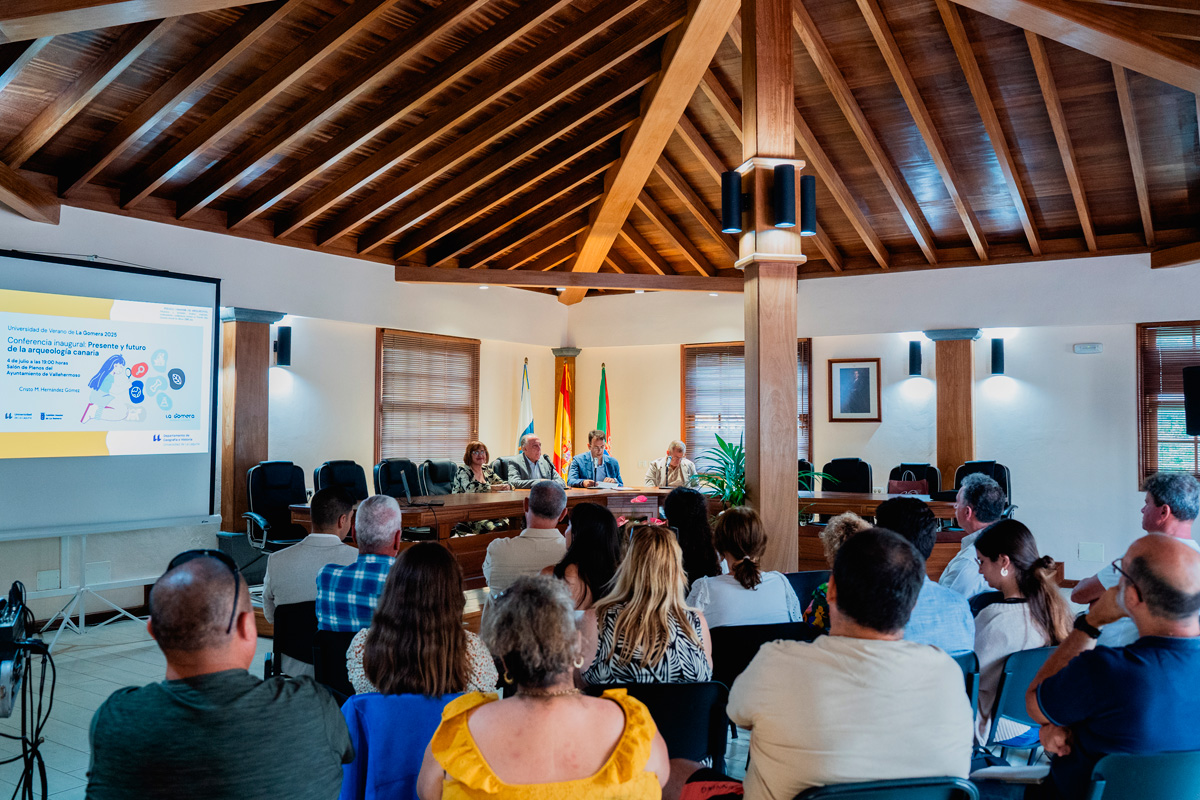 The event concluded with Island Councillor Rosa Elena García announcing the courses that make up the academic program. Finally, Abel López invited the public to actively participate in the Summer University's activities and emphasized that "the University's presence in La Gomera should not be limited to the summer; the goal is to continue expanding this connection throughout the year.".
Training itinerary and next appointment
The La Gomera Summer University will continue its academic program from July 8th to 10th in Alajeró with the course '‘First Course on Paleontology of the Canary Islands. Exceptional sites and fossils and their use and management’', focused on the fossil heritage of the Archipelago and its application in environmental management.
On July 12, the same municipality will host the main event of this edition, entitled “Culture Among the Terraces.” This day will bring together dissemination, knowledge sharing, and celebration of La Gomera's heritage, with an agenda that will include a Tagoror of Knowledge —where students from the academic institution will present their Bachelor's and Master's theses—, a Masterclass on the wines of La Gomera, a film forum with audiovisual projection and discussion panel, and a final tasting of local wines.
During the second half of July, other courses will be held in different municipalities on the island: ‘'Basic drone pilot course’' (July 14-16 in Hermigua),'‘Geodiversity and geological heritage’' (July 14-16 in Agulo), and '‘Big Data. Extracting knowledge from datas' (July 15-17 in Playa de Santiago). After the August break, the program will conclude from September 16-18 in San Sebastián, with the course '’The Canary Islands and America: five centuries of cultural exchange’', a look at the historical and cultural links between the Archipelago and the American continent.
The University of La Laguna, through the Vice-Rectorate for Culture and University Extension, will issue a certificate of attendance to those who attend the in-person sessions of the 80% course. In addition, those who complete the independent work will receive a certificate of completion, recognized for 1 or 2 ECTS credits.

 Spanish
 English
 French