
The Vice-Rectorate for Internationalization and Cooperation at the University of La Laguna has organized a specific training program for its faculty members interested in developing international cooperation projects with a cross-cutting approach. The course began today, Monday, July 7, and will run until July 9. It is being taught by Lara González, a graduate in Political Science and Sociology from the University of Deusto, with a doctoral thesis in the evaluation of international cooperation projects and a Master's degree in development management. She has been a lecturer and consultant since 1999 and, since 2008, the manager of a consultancy specializing in international cooperation initiatives with a feminist perspective. Kalidadea.
The course was presented by the director of the Internationalization Secretariat Judit Mendoza Aguilar, who explained that the purpose of this initiative is to provide the necessary methodological tools so that the faculty of the University of La Laguna can formulate more competitive cooperation projects to increase their chances of being selected in the calls to which they apply and, above all, improve their effectiveness on the ground and capacity for consolidation over time.
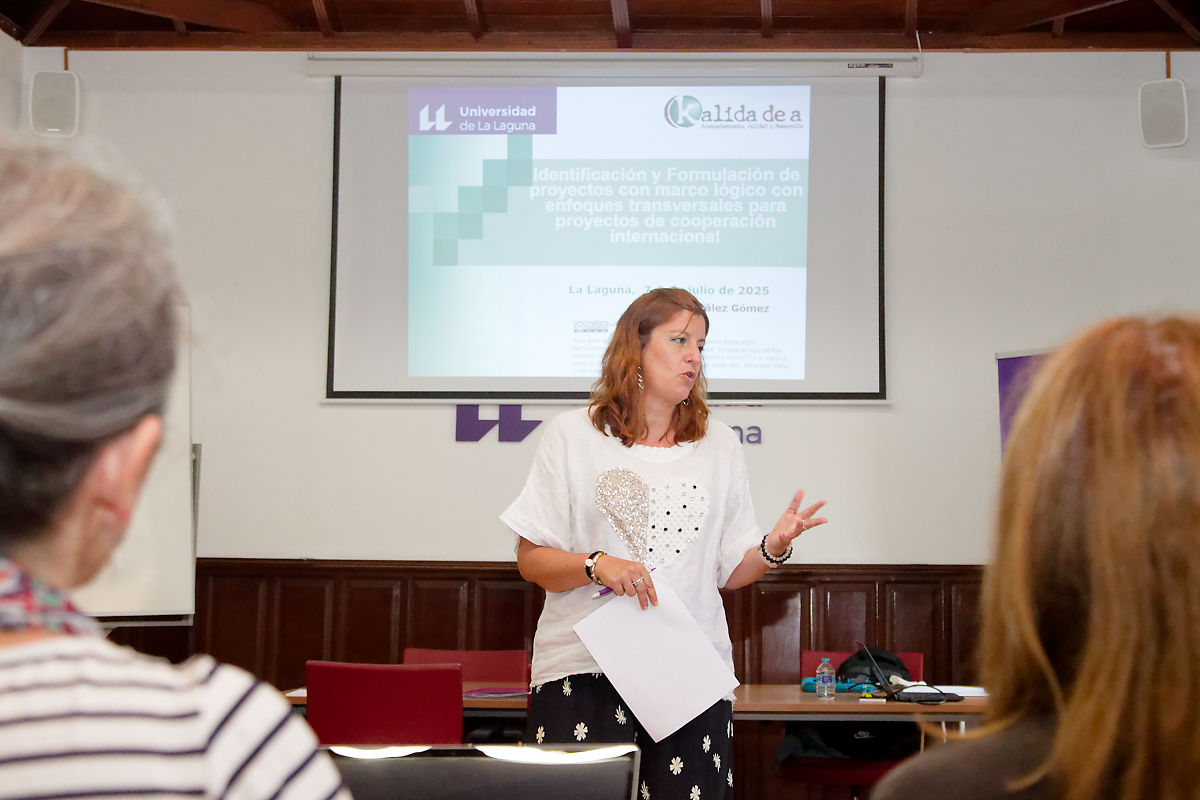
Lara González.
As the main speaker explained, this training initiative focuses particularly on identification as a necessary phase in project formulation. In this regard, she pointed out that it is important to be able to identify the vulnerabilities that exist in a territory to determine exactly what needs to be addressed, but also to identify the existing capacities within the territory to tackle those vulnerabilities. In other words, that there is some kind of minimum infrastructure in place that will allow the proposed project to succeed.
González also explained that his approach to cooperation is based on humility and a rights-based approach, not mere assistance: the idea is that the external personnel who come to a project area - such as, in this case, the researchers from the University of La Laguna - will be facilitators of development, but that the process will be led by the community itself, which will ultimately be able to give continuity over time to any initiative that is proposed.
The course has enrolled around twenty members of the teaching and research staff from different faculties and schools of the University of La Laguna who have already carried out some international cooperation initiative or are preparing to propose it soon, in countries such as Senegal and Cape Verde on subjects as diverse as water channeling, renewable energies and education, among others.
The speaker requested these project proposals a few days before the course began so she could review them beforehand. These initiatives will be analyzed and optimized during the three-day course, which is being held in person at the university facilities located at 50 Viana Street in La Laguna.

 Spanish
 English
 French