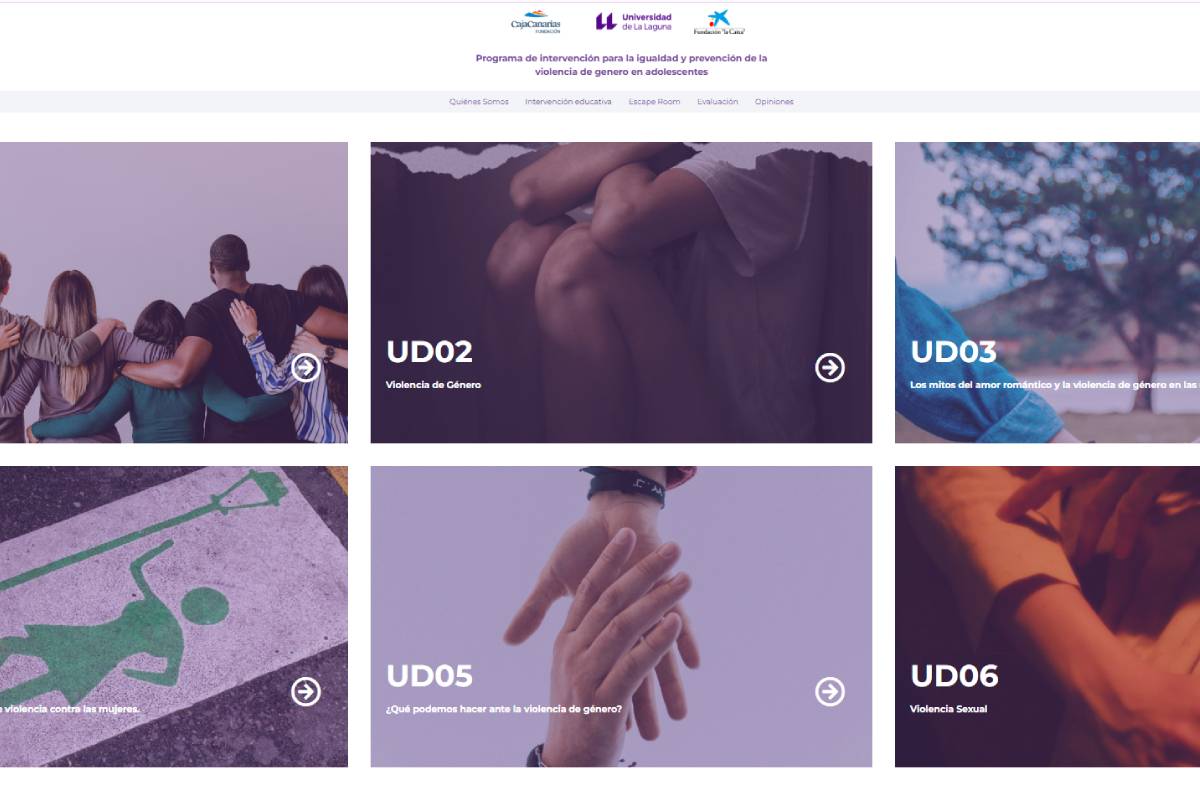
A research team from the University of La Laguna has just published in the Swiss journal Adolescents an article with the results of the evaluation carried out on an intervention program for equality and prevention of gender violence in adolescents called Previogen. This program was designed by the same team and, after being implemented for 12 months in 561 students with an average age of 16, it has proven to be effective in reducing sexist attitudes.
Both the evaluated intervention program and the article with the results that confirm its effectiveness have been developed by Elena Vila Cortavitarte, from the doctoral program in Health Sciences; Marta Díaz Gómez, from the Nursing Department, and José Miguel Díaz Gómez, From the Department of Cognitive, Social and Organizational Psychology at the University of La Laguna. The Previogen program It was financed by the CajaCanarias Foundation and "la Caixa" and has now been published internationally in a high-impact scientific journal.
The program proved effective in reducing explicit and implicit sexist attitudes, both in the short and medium term, achieving a lasting change in attitudes over time. Part of its success is likely due to its participatory methodology, which incorporates games in the classroom to spark participants' interest and motivation.
Methodology
Few previous studies have evaluated the medium- and long-term outcomes of sex education programs. Therefore, the research team undertook this evaluation of the effectiveness of their educational intervention program aimed at promoting equality and preventing gender-based violence among adolescents. Participants, mostly of Spanish nationality, were randomly assigned to either an experimental or a control group, and both groups were followed for 12 months.
The experimental group received a 15-hour sex education intervention that included lectures followed by discussions and small group work using worksheets and videos. It also included reading a comic strip depicting the manifestations of an unequal relationship, and a escape room The aim of the activity was to discover, through play, the obstacles women have faced throughout history in their fight against inequality. The control group, meanwhile, received a talk on contraception and sexually transmitted infections.
Two previously validated scales were used to measure sexist attitudes and gender roles; and a narrative, used to assess implicit sexist attitudes, was also used, describing how the protagonist adopts a passive attitude when forced into an unwanted sexual relationship. After reading it, the participating students were asked to evaluate the protagonist's behavior.
To contribute to the continuity and scalability of the program, their website The program makes the content used in this educational intervention publicly available so that teachers have all the tools used to address equality education and the prevention of gender-based violence in the classroom. In this way, the program can reach more students at no initial cost to schools.
Relevance of the intervention
As the research team explains, gender-based violence affects all ages and has multiple causes related to socio-cultural and individual factors, among which the power imbalance between men and women is particularly important. A patriarchal culture persists in society, in which traditional stereotypes of femininity and masculinity are ingrained in many families, becoming ingrained from childhood and often imitated.
Gender-based violence manifests in various ways, from subtle forms like sexism to explicit ones such as emotional blackmail, threats, and insults, and can even escalate to physical aggression and murder. Therefore, in the opinion of those responsible for the project, sexism among adolescents must be addressed with a comprehensive and systematic approach. Sexist attitudes are linked to harmful forms of intimate interaction; thus, one of the cornerstones of preventing gender-based violence is achieving a change in attitudes.
Comprehensive sex education programs are known to be effective tools for combating gender inequality, but in most schools, they have not been incorporated into the curriculum. The education adolescents receive on this topic is generally limited to basic anatomy and the prevention of sexually transmitted infections and unwanted pregnancies, without addressing aspects of affection, emotions, and equal enjoyment.

 Spanish
 English
 French