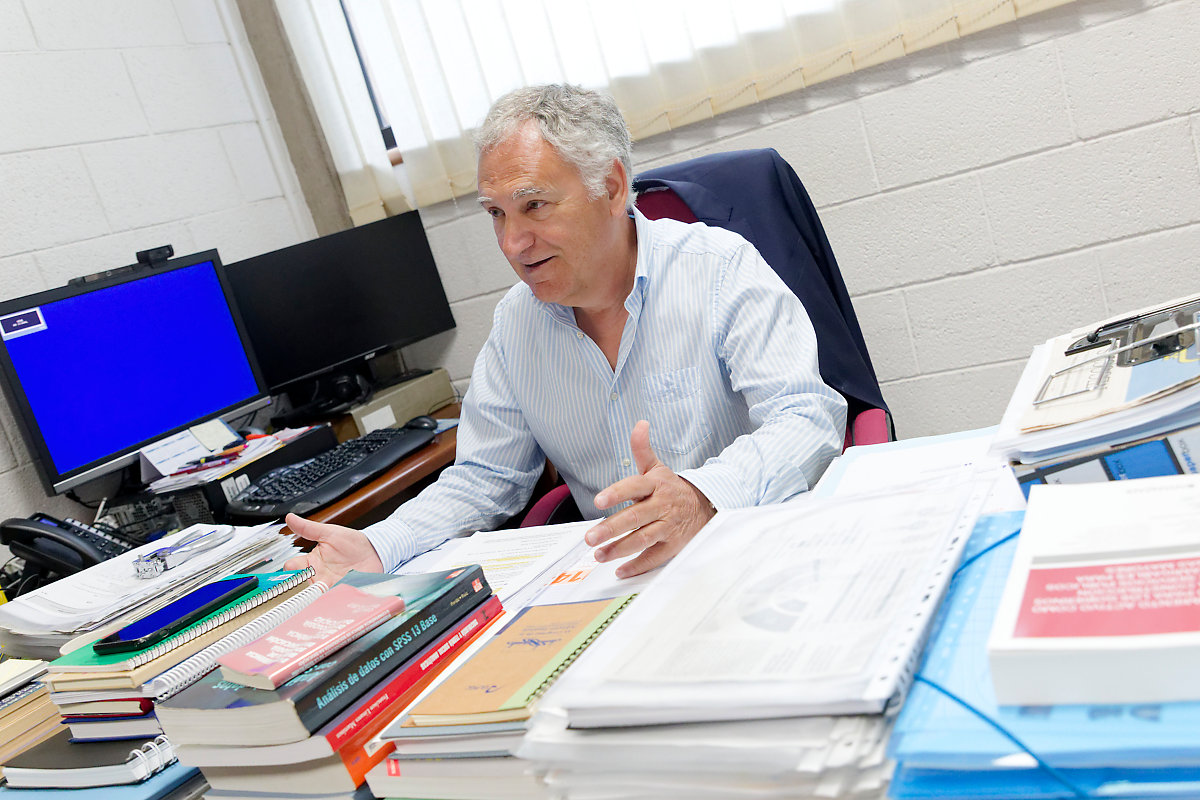
Education is the most powerful tool for transforming lives, but not everyone has the same opportunities to take advantage of it. This is the view of sociologist Leopoldo Cabrera, a tenured professor at the University of La Laguna, who has dedicated decades to studying educational inequalities. Based on his experience, he issues a clear warning: “The education system does not compensate for social differences of origin; it often reproduces them.” In a context where access to university has been formally democratized, Cabrera urges us not to fall into the trap of apparent egalitarianism. “It is true that today it is easier to enter university than it was thirty years ago, but the odds of access are still four times in favor of upper-class students compared to those from lower-class backgrounds,” he explains.
Every year, thousands of young people face the University Entrance Exam (PAU). Although the intention behind establishing a single national assessment is to guarantee fairness, Cabrera emphasizes that the exam alone does not level the playing field. “Social structure weighs heavily before students even step into the exam room. Studying in Madrid is not the same as studying in the Canary Islands. Being born into a family with a history of university education is not the same as being born into one with a history of school dropout,” he states. The sociologist points out that, in communities like the Canary Islands, high school enrollment rates are lower. “Here, those who reach the PAU have already passed a preliminary screening. There are fewer of them, but they are more selective. The problem is structural, not inherent to the students themselves,” he clarifies.
One of the problems the expert identifies is the shortage of places in the most sought-after degrees, such as those in the health sciences. “Public universities have limited resources. We can’t expand the offerings without planning. The solution lies in political decisions regarding funding and educational strategy,” he argues. Furthermore, he questions the idea that private education is synonymous with higher quality. “When it comes time to enter medical school, families want a public one. Because it’s more competitive, it has more prestige. At that level, true meritocracy prevails,” he asserts. “You can inherit wealth, but you can’t inherit your MIR exam score.”.
Beyond economic status or school type, Cabrera points to other, less visible factors that profoundly impact academic performance. One of these is birth month. “It’s been proven that children born in the last quarter of the year perform worse and are more likely to repeat a grade. It’s a bias of the system itself, not a lack of ability,” she warns. Another determining factor is access to extracurricular activities. “Families with more resources can afford tutoring, language classes, or sports, which act as academic boosters. But public education alone should be sufficient to offer true equality.”.
In her analysis, Cabrera highlights the role of mothers, especially in single-parent households. “When a mother has a university degree and works, her involvement in her children's education is greater than that of the father. In the Canary Islands, where there are more single-mother households than the national average, this is key,” she points out. She also denounces the persistent gender gaps. “Girls get better grades, but they still perform worse in mathematics. Boys, on the other hand, struggle in language. It's not a biological issue: in intelligence tests, both sexes obtain similar results. The problem lies in educational biases and societal expectations.”.
Social elevator
The sociologist is emphatic in stating that education remains the most realistic path to social mobility, though not the only one. “The lottery or elite sports are possible, but improbable, routes. Education has a more reasonable success rate, although it's not a guarantee either,” he clarifies. However, he warns that even the sons and daughters of privileged families can lose status. “A family in the 95th percentile of income cannot expect their children to climb any higher: at best, they can maintain their position. And the 20% group doesn't manage to do so. This isn't determinism, it's social probability,” he points out.
Cabrera challenges the idea that only university leads to success. “It’s not right for a parent to call their child a failure for not going to university. There are technical professions that are just as dignified and profitable. Social value isn’t solely about degrees, but about how professions are perceived,” he argues. He emphasizes that the goal of the education system shouldn’t be solely economic. “We need to inspire students with knowledge, not just promise them a salary. Reading, understanding the world, participating in society… that’s also success.”.
For Cabrera, the responsibility doesn't lie solely with public policies. “We need real involvement from teachers, families, and the entire community. In the Canary Islands, this collective effort is essential. And it must begin in primary school, not when failure has already taken hold in secondary school.” The solution, he concludes, lies in a long-term educational strategy: “Schools can transform lives, but they can't do it alone. Talent shouldn't depend on postal code or birth month. Equal opportunities aren't just a statement of principles; they're an unfinished task.”.

 Spanish
 English
 French