
The University of La Laguna has been celebrating since Monday, July 14th the 1st GenIA Conference, This forum is a meeting to discuss and reflect on the impact of artificial intelligence on equality and education, without allowing it to dehumanize. It features conferences, roundtables, and expert voices from the fields of technology, philosophy, education, and communication to address the limits, risks, and possibilities of AI that cares, educates, and transforms.
This initiative, promoted by the University Institute for Women's Studies (IUEM), has the collaboration of the Canary Islands Institute for Equality, the CajaCanarias Foundation, the La Laguna City Council and the MAPFRE Canary Islands Foundation Chair of Technology and Education (TECNOEDU).
The presentation of its second session, held yesterday, Tuesday the 15th, was given by José Manuel García, Vice-Rector of Teaching; Carina González, director of IUEM; Roberto González Zalacaín, Director of the Secretariat of University Institutes and Publications; and Julio Brito, Managing Director of the General Foundation of the university institution.
“These conferences allow us to ask ourselves how artificial intelligence can help close gender gaps,” noted Carina González, who also emphasized that one of the objectives of this meeting is to discuss what kind of education we want to design with tools that are here to stay. For his part, Roberto González recalled that ”university institutes like the Institute for Women’s Studies fulfill a dual mission: research and the social transfer of knowledge, and these conferences are a clear example of this.“.
Julio Brito emphasized the need to support initiatives that foster dialogue and reflection on emerging technologies, stating that “it is essential to analyze the impacts of AI on equality and inclusion.” For his part, José Manuel García reaffirmed that “the University of La Laguna must continue to promote spaces for reflection on the relationship between technology, equality, and education.”.
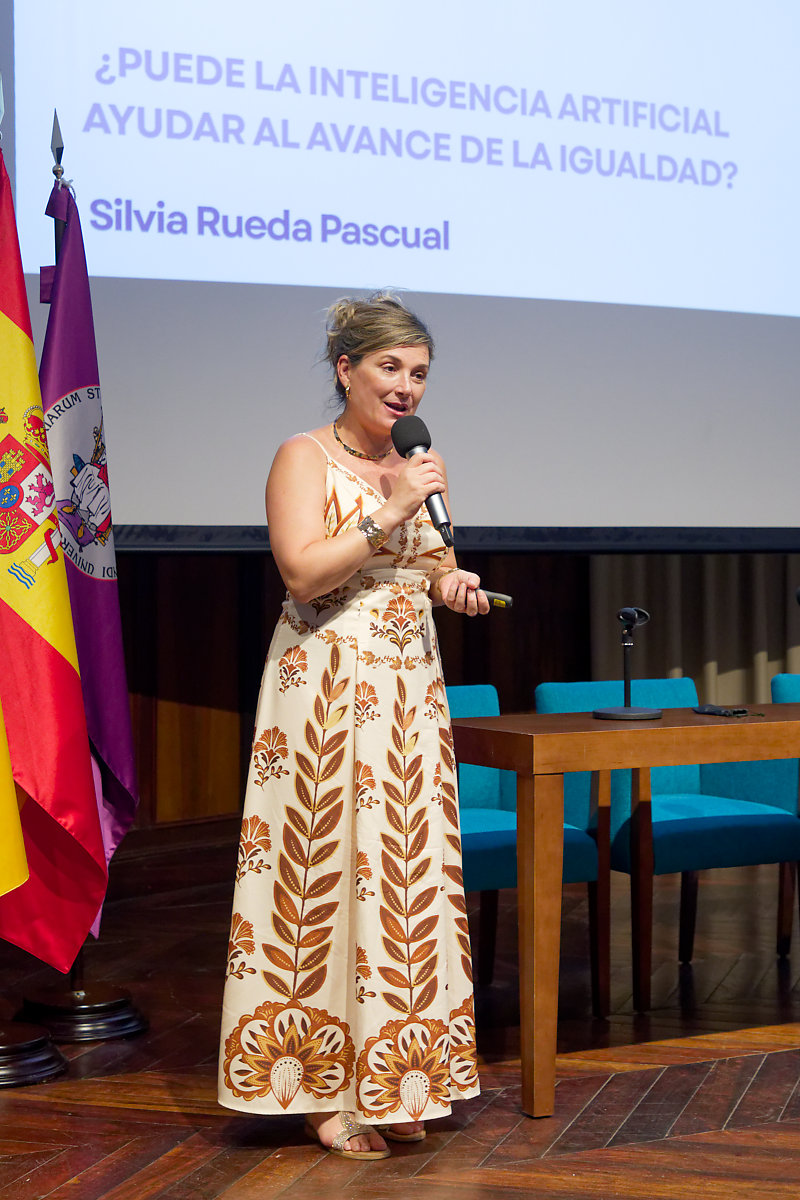
Silvia Rueda.
AI, equality and bias
The main activity of this session was the lecture “Can Artificial Intelligence Help Advance Equality?”, given by Silvia Rueda, PhD in Computer Science from the University of Valencia. During her presentation, she provided concrete examples of how AI is already contributing in areas such as medicine, with systems supporting the early diagnosis of diseases that particularly affect women, such as ovarian or breast cancer. However, she cautioned that this tool “is neither neutral nor infallible, because it is built by people” and reflects biases. “The good news is that we can detect them and work to correct them.”.
Rueda explained that these biases are transmitted through data, algorithms, and automated decisions. “Artificial intelligence can be a great tool for advancing equality, but it must be designed, audited, and implemented with an ethical and responsible approach, taking all of society into account,” she emphasized.
Transforming education to transform society
The meeting continued with the round table 'Digital transformation with AI: What education do we want to design?', in which Belén San Nicolás, director of the Secretariat of Digital Teaching; Antonia Varela, director of the Starlight Foundation and the Museum of Science and the Cosmos of Tenerife; and the speaker Silvia Rueda participated.
This forum addressed the urgent need to foster critical thinking skills that make these intelligent systems accessible to all audiences, especially young people. San Nicolás outlined some of the initiatives undertaken at the University of La Laguna during the past academic year, such as the creation of a dedicated committee comprised of experts from the Faculties of Education, Computer Science, and Law, and the drafting of a ten-point code of conduct for the ethical use of these tools by faculty and students, open to input from the entire university community.
For her part, Varela emphasized the need to “break down barriers and awaken scientific and technological vocations from an early age, with an equal and equitable education that allows girls and young women to actively participate in the creation of knowledge and technology.” Rueda pointed out the importance of strengthening critical thinking and mentioned one of the problems that exist today, where people blindly trust what AI says, “we cannot blindly trust technology without asking ourselves what it is used for and who benefits from it.”.
Closing remarks: Humanizing AI to build the future
The first GenIA Conference concludes today, Wednesday, July 16, at the CajaCanarias Foundation Cultural Center, with a session that will once again focus on reflecting on AI from a humanistic perspective. The opening of this session will be led by Margarita Ramos, president of the CajaCanarias Foundation; Carmen Barreto, parliamentary director of Internal Affairs; and Ernesto Pereda, director of the Higher School of Engineering and Technology at the University of La Laguna.
Cristina Aranda, a consultant specializing in Innovation, Big Data, and Artificial Intelligence, will deliver the lecture 'Beyond the Algorithm: Humanizing AI'. Following this, the day will conclude with the panel discussion 'Interfaces of Power: How the AI We Don't See Affects Us', featuring Lourdes Muñoz, director of Barcelona Open Data; Lourdes Santana, regional director of Grupo Prisa; and Cristina Aranda herself.

 Spanish
 English
 French