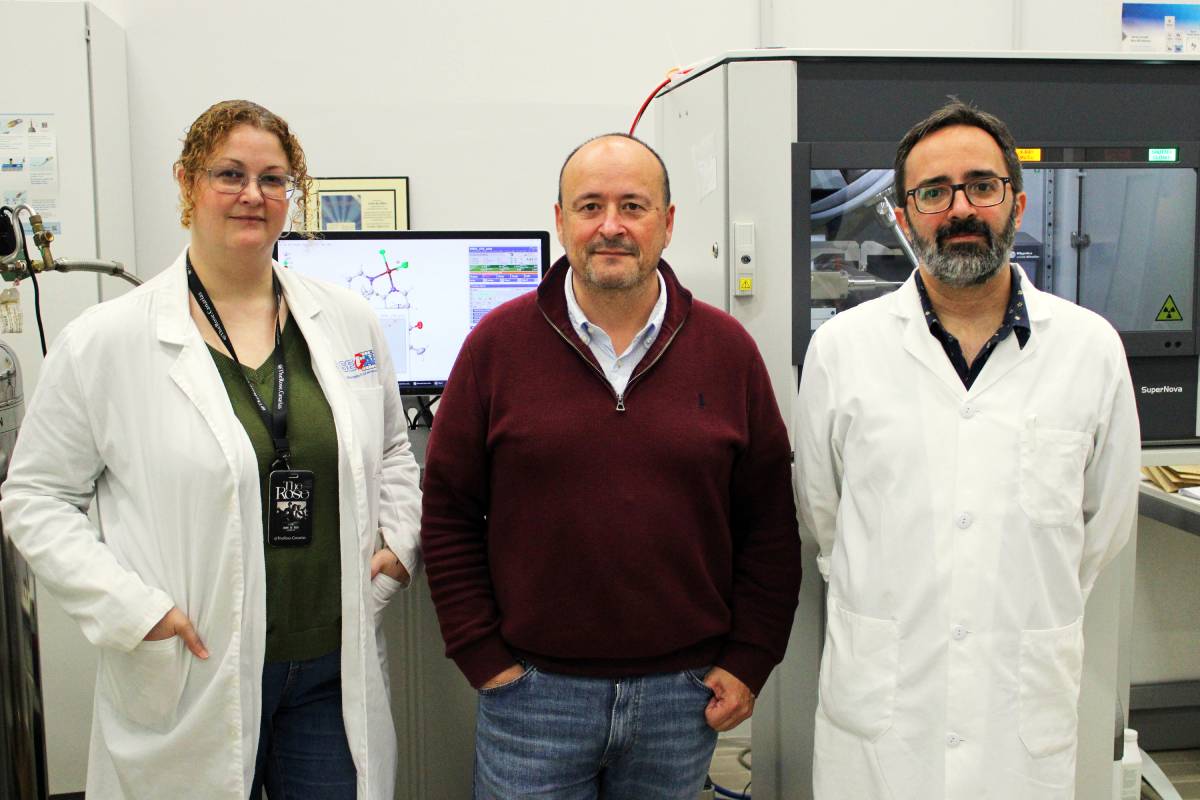
The General Research Support Service (SEGAI) at the University of La Laguna provides scientific, instrumental, and technical support to research within the institution itself and in collaboration with external entities. Within this framework, the Integrated X-ray Diffraction Service It stands out for its multidisciplinary nature, with applications in fields as diverse as Geological, Chemical, Physical, Materials Sciences, Pharmacy, Archaeology, Environmental Sciences, as well as in areas such as Construction or Civil Engineering.
X-ray diffraction techniques allow the determination of a compound's crystalline structure, and therefore can only be applied to materials with atomic order. Furthermore, the analyses performed by this service can provide information on the chemical composition of materials and on the changes that these crystalline structures undergo under different temperature and pressure conditions.
The Integrated X-ray Diffraction Service analyzes crystalline samples for research projects at the University of La Laguna, as well as for public bodies and companies in various sectors across the Canary Islands. Materials studied range from cement and paper to jewelry and works of art undergoing restoration. The service is headed by Javier González Platas, with technical support from María del Pino Déniz Hernández and Celso Agustín Hernández Díaz.
Currently, it maintains collaboration agreements with the Canary Islands Institute of Criminalistics, the Institute of Natural Products and Agrobiology (IPNA-CSIC), as well as with various companies. It is the only laboratory of its kind in the Canary Islands, which gives it high demand, with nearly 2,000 tests performed in 2024. The service has been certified by AENOR according to the ISO 9001 standard, which means that it has demonstrated compliance with the required quality standards.
This service considers it essential to bring its work closer to the educational community, especially students. Therefore, it regularly receives visits from secondary school groups, who have the opportunity to see the facilities firsthand and receive a tailored explanation of the work carried out there. In addition, the laboratory frequently hosts training placements for Master's students in Chemistry and external internships for Bachelor's students in Physics, thus reinforcing its commitment to education and the dissemination of scientific knowledge.
Equipment
For this purpose, the service's facilities are equipped with two instruments for analyzing single-crystal samples (the Oxford Diffraction SuperNova and Rigaku Oxford Diffraction SuperNOVA diffractometers) and two others for polycrystalline samples (the PANalytical Empyrean and Panalytical X'Pert PRO diffractometers). This is a non-destructive analytical technique in which the samples are exposed to radiation, producing a spectrum that is subsequently analyzed by technicians to determine the atomic structure of the compound or its crystalline phases. From this information, it is possible to infer a series of properties of the analyzed compound and characterize it in detail.
In addition, the service also has a Bruker S2 Puma energy dispersive X-ray fluorescence spectrometer and a Niton XL3 T950 portable energy dispersive X-ray fluorescence analyzer (4), thus expanding its analytical capabilities.
This service is maintained through SEGAI's general budget, as well as contributions from research and infrastructure projects. In addition, the laboratory's infrastructure has been partially funded by the European Regional Development Fund (ERDF). The application process for using the Integrated X-ray Diffraction Service is unified within SEGAI and managed through a web platform. Users access the portal, select the service they require, and submit their application.

 Spanish
 English
 French