
The application of certain nanomaterials to buildings can generate a self-cleaning effect on surfaces, eliminating dirt and environmental pollution, which also contributes to improving air quality by preventing the accumulation of contaminants. Researchers at the University of La Laguna Pedro Esparza, from the Department of Chemistry, and Jorge Méndez, Physics students investigate photocatalysis, the physical-chemical process behind these applications, and have recently begun collaborating with Photocan, a company that markets products using this technology. To strengthen this joint effort, the university and the company have signed a general protocol of action for a period of two years, renewable.
Professor Méndez and Pedro del Real, from Fotocan, met today, Thursday, July 17, with the Rector of the University of La Laguna, Francisco García, and the Vice-Rector for Research and Transfer, Antonio Aparicio, to explain the details of this collaboration, which already has the support of the Provincial Federation of Construction Entities of Santa Cruz de Tenerife (FEPECO).
The professor from the University of La Laguna explained that his team has been researching photocatalysis for more than a decade for various applications, such as the creation of artificial photosynthesis with applications in the field of energy, or a "security ink" that is only visible when a laser is applied to it and that will soon begin to be commercially exploited through a spin-off company of the University of La Laguna that is in the process of being formed.
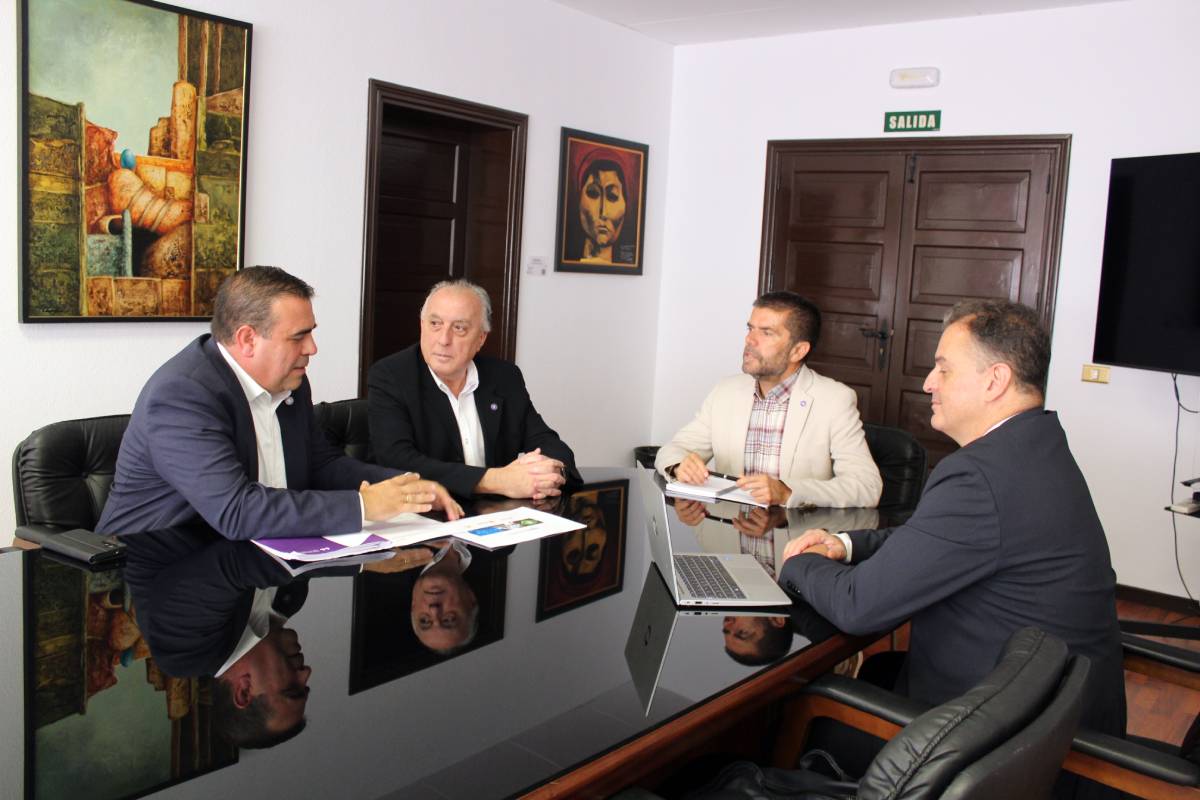 Del Real explained that his company markets a liquid coating based on titanium oxide, a material that enhances self-cleaning properties by absorbing ultraviolet radiation, and whose application could be of great interest in large public infrastructures. The research and development of this product followed a similar line of inquiry to that of Professors Esparza and Méndez, which is why, after meeting at a research conference, they decided to join forces.
Under the signed agreement, the university team will be able to monitor and test the product developed by the company to certify its validity. Furthermore, by adding the aforementioned security ink, it will be possible to ensure that the building or infrastructure has actually received Fotocan's treatment, and not one from another company. Contacts will now be initiated with public and private entities to present the product with a view to its potential acquisition and application.
Both the rector and the vice-rector valued this collaboration as a model example of research transfer and public-private collaboration, to introduce a product that will improve the sustainability of buildings and, therefore, is linked to several of the objectives of the 2030 Agenda.

 Spanish
 English
 French