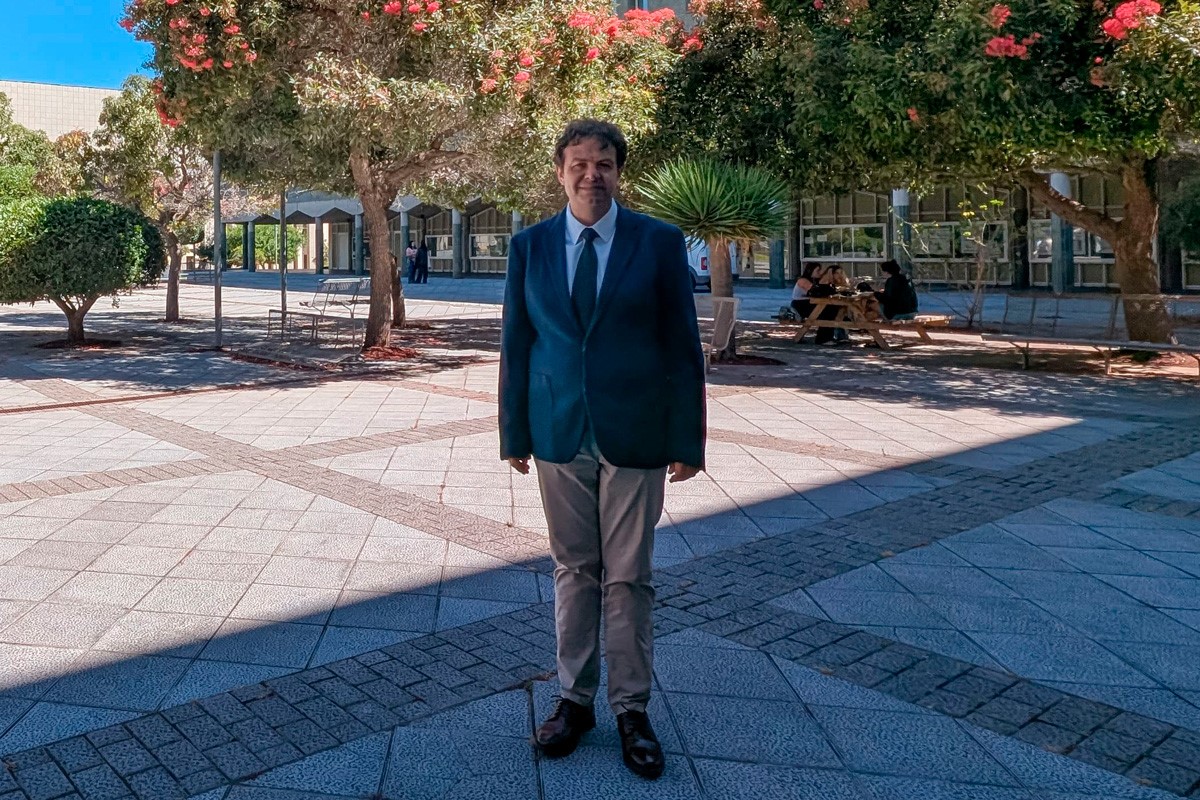
The University of La Laguna recently hosted the doctoral thesis defense of Rafael Manuel Barbudo González, a researcher in the Doctoral Program in Art and Humanities, entitled "Transcendence in Pablo Neruda." The academic event took place on July 14th in the Audiovisual Room of the Faculty of Philology and was supervised by Professor [Name of Professor]. Domingo Luis Hernández Álvarez. The work proposes a broad and deep study on the idea of transcendence as a guiding thread in the poetry of the Chilean author, approaching it from a philosophical, poetic, existential and political perspective.
The thesis was evaluated by a panel composed of Dr. José Carlos Rovira Soler, emeritus professor of Latin American Literature at the University of Alicante; Dr. Remedios Mataix Azuar, tenured professor at the same institution; and Nieves María Concepción Lorenzo, a professor at the University of La Laguna, all of them specialists in contemporary Latin American literature. The work was highly praised for its breadth, originality, and rigor.
The motivation behind this thesis has a strong personal and vocational component. In her defense, Barbudo explained that her first encounter with Neruda's work stemmed from the emotional impact his treatment of nature, love, and lived experience had on her as a reader. Over time, and already working as a secondary school teacher, she identified a recurring need: to find ways to introduce students to a poetry that transcends traditional lyricism and is articulated as a form of thought. It was then that she identified a category—transcendence—that ran through much of the poet's work and that had not been the subject of a comprehensive and systematic study. Based on this initial intuition, she decided to dedicate her doctoral research to analyzing how this dimension manifests itself in Neruda's poetry and what implications it has in terms of reading, interpretation, and critical reception.
The study employs an integrative methodology that combines three lines of inquiry: the semantic, stylistic, and structural analysis of the poetic texts; philosophical reflection from disciplines such as ontology, metaphysics, and aesthetics; and the biographical and life contextualization of Neruda, taking into account both his personal experiences and the historical moment in which he wrote his works. This three-pronged approach has allowed the study to address an extensive corpus that includes fundamental poetry collections such as Residence on Earth, General Song, The flaming sword, End of the world, The Book of Questions o Elemental odes.

Photo of Pablo Neruda in 1956. Source: Wikipedia
One of the thesis's main contributions is the identification of a poetic thought that articulates the immanent and the transcendent from a materialist perspective. In Neruda, the author asserts, transcendence is not an escape from the world, but rather a form of complete integration within it: objects, landscapes, bodies, food, affections, and memories become vehicles of meaning that allow human beings to connect with a broader and deeper dimension of existence. This vision permeates all aspects of his work, from love poems to political protest, from natural contemplation to historical memory.
The author also introduces a series of concepts that enrich the reading of Neruda from this perspective. Among them are “transcendental nomination,” which alludes to the symbolic value that proper names acquire in his work as a form of poetic immortalization; “proletarian metensicosis,” a metaphor for symbolic reincarnation among social activists throughout Latin American history; and “mythical laconicism,” a technique of expressive condensation that transforms the everyday into an archetype and endows poetic language with a foundational character.
The thesis also reflects on how Neruda constructs his own unique thought from indirect influences of German idealism, Hindu thought, and Amerindian tradition, without this implying an explicit philosophical apparatus in his work. Instead, through resources such as metaphor, personification, animism, and symbolic syncretism, his poetry manages to express philosophical intuitions about time, death, the continuity of life, and the power of the creative word. Time, in particular, appears as a constant in his work: not only as chronological succession, but as a space of growth, transformation, and permanence, consistent with a worldview in which everything is in flux and interconnected.
Another aspect studied in depth is the role of the home and personal belongings as spaces of transcendence. In Neruda's work, the home is not only a refuge, but also a symbolic extension of the body and soul: a place where memory, creation, intimacy, and openness to the world converge. His collections of objects, his relationship with food, and his way of inhabiting space are integrated into a vital aesthetic that also forms part of his transcendent vision of existence.
Rafael Barbudo is currently working on revising and adapting the manuscript for future publication. His aim is for this study to contribute not only to Neruda research but also to renewing ways of reading Latin American poetry from a perspective more connected to the philosophical and existential questions of the present.

 Spanish
 English
 French