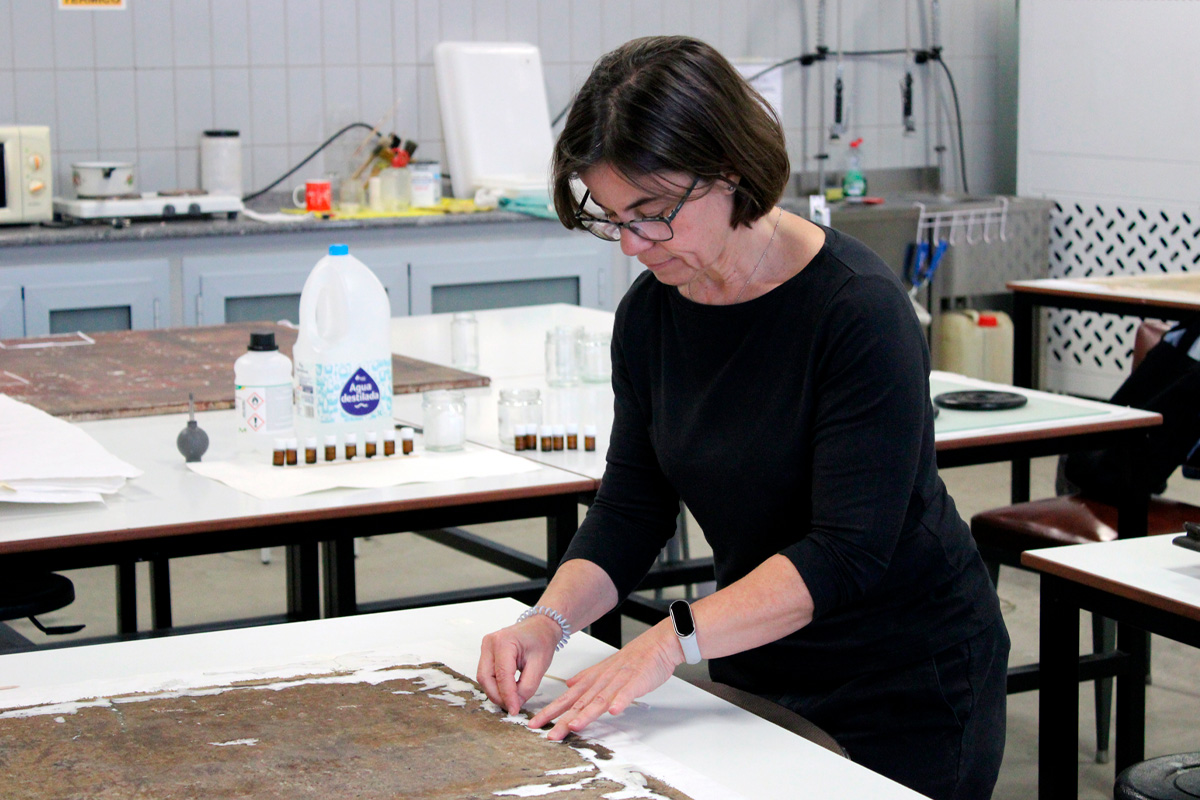
The General Research Support Service (SEGAI) at the University of La Laguna offers scientific, technical, and instrumental support to research projects both within the university and from other institutions. One of its most prominent units is the Service for the Analysis and Documentation of Works of Art (SADOA), dedicated to the study and conservation of heritage using specialized non-invasive techniques and high-precision equipment.
Although the service's origins predate this, its current structure was established in 2017 with the arrival of the team that manages it today and its relocation to the Faculty of Fine Arts. Elisa Díaz González, who heads the service, and Elvira Isora García Vacas, its technician, explain that, despite its name, its focus extends beyond traditional works of art: "We are open to heritage in general." "We conduct material studies of the works using techniques such as multiband photography, which allows us to analyze underlying layers, for example, of a painting, always without physically intervening in the artwork," says García Vacas.
Multiband photography is one of SADOA's key tools. For this, they use modified cameras such as the Fujifilm XT1 IR and infrared reflectography systems. "We also have the Artist, Art-Innovation, a multispectral camera which, although older, allows us to reach greater depths in the infrared," notes Díaz González. In addition, they use the Nikon D850 for general photography and photogrammetry, as well as an Artec EVA-40 3D scanner for high-resolution three-dimensional digitizations.
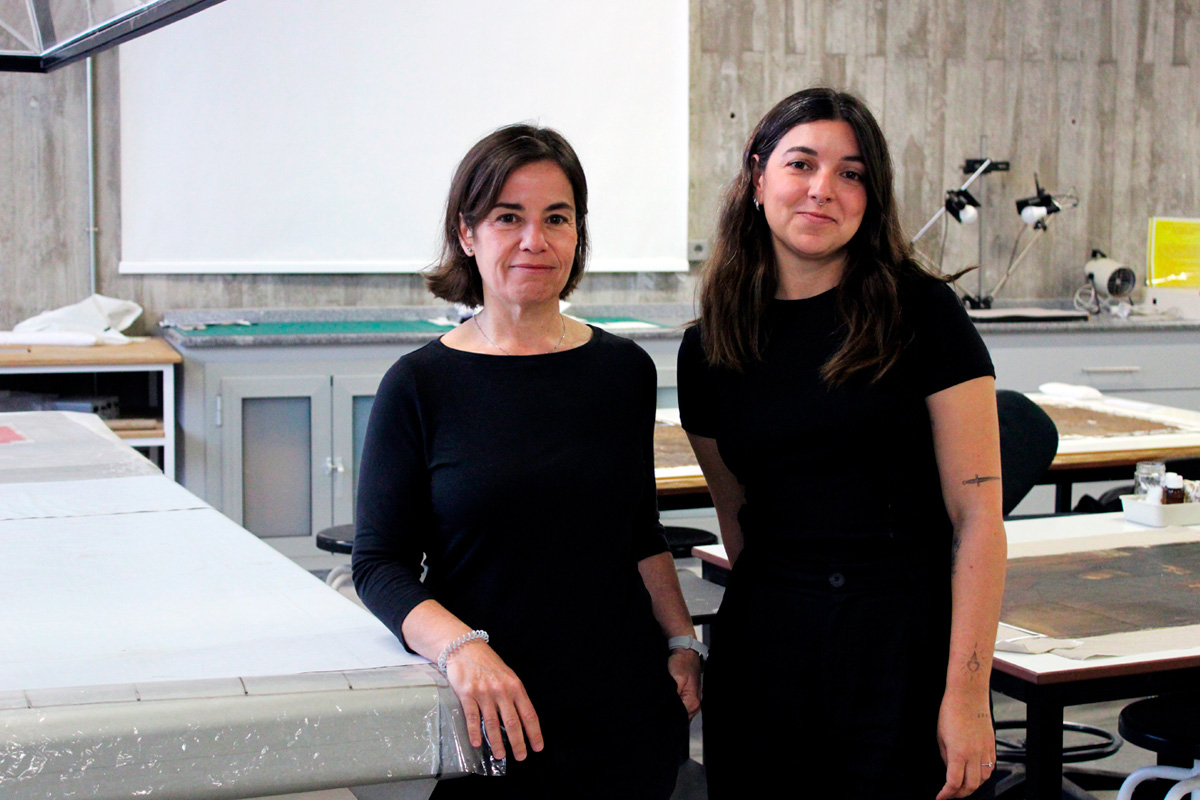
Elisa Díaz, director, along with Elvira García, service technician.
In recent years, the service has incorporated active conservation treatments. One of the most notable is the Isosep Mistral D Mobile anoxia disinfection, a technique that modifies the atmospheric conditions surrounding a property to halt insect and fungal infestations: “It’s a non-invasive treatment,” says García Vacas. “Unlike others, which can be harmful to health,” he clarifies. Acquired in September 2023, according to Díaz González, this is the only equipment of its kind currently available in Tenerife, which has increased the demand for this type of intervention.
SADOA primarily focuses on providing services to conservation and restoration professionals, as well as cultural institutions and individuals. “We collaborate with conservators who lack access to specialized equipment, such as anoxia equipment or low-pressure tables. We handle that specific aspect of the treatment,” explains García Vacas. “We also work with institutions that need to document their collections or implement conservation measures,” adds Díaz González.
Projects
Among their projects are the disinfection of the Nava carriages, located at La Casa Lercaro in La Laguna, and the treatment of the frames of a large painting belonging to the church of Taganana, as part of a comprehensive restoration project for the building. They have also collaborated with the Casa de Colón in Gran Canaria, where they carried out a technical study. in situ They carried out a conservation project on a painting, transporting the team from Tenerife. Similarly, the service traveled to Fuerteventura to examine a work located in a chapel managed by the Diocese of the Canary Islands, which is entirely decorated with mural canvases, thanks to the intervention of a conservator. They also participated in a transfer project for the conservation of artworks from the Institute of Astrophysics of the Canary Islands.
The team also participates in research projects, some of them led directly by the service itself: “We don’t just collaborate, we are also principal investigators on several projects,” emphasizes the head of SADOA. These include the documentation of the ULL's art collections, which range from painting to contemporary photography, as well as studies on the biodeterioration of cultural assets in collaboration with the Genomics Service of SEGAI, and the development of customized supports for preventive conservation in conjunction with SEGAI's Digital Design and Fabrication Laboratory.
Thus, cross-disciplinary collaboration becomes one of the keys to its operation. “We are 100 transdisciplinary % team members,” says Díaz González. “We create the technical images, but a complete diagnosis requires many perspectives,” she adds. In this regard, SADOA collaborates with various SEGAI services, such as Infrared Spectroscopy, which helps identify materials like pigments, binders, and varnishes, and Electron Microscopy, which provides information on the structure and composition of the layers in the pieces. The Electronics Service, for its part, is responsible for the maintenance and adaptation of the equipment.
SADOA has specific funding within the budget of the SEGAI of the ULL and also participates in public calls to improve and renew its technical equipment, as is the case of the MINERVA project, which is part of the Canary Islands Development Fund of the Government of the Canary Islands.

 Spanish
 English
 French