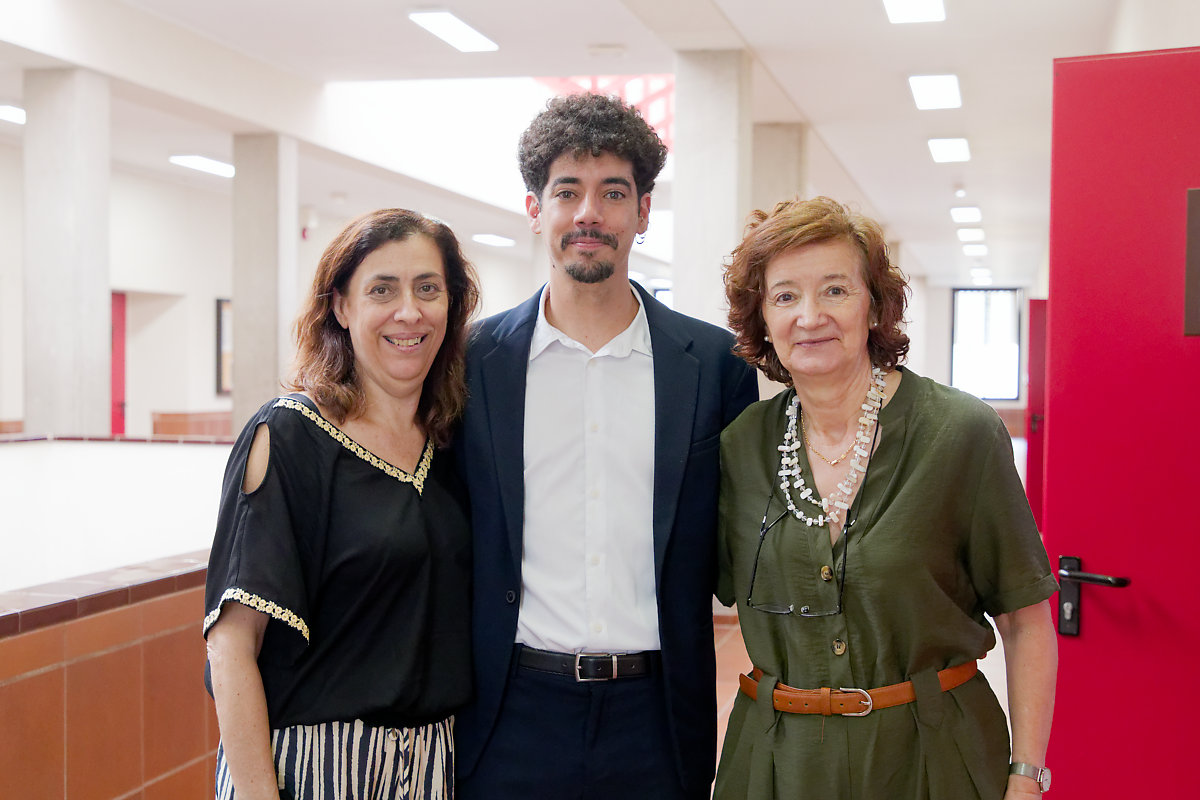
The Chemistry Department of the University of La Laguna hosted this week the defense of the doctoral thesis of the researcher Sergio Fajardo Rodríguez, The thesis, titled “Graphene-based catalysts for the oxygen reduction reaction in electrochemical energy conversion devices,” received the highest possible grade. The work was led by professors Elena María Pastor Tejera from the University of La Laguna and María del Pilar Ocón Esteban, from the Autonomous University of Madrid, is part of the Doctoral Program in Chemistry and Chemical Engineering, with international mention and the modality of compendium of publications.
The research stems from an urgent need: to decarbonize the global energy system. One of the most promising technologies in this process is electrochemical devices such as fuel cells and metal-air batteries, capable of converting chemical energy directly into electricity with high efficiency and without polluting emissions. However, a recurring barrier is the need to obtain highly efficient and durable catalysts to facilitate a key reaction in these systems: the oxygen reduction reaction. Until now, this function has been fulfilled by catalysts based on platinum, a scarce, expensive, and unsustainable metal.
In his thesis, Sergio Fajardo has developed an innovative alternative: chemically modified graphene-derived materials combined with non-noble metals such as cobalt and manganese. These new catalysts not only reduce cost and environmental footprint but also offer electrochemical performance comparable to or better than traditional materials. As he explained during the presentation, the graphene used is chemically generated with low purity compared to that used in electronic applications. "What we're looking for are imperfections, because it's in those defects where the electrochemical reactions actually occur," the author explained.
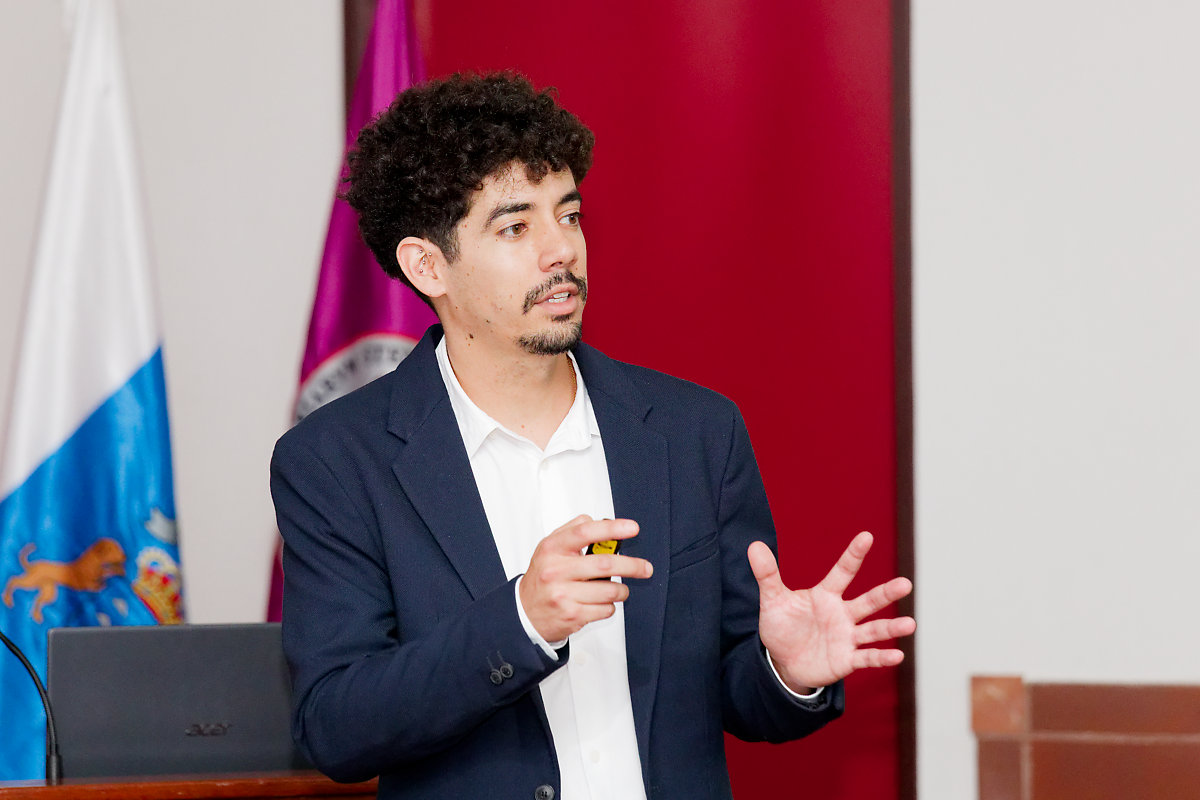
Sergio Fajardo, during the defense of his doctoral thesis.
Through controlled chemical processes, nitrogen, oxygen, or sulfur atoms are introduced into the graphene structure, generating active sites that, in combination with transition metals, improve both the catalytic activity and the stability of the system. One of the key achievements of the thesis has been demonstrating that the incorporation of manganese into cobalt-based systems significantly increases the material's durability, an essential property for its use in real-world devices. Furthermore, the possibility of recovering catalytic activity after degradation was confirmed, opening the door to recycling strategies within the framework of the circular economy.
“With these materials, we want to contribute to a realistic and affordable energy revolution, with technologies based on abundant, recyclable, and efficient materials,” Fajardo Rodríguez stated in his defense. In their experiments, the new catalysts have demonstrated competitive electrochemical performance, good current density, and, above all, resistance to aging and demanding conditions.
The work includes several scientific publications in specialized journals and was developed in part in collaboration with European laboratories, which has earned it the International Doctoral Mention. The thesis supervisors emphasized the scientific rigor of the work and its medium-term industrial applicability.
Although industrial production still requires further research, the techniques used are easily scalable to a semi-industrial level, which allows us to think about future real applications in sectors such as energy storage, electric mobility or hydrogen-based backup systems.
This work represents a concrete step towards a future where clean energy doesn't depend on expensive or hard-to-access materials. Using chemically modified natural graphite—the same component of pencils—and abundant metals, promising catalytic materials have been obtained that could facilitate the development of new generations of electrochemical devices. In the doctoral candidate's words, "We're not just talking about doing science, but about creating viable tools for a real energy transition, with cheaper, more durable, and recyclable technologies.".

 Spanish
 English
 French