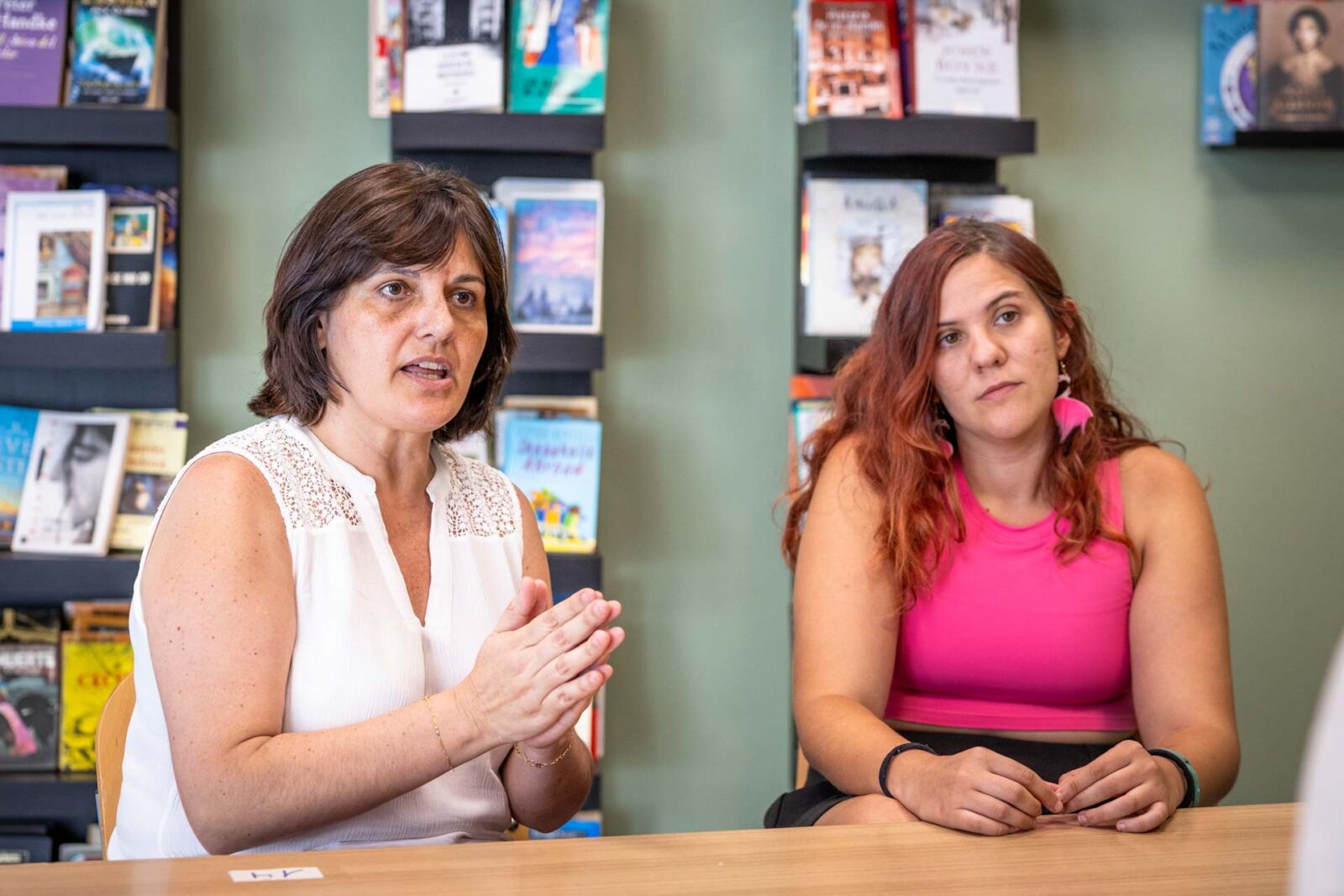
Generative Artificial Intelligence (AI) can be highly effective not only for solving math problems, but also for helping to formulate and adapt them to any type of student, which can be very useful for teachers at different educational levels. Professor Josefa Perdomo Díaz, from the Department of Mathematical Analysis at the University of La Laguna, is leading a course at the Adeje Summer University that addresses precisely this potential, adding a multicultural component. The expert acknowledges that it is a useful tool, but one that must be used critically: “We know that, although it evolves rapidly, AI has its limitations, and in the course we want to emphasize the importance of reviewing, being critical, and analyzing the answers it provides.”.
The course proposes leveraging generative AI to construct mathematical problems that also take advantage of the multicultural contexts found in the classroom and that offer multiple solutions, giving all students the opportunity to contribute and even offer different types of solutions. “This means that, regardless of your cultural background, you can contribute an answer from your own perspective,” explains Perdomo. “One of the challenges that multiculturalism brings to the classroom is a lack of knowledge about other cultures. These problems allow specific characteristics related to celebrations, family gatherings, or family structure to emerge and be discussed. They allow for different cultural representations in the classroom through mathematics.”.
Sara Embid Solano, also from the Department of Mathematical Analysis, is another of the course instructors and explains these types of problems, for example, when addressing the family as a topic: “Let's say a family has three members and their average age is 30. Who are these members? To answer that, you have to think about balancing that age. If there were two members, one could be 50 and the other 10. Well, the same applies to three. From there, multiculturalism can emerge by considering a family with a father, a mother, and a child; or two parents and a child; or a grandparent and a partner… In this way, all of this can be discussed, and the mathematical concept—in this case, the arithmetic mean—is underlying it. The contribution of artificial intelligence is that, based on this model, you can ask it to solve similar problems for other situations.”.
Thus, AI is a support tool for formulating problems of this type, given that one of the difficulties for teaching staff at all educational levels is to find challenging activities for their students that go beyond the mere mechanical application of knowledge and lead them to seek strategies and other ways of responding to different situations.
As already mentioned, this contribution of AI must be approached with a critical eye. As Embid Solano explains, “artificial intelligences are being treated as an authority, and they lack that authority,” since their responses depend on the data with which they have been trained. “Poor quality data yields poor responses. The problem with the platforms is that many are freemium, with a free version and a paid version after reaching a certain number of queries.”.
Therefore, during the course, students have been taught to use ChatHub, a comparison tool for different AI models: Grok, Gemini, OpenAI (the company behind ChatGPT), the Chinese platform Qwen, Duke.AI, Perplexity, and others. “A year ago, I did a comparison of platforms, and what I considered the worst model at the time is now the best. Things are moving so fast! Google has really stepped up its game, and now Gemini even has a specific section for education. If you have an account, you can create materials with astonishing ease, even entire applications. It generates the HTML, it generates the code, and you have a website.”.
Of course, the use of AI naturally raises concerns, but for Josefa Perdomo, there's no alternative but to embrace this technology, because students are already doing so. “The risks we run if we allow the use of AI are the same as if we allow any other resource. Students used to copy too: from books, articles, their classmates…” Furthermore, there can be legitimate uses, as Sara Embid points out: “If you explain to me how you've used it, I can assess whether the use is appropriate or not.”.
In fact, both point out that the public has been using AI for many years without realizing it, as it's a technology that has been around since the 1950s, and generative AI, which emerged in 2022, is just a new phase: “Spell checkers use AI; it's a use that isn't talked about, but it's there. Even those who say they don't use it have, and they don't know it: WhatsApp already tells you what the next word is. It's undeniable that it's there.”.

 Spanish
 English
 French