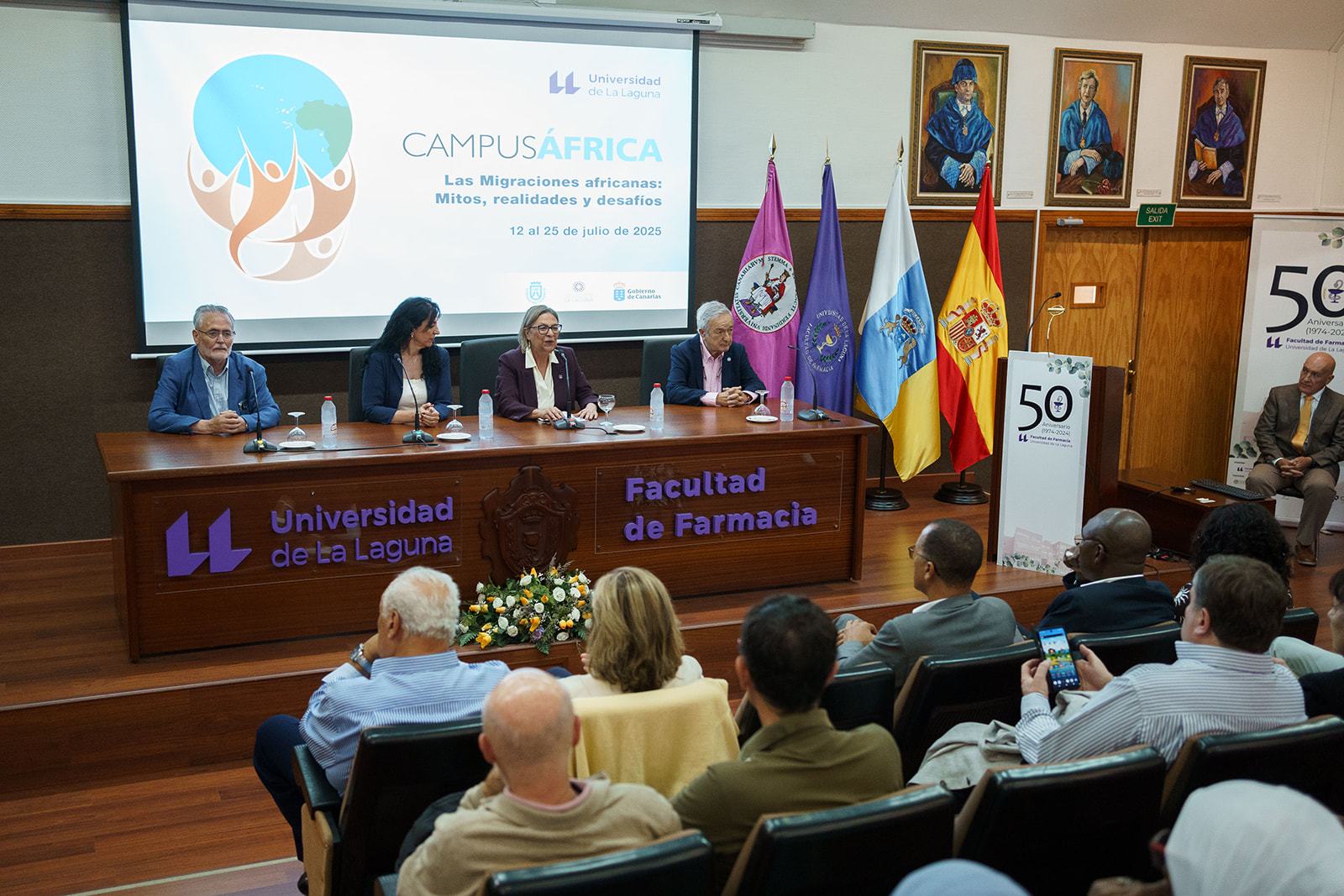
Africa Campus The university paid a heartfelt tribute to Manuel Elkin Patarroyo, who passed away in January of this year, in recognition of his scientific work and his connection to the University of La Laguna. This relationship culminated in his being awarded an honorary doctorate in 1998. The moving ceremony highlighted his spirit of solidarity, his commitment to the most disadvantaged social classes, and his desire to change the world through science. This drive led him to discover the first synthetic vaccine against malaria, SPF-66, which he generously donated to the WHO.
Manuel Elkin Patarroyo was also one of the first leading scientists to readily link his name and career to the Campus Africa project from its inception. His participation in several editions served to illustrate and share his knowledge and research with the scholarship recipients. Basilio Valladares, professor emeritus at the University of La Laguna and co-director of Campus Africa, announced the institutionalization of the Manuel Elkin Patarroyo Conference as a key event in the program for future editions. The first lecture given under this recognition was: "The Synergy of Tropical Medicine with One Health," by Dr. Óscar Noya.
“For us, it is an honor,” he stated, “that Manuel Elkin Patarroyo’s name has been linked to this project since its inception. With this gesture, we simply want that relationship to continue despite his physical absence, and for his spirit and example to inspire our scholarship recipients,” noted the co-director of Campus Africa.
Valladares also wanted to acknowledge the crucial role the Colombian scientist played in the creation of the current University Institute of Tropical Diseases and Public Health of the Canary Islands. “He inspired us at a time when we were exploring ways to establish this research institution in the Canary Islands. He already had his own institute in Colombia, and when we shared our idea with him, he not only encouraged us but later committed to collaborating by sending us materials to support our research.”.
For her part, the Vice-Rector for Internationalization and Cooperation, Inmaculada González, gave a brief overview of Patarroyo's academic career, emphasizing his influence on the development of research at the University of La Laguna. The Dean of the Faculty of Pharmacy, Susan Abdalá Kuri, as host of the event, expressed her excitement at receiving this recognition at the Faculty of Pharmacy and highlighted the scientific legacy he leaves to the community.
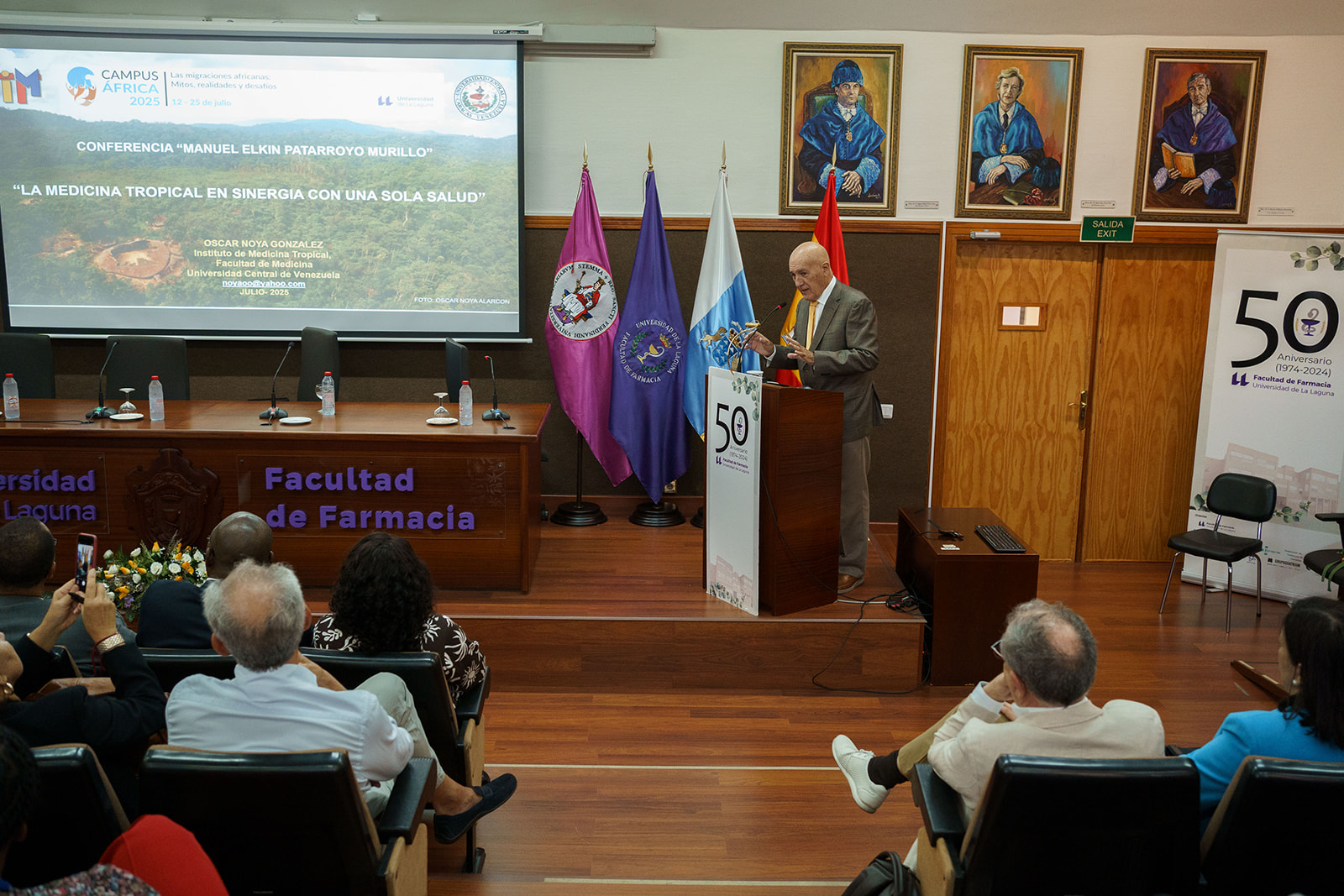
Dr. Oscar Noya.
The synergy of tropical medicine
Noya began her presentation by outlining the 'One Health' concept as a global strategy linking human and animal health, referencing the rise in zoonotic diseases worldwide. At least 60% of emerging diseases have this origin; a clear example is COVID-19, which caused over 7 million deaths and a significant economic impact. Currently, Noya warned, we have a new pandemic underway, H5N1, which has led to the culling of 49 million birds and the deaths of 70 people in the US, in addition to having a major impact on wildlife. "If it jumps species and reaches humans, virologists indicate that it could be much more serious than what we experienced with COVID-19." This new disease is joined by Chagas disease, dengue fever, and malaria, which are currently experiencing a resurgence.
Among the challenges, Noya pointed to climate change as a key issue that must be addressed urgently, since rising temperatures are causing disease vectors to spread to areas where they were not previously found. “Dengue-carrying mosquitoes have already been detected in Spain,” he stated, “in Galicia, for example, something that seemed unthinkable.”.
The tropics have the highest rates of malaria transmission and mortality, due to the high biodiversity concentrated in this region. Noya warned of the current resurgence of malaria, with 263 million cases and 597,000 deaths worldwide in 2023. “The number of primates that act as vectors has increased; there are now four species, and this influences the spread of the disease. Furthermore, mining is one of the factors contributing to the increase in malaria due to the proliferation of vectors in these areas.”
“Tropical medicine has always been One Health because we have always worked with animal and environmental health,” concluded the professor in charge of the parasitology department at the UCV School of Medicine.
The day ended with a round table discussion in which doctors Manuel Carlos López, Santiago Mas Coma and Antonio Muro participated, recounting some of the experiences shared with Manuel Elkin Patarroyo.

 Spanish
 English
 French