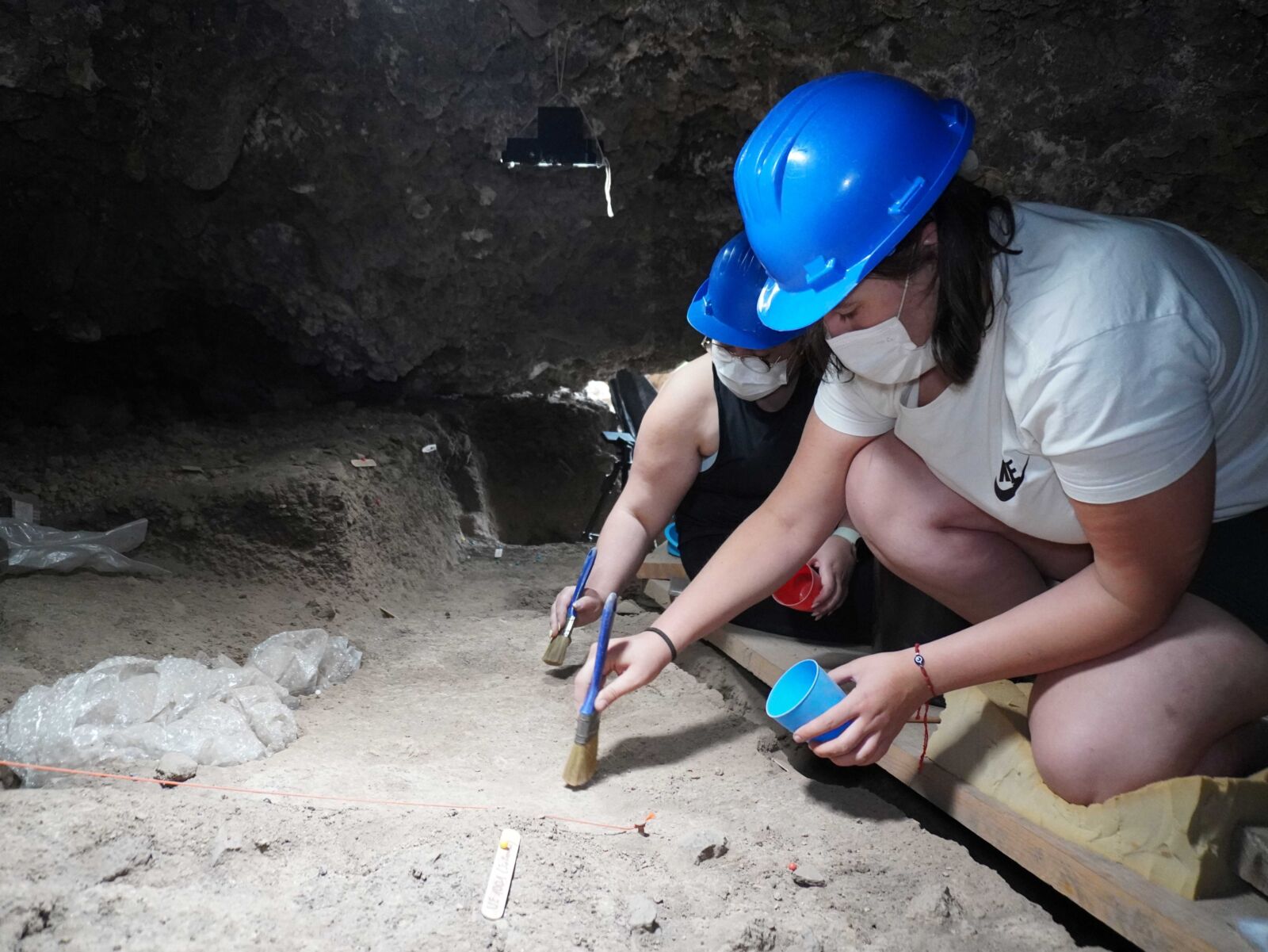
The fourth archaeological excavation campaign at the Cueva de Los Cabezazos (Tegueste) began this July with the aim of establishing a precise chronology of the first aboriginal occupation of the Barranco de Agua de Dios, as well as documenting the sequences of settlements. This intervention, led by the archaeologist Paloma Vidal Matutano, The project, from the University of La Laguna, funded by the Government of the Canary Islands, the Ministry of Science, Innovation and Universities and with the collaboration of the Tegueste City Council, reinforces the uniqueness of this site as a strategic case study for the archaeology of Tenerife.
One of the main hypotheses that has emerged from this new excavation is that the Cueva de Los Cabezazos (Cave of the Heads) may have been used simultaneously as a living space and as a corral. This idea is based on the spatial differentiation observed within the cave, since in one area "fauna remains predominate, especially bones linked to food consumption," while in the other "items of daily use have been recovered, such as ceramic fragments and pieces of lithic industry," explains Emilio Vacas, co-director of the research.
However, it cannot yet be confirmed whether these uses were contemporaneous or occurred at different times during the occupation. Although everything suggests that it is a site of mixed use, it remains to be determined whether the Guanches actually lived with their livestock inside the cave or whether this cavity had several uses over the centuries.
Among the most significant findings of this campaign are the remains of human, pig, and dog excrement, according to the research team. Through genetic DNA analysis, it will not only be possible to pinpoint the species, but also to obtain valuable information "about the health, diet, and living conditions of those living beings that inhabited the area around the Agua de Dios Ravine," Vacas explains.
It is worth noting that the Cueva de los Cabezazos has established itself as “one of the archaeological sites with the highest number of dates in Tenerife,” says Salvador Pardo, co-director of the research. Until 2023, there were five dates, but with the reactivation of archaeological excavations, there are now “more than twenty new dates that confirm continuous occupation from the beginning of the 7th century until the European conquest in the 15th century,” explains the archaeologist.
In this regard, the team seeks to identify the oldest occupation levels through stratigraphic surveys that will allow them to expand the excavated area. These new actions will not only contribute to a more complete understanding of the activities carried out at the site, but also to "deepen as far as the stratigraphic thickness allows," since, according to Luis Diego Cuscoy's research from the 1970s, "the top of the cave had been reached, but current excavations have shown that there are still levels to explore," Vacas explains.
However, the project has a clearly multidisciplinary and interinstitutional character. In addition to the ULL, with Paloma Vidal, Salvador Pardo, and Emilio Vacas leading the project, researchers from the Autonomous University of Barcelona, the University of Valencia, and the University of Basel in Switzerland are participating; the latter is collaborating on the study of the lithic industry from morphotechnical and traceological perspectives.
As in previous years, the research also serves an important educational purpose, with more than a dozen History students from the University of La Laguna (ULL), from various years of study, volunteering in both fieldwork and laboratory work. In fact, two Master's theses focused on this archaeological site have already been defended, demonstrating the academic value of this type of practical experience.
Open House
Aware of the importance of bringing science closer to the public, the Tegueste Town Council has organized an Open Day since the first season. The activity, entitled “Open for Excavation,””, The event will celebrate its third edition this Saturday, July 26, between 8:00 a.m. and 1:00 p.m. During the day, guided tours will be offered in small groups to the cave itself, where the excavation process and the latest findings of this campaign will be explained.
The initiative also includes an educational space in St. Mark's Square where some of the recovered archaeological materials, replicas, and tools will be displayed to provide firsthand knowledge of how the pieces are cataloged and studied in the laboratory. The aim is to foster public interest in archaeological heritage and involve citizens in projects funded with public money.
Those interested should register beforehand at the Tegueste Tourist Office, by calling 922316102 or writing to turismo@tegueste.org.
(Note and image provided).

 Spanish
 English
 French