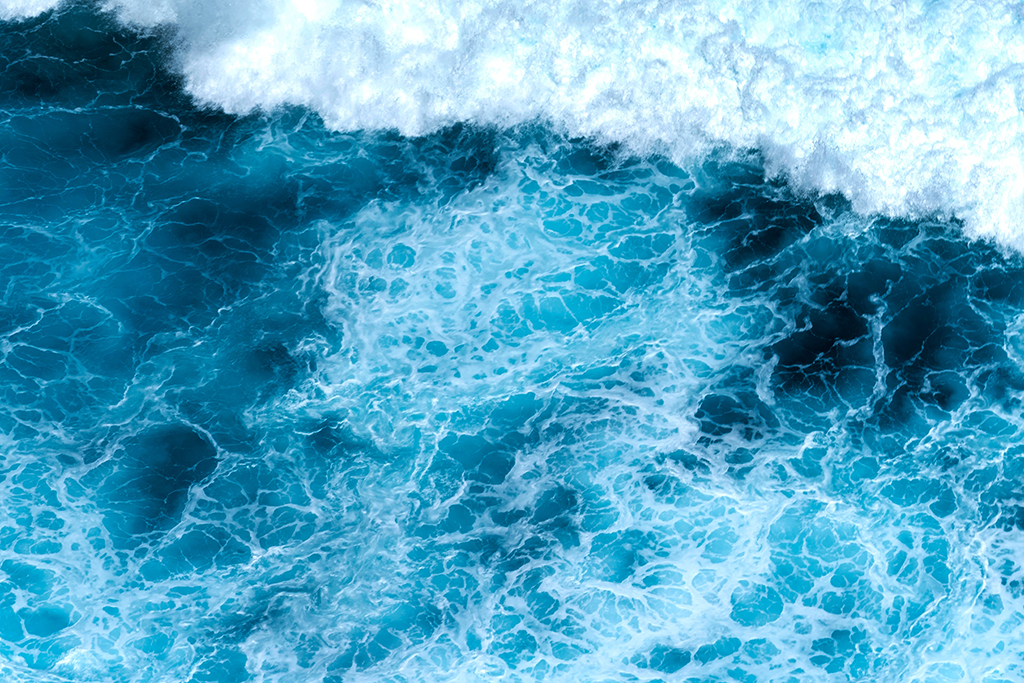
The arrival of swells originating in the Southern Hemisphere to the Canary Islands is more frequent than one might think. These swells arrive as a long-distance wave, after traveling for several days, with much lower wave heights and very long wavelengths than at their source. These two characteristics mean that, on the one hand, they are masked by other, higher waves generated locally, and on the other hand, that despite their low height, they carry enough energy to cause flooding and damage to beaches and coastal promenades.
This interesting 'trans-hemispheric' swell was the subject of Emilio Megías' doctoral thesis, whose director was the professor of the Department of Civil, Nautical and Maritime Engineering of the University of La Laguna Manuel García Román. Both researchers are the authors of this article published in one of the scientific journals of the oldest College of Engineers in the world, the Institution of Civil Engineers British (ICE), of which Emilio Megías is a member.
In this article, the authors analyze the energy of this wave and its potential harnessing through the use of wave energy converters, known by their acronym WEC (Wave Energy Converter). The novelty of this study lies in the simple methodology employed to separate this type of mature wave and estimate its energy.
This has allowed researchers to determine its contribution to the overall state of the sea, representing 6.61 TP3T of the total wave energy potential in the area. The research is based on 15 years' worth of data (2008-2022) from the buoy that Puertos del Estado (Spanish Port Authority) has anchored in deep waters south of Tenerife, supplemented with data from a nearby virtual buoy, SIMAR.
Wave energy depends primarily on its period and height. Waves with long periods, such as those studied here (peak periods greater than 14 seconds), are expected to contain a large amount of energy, but this is diminished by their small heights, typically less than 1 meter. Therefore, after in-depth study of these waves, and considering the current state of knowledge, it can be stated that their commercial exploitation is not yet viable.
But their knowledge is interesting for considering the possible joint use of the waves existing on the southern facades of the islands with other renewable energy sources, such as floating offshore wind in deep waters, the researchers say.
Another result of this work has been the estimation of the relationship between the energy period Te, and the peak period Tp for the study area. This coefficient is very useful when direct spectral data are not available to obtain the energy period, a variable necessary for calculating wave energy.

 Spanish
 English
 French