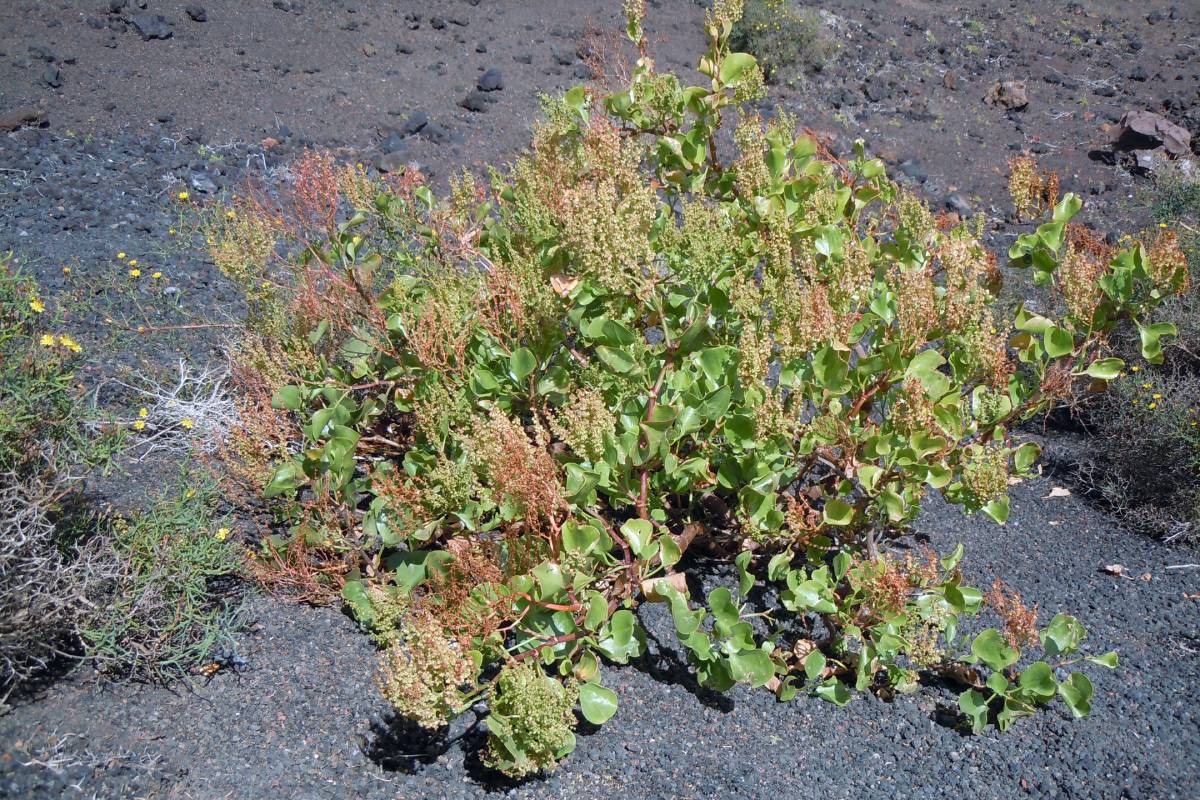
An investigation recently published in the magazine Perspectives in Plant Ecology, Evolution and Systematics which includes the participation of Jonay Cubas, A professor and researcher in the Department of Botany, Ecology, and Plant Physiology at the University of La Laguna challenges one of the most widely accepted hypotheses about herbivory-related invasions. His findings underscore the importance of rethinking how endemic plants of the Canary Islands adapt to their environment, especially when they establish themselves in new areas of the archipelago.
This study reveals that the vinegar cruet (Rumex lunaria*Solanum spp.*, a plant native to La Palma, El Hierro, La Gomera, Tenerife, and Gran Canaria, shows higher levels of herbivory and foliar defenses in Lanzarote, where it was introduced in the 20th century, compared to the islands where it is endemic. These results contradict the so-called enemy release hypothesis, which suggests that invasive species typically suffer less insect herbivory in non-native areas, thus providing them with an ecological advantage.
On the contrary, the research indicates that the sorrel is not only freed from its herbivorous enemies in Lanzarote, but also develops higher levels of defensive compounds (phenols, flavonoids) and thicker leaves, in an effort to cope with the increased herbivorous pressure from insects.
The study, which involved sampling 40 populations (32 populations on the islands where sorrel is native and eight non-native populations on Lanzarote) and analyzing nearly 2,000 leaves, was conducted on six islands: five where the species is native and one where it was introduced, Lanzarote, in the 1940s as fodder for goats, due to its tolerance to drought and volcanic soils. The research shows that sorrel suffers greater insect damage on Lanzarote, and that the plant responds with common defense mechanisms, which contradicts traditional expectations regarding invasive species.
The research also analyzed environmental factors that could influence herbivory and defense traits, such as climatic conditions and soil characteristics. As expected, Lanzarote presented more extreme conditions, including higher average annual temperatures, lower rainfall during the driest months, and denser soils.
However, the statistical models used indicated that abiotic differences did not explain the observed variations in herbivory or foliar traits. Furthermore, no significant relationships were found between levels of defensive compounds and herbivory damage, suggesting a more complex dynamic than classical models account for.
The study's findings have a significant impact on research into biological invasions, especially on islands, which have historically been viewed as natural laboratories for understanding these phenomena. In particular, they challenge the validity of theories such as the release of natural enemies or the previously reduced defenses hypothesis, which have been primarily developed in continental contexts and with exotic, non-native species.
The research highlights the importance of considering island endemics as key players in invasion dynamics, since their behavior in new island environments can be as complex as that of non-native species. The case of the sorrel demonstrates that even a plant adapted to island conditions can develop new defensive strategies when colonizing another island within the same archipelago.
This research has also involved the participation of the Biological Mission of Galicia; the Department of Molecular Biodiversity and DNA Bank of the Canary Botanical Garden Viera y Clavijo – CSIC Associated Unit; the Pablo de Olavide University; the GMI SLP Engineering Studio; the Institute of Natural Products and Agrobiology; the Cabildo of La Gomera; and the Autonomous University of Yucatán (Mexico).
Scientific Culture and Innovation Unit (Cienci@ULL)

 Spanish
 English
 French