The Dent-1 disease It affects the kidneys and is X-linked, primarily affecting males, with females being carriers. There are just over 250 known cases worldwide, and although it appears in childhood or adolescence, it can progress to end-stage renal disease in the patient's third or fourth decade of life. Clinically, it is characterized by urinary loss of low molecular weight proteins (LMWP), hypercalciuria, nephrolithiasis, nephrocalcinosis, and, occasionally, rickets. As with most rare diseases, there is no cure, and care is limited to managing symptoms.
Elena Ramos Trujillo, A professor in the Nutrition and Food Science department at the University of La Laguna and a researcher at the Nuestra Señora de Candelaria University Hospital, she has been investigating this disease for several years, and in fact, her doctoral thesis, defended in 2016, was already on this topic. Recently, she has participated in a study that has so far generated various cell models to test potential therapeutic strategies, as well as a specific mouse model to address this pathology.
As is often the case with rare diseases, the dedication of affected families is usually a key factor in driving research. The Ramos Trujillo laboratory is a reference laboratory for the molecular diagnosis of Dent-1 disease through the platform RenalTube, And that's how he was able to identify the p.V523del mutation in the gene Clcn5 in Nacho, a Catalan child with a particularly severe phenotype of the disease.
His family contacted the research team as soon as he received the diagnosis and created the Spanish Association for Dent's Disease (ASDENT) to raise funds for the research. “Her mother, Eva Giménez, has fought tirelessly and thanks to her efforts we were able to create this animal model,” explains the researcher.
Animal model
The mouse knock‑in The (KI) mouse used in this research has the p.V523del mutation in the Clcn5 gene, detected by the research group at the academic center, and which is consistent with the symptoms caused by Dent-1 disease. “Our KI mouse is able to express the mutated protein, unlike the models knock‑out which completely lack it, allowing us to investigate drug therapies. The KI mouse exhibits the key symptoms of Dent-1 disease: high proteinuria, calcium and phosphorus loss, and polyuria, making it an optimal tool for preclinical trials,” explains the researcher.
Since its inception, this animal model has been used to test various compounds already approved for human use, as part of a drug repurposing strategy to accelerate the translation of the research group's findings into clinical practice. "To date, we have identified three molecules capable of significantly reducing PBPM and some of the other clinical characteristics of the disease, such as urinary calcium and phosphate loss.".
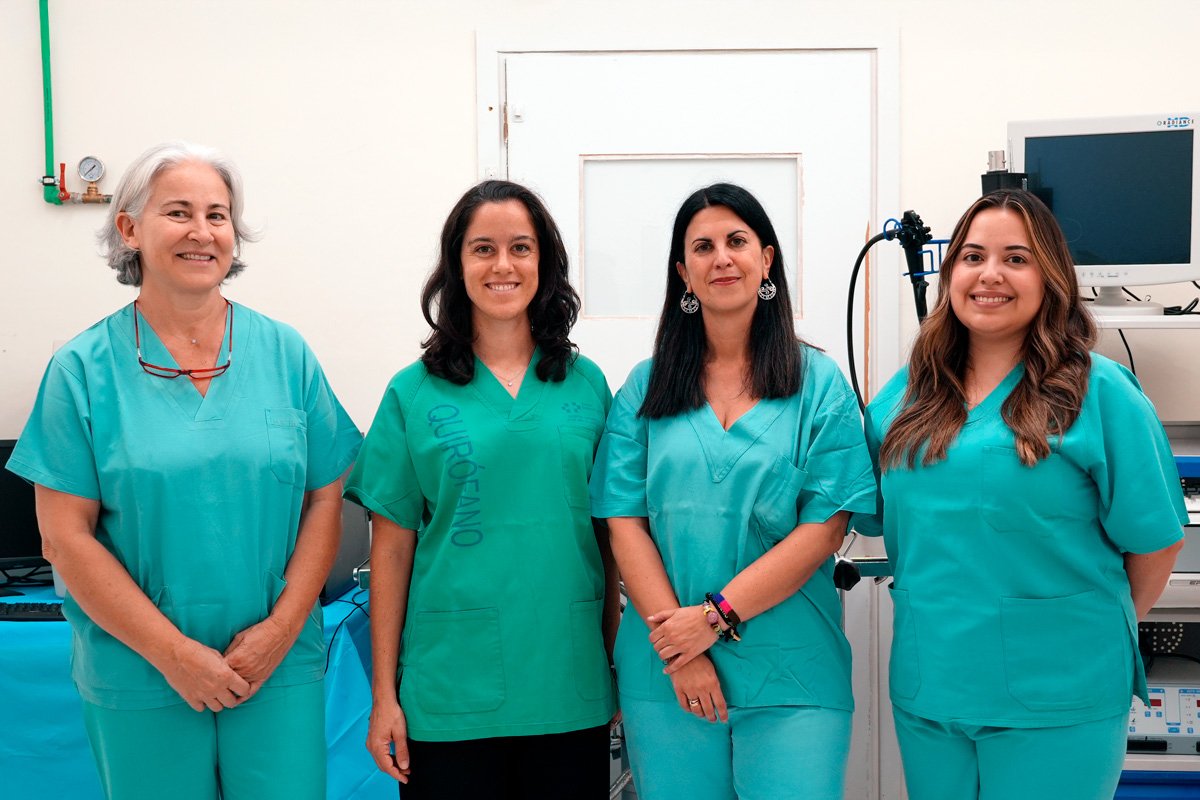
From left to right, María Rosa Arnau, Carolina González Navasa, Elena Ramos Trujillo and Glorian Mura Escorche.
These molecules are sodium 4-phenylbutyrate (4-PBA), a chemical chaperone that, when administered orally, reduced proteinuria by up to 77% and showed improvement in hypercalciuria; tauroursodeoxycholic acid (TUDCA), a bile acid with cell-protective effects, which, when administered intraperitoneally, decreased proteinuria by 56% and improved hypercalciuria and phosphaturia; and 3-indolepropionic acid (IPA), previously studied in neurological pathologies for its effects on metabolism, which reduced proteinuria by 75% and was able to slow the progression of calcium loss.
The work with the IPA is the most recent study carried out, and it has been developed by Carolina González Navasa as part of her doctoral thesis, directed by Doctors José David Machado Ponce, from the Pharmacology Department of the University of La Laguna, and Elena Ramos Trujillo herself. This work was recently awarded the José Simón González Prize for best oral presentation at the XLVIII National Congress of the Spanish Association of Pediatric Nephrology (AENP), held this May in Santa Cruz de Tenerife.
This work is mainly carried out in the Research Unit of the University Hospital Nuestra Señora de Candelaria, by the group led by Doctors Félix Claverie Martín and Elena Ramos Trujillo, whose line of research is called “Hereditary kidney diseases and alterations of pre-mRNA”.
We have also benefited from the collaboration and funding of the University of La Laguna over the years through various research and predoctoral training contracts, as well as from the support and scientific advice of the staff of Stables and Animal Facility of the academic institution, especially its director María Rosa Arnau.
This line of research is supported and funded by ASDENT, as well as the University of La Laguna, the Canary Islands Foundation Institute of Health Research of the Canary Islands (FIISC); the Carlos III Health Institute (ISCIII), the Dent Disease Foundation (DDF) of the United States and the Canary Islands Agency for Research, Innovation and the Information Society (ACIISI) in collaboration with the European Social Fund Plus.

 Spanish
 English
 French