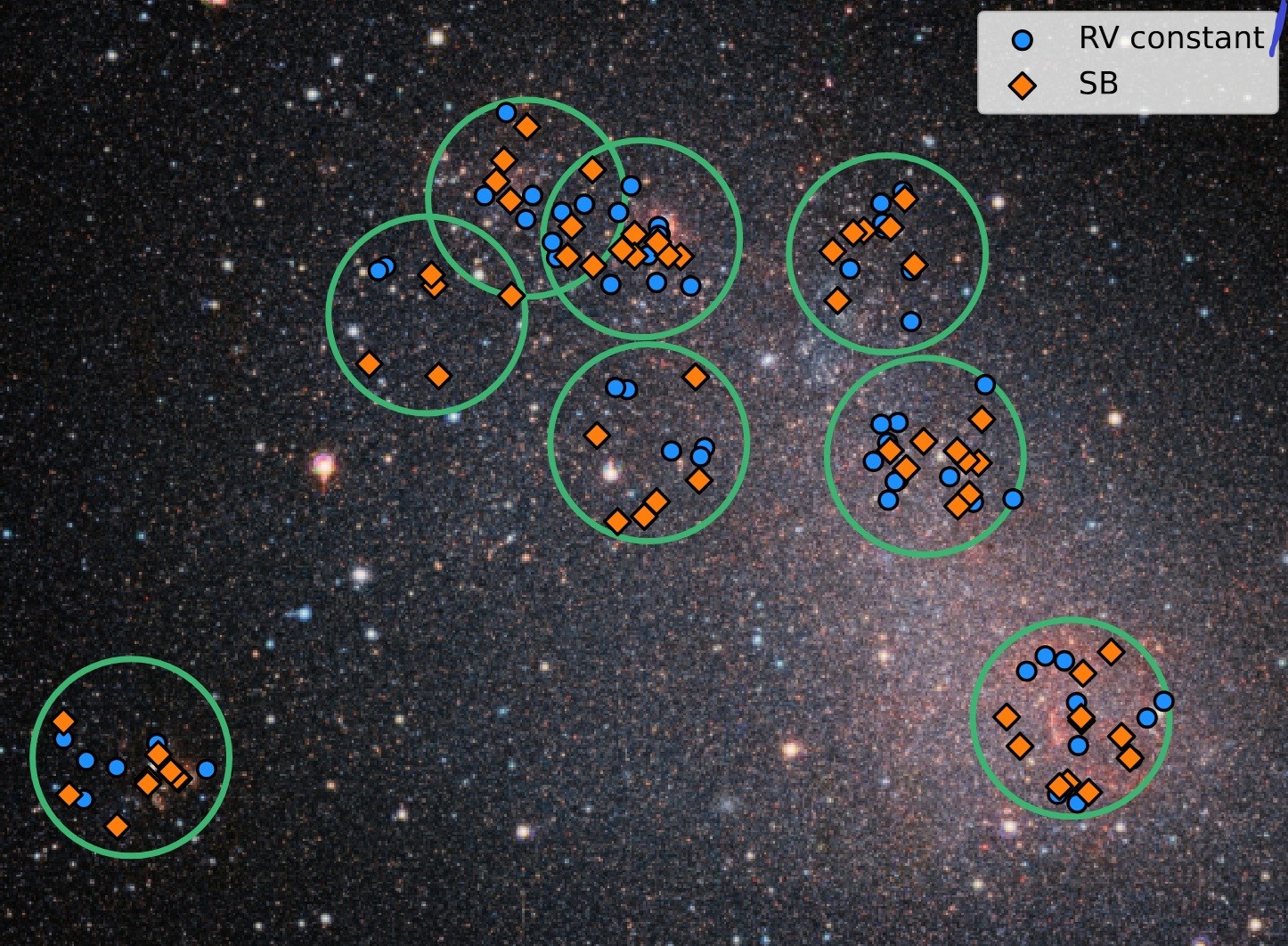
Massive stars in metal-poor galaxies often have close companions orbiting them in what are known as binary systems, just like stars of similar mass in our Milky Way, which has a higher metal content. This has been discovered by an international scientific team that includes researchers from the Canary Islands Institute of Astrophysics (IAC) and the University of La Laguna. The study used... Very Large Telescope European telescope, located in Chile, to monitor changes in the velocities of massive stars in the Small Magellanic Cloud. The research is published in Nature Astronomy.
For the past twenty years, astronomers have confirmed that many massive stars in the Milky Way typically share their lives with close companions, with whom they dance for a lifetime. The interaction between these star pairs has also been shown to play a crucial role in their evolution. However, until now, it was unclear whether this same behavior occurred in massive stars within metal-poor galaxies. The new research confirms that it does.
«We used the Small Magellanic Cloud as a time machine,» explains Hugues Sana of KU Leuven (Belgium), first author of the paper. «The Small Magellanic Cloud has a metallicity environment representative of that of distant galaxies when the Universe was only a few billion years old,» he adds.
“Studying massive stars outside the Milky Way is difficult because the stars are very far away and we receive little light from them,” they commented. TOmer Shenar and Julia Bodensteiner, who jointly lead the BLOeM project from the universities of Amsterdam (Netherlands) and Tel Aviv (Israel), respectively, and from which this work stems, used the FLAMES multi-fiber spectrograph on the Very Large Telescope at the European Southern Observatory in Chile. FLAMES has 132 optical fibers, each of which can be directed at a different star, allowing for simultaneous observation.
Acceleration and deceleration
Over a three-month period, researchers observed the acceleration and deceleration of 139 massive O-type stars at nine different times. These stars have masses between 15 and 60 times that of our Sun. They are hot, shine intensely, and end their lives in supernova explosions. In the process, the star's core collapses into a black hole. The results show that more than 70 percent of the observed stars exhibit periodic changes in their velocities consistent with the existence of a close companion.
«The fact that the massive stars in the Small Magellanic Cloud have a companion suggests that the first stars in the universe, which we suspect were also massive, also had companions,» says Gonzalo Holgado, a postdoctoral researcher at the IAC and co-author of the article. «Perhaps some of these systems will end up being two black holes orbiting each other. It’s a fascinating idea,” notes Michael Abdul-Masih, who currently holds a La Caixa postdoctoral fellowship and will soon join the Department of Astrophysics at the University of La Laguna with a Ramón y Cajal contract.
The researchers plan to observe the same stars 16 more times soon. Their goal is to reconstruct the precise orbits of the binary stars, determine the masses of their components, and study the nature and properties of the companion star.
«"Thanks to our measurements, cosmologists and astrophysicists studying the young, metal-poor universe will be able to have greater confidence in our knowledge of massive binary stars," concludes Sara R. Berlanas, Margarita Salas postdoctoral researcher at the University of La Laguna, who also participated in the study.
Contribution of the IAC and the ULL
In addition to Holgado, Abdul-Masih, and Berlanas, the study involved senior researchers from the IAC's massive star group: Danny Lennon, Artemio Herrero, and Sergio Simón-Díaz, the latter being the leader of the IACOB project. The team is involved in the BLOeM project (Binarity at Low Metallicity) since its inception, this being a natural continuation of the successful VLT-FLAMES Tarantula Survey (VFTS) program.
Within the framework of the BLOeM project, the IAC is currently leading the study of stellar rotation —a key parameter for understanding the evolution of massive stars— and is collaborating on the spectroscopic characterization of OB stars, both single and binary, and of red supergiants, which represent the earliest and latest phases of the life of these stars, respectively.
Thanks to this experience, the IAC not only maintains its position as an international benchmark in the physical characterization of massive stars in the Milky Way, but through BLOeM, it is expanding its research to environments with different metallicity.
(Note and image provided by the IAC).

 Spanish
 English
 French