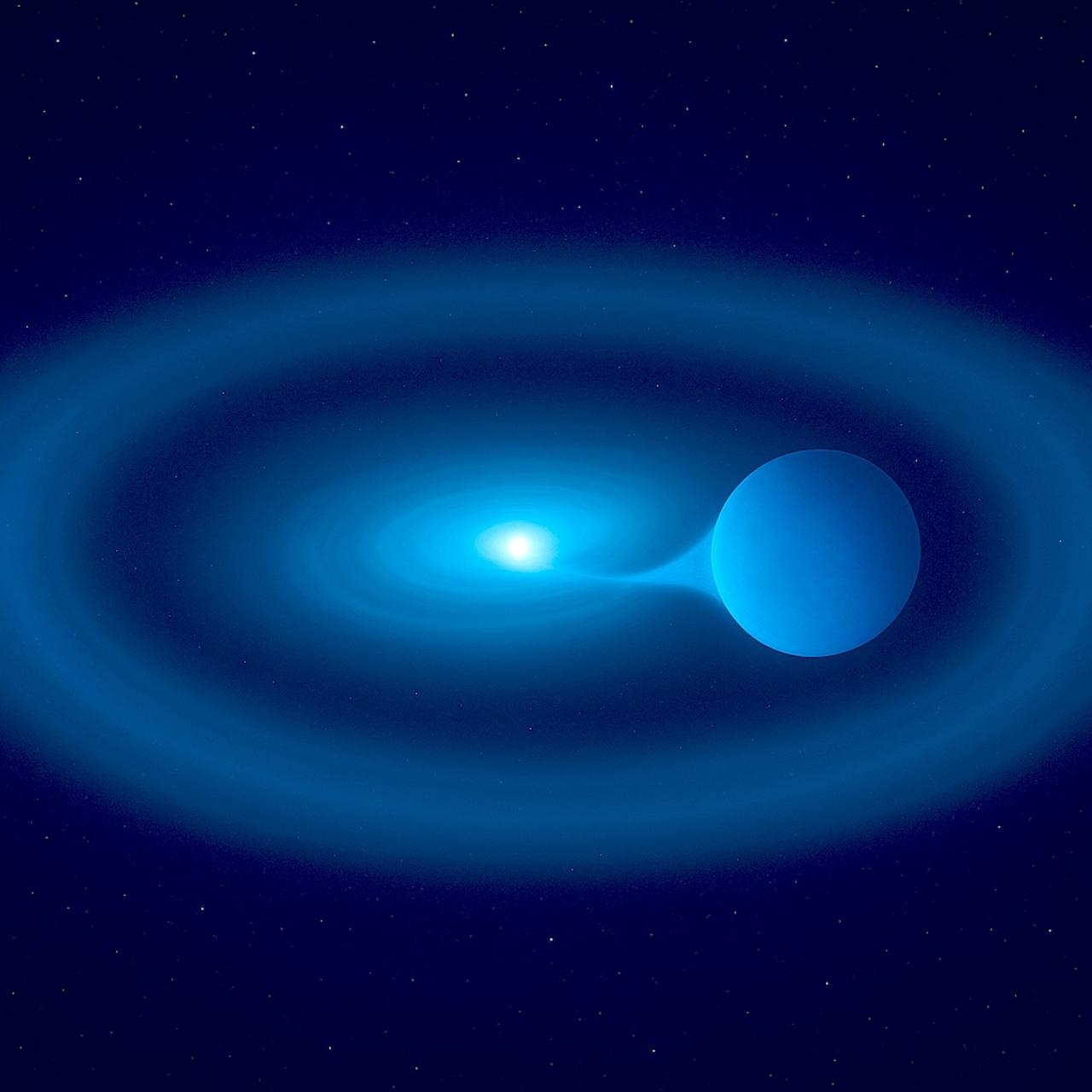
Artistic rendering of the V Sagittae star system, where a superdense white dwarf is extracting matter from its larger companion. Unable to assimilate all the transferred mass, a bright ring of gas forms around it. (AI-generated image).
A white dwarf star in our own Milky Way galaxy is devouring its celestial companion at an unprecedented rate, according to an international study with participation from the Canary Islands Institute of Astrophysics (IAC) and the University of La Laguna. The research, published in the journal Monthly Notices of the Royal Astronomical Society, It shows that the system, called V Sagittae, shines unusually brightly as the super-dense white dwarf consumes matter from its larger companion in a veritable stellar feast.
Experts believe that the two stars are locked in a kind of "cosmic dance" as they orbit each other every 12.3 hours, slowly drawing closer together, and they point out that this could cause an explosion so dazzling that it will be visible to the naked eye from Earth, some 10,000 light-years away.
Phil Charles, a researcher at University of Southampton And co-author of the study, highlights that these results solve a mystery about the stellar pair that has puzzled astronomers for a century: “V Sagittae is no ordinary star system: it is the brightest of its kind and has perplexed experts since its discovery in 1902. Our study shows that its extreme brightness is due to the white dwarf extracting and accumulating matter from the other star at an extraordinary rate.» He adds: «It is such an intense process that it triggers thermonuclear reactions on the surface of the white dwarf, shining like a beacon in the night sky.».
The researchers captured this stellar feast using the powerful Very Large Telescope of the European Southern Observatory (ESO) in Chile and made another discovery. They found that a ring of gas surrounds both stars, like a giant halo, a consequence of the enormous amount of energy generated by the hungry white dwarf.
«"This unexpected ring, formed from the remnants of this violent interaction, offers clues that could change what we know about how stars live and die," says Pasi Hakala, a researcher at the University of Turku who led the study. “The white dwarf cannot consume all the mass transferred from its companion, so it creates this bright ring that surrounds them. The speed at which this stellar system wobbles violently, probably due to its extreme brightness, is a clear sign of its imminent and violent end,” he points out.
“The matter accumulating on the white dwarf will likely produce a nova explosion in the future, during which V Sagittae will become visible to the naked eye in the night sky,» he explains. Pablo Rodríguez-Gil, A researcher from the University of La Laguna and the IAC, who also participated in the study, concluded, "But when the two stars finally collide and explode, a supernova so bright will be produced that it will be visible from Earth even in broad daylight.".
Article: Pasi Hakala, Phil Charles, Pablo Rodríguez-Gil: «V Sge: Supersoft Source or Exotic Hot Binary? I. An X-Shooter campaign in the high state», MNRAS, 2025. DOI: https://doi.org/10.1093/mnras/staf1284

 Spanish
 English
 French