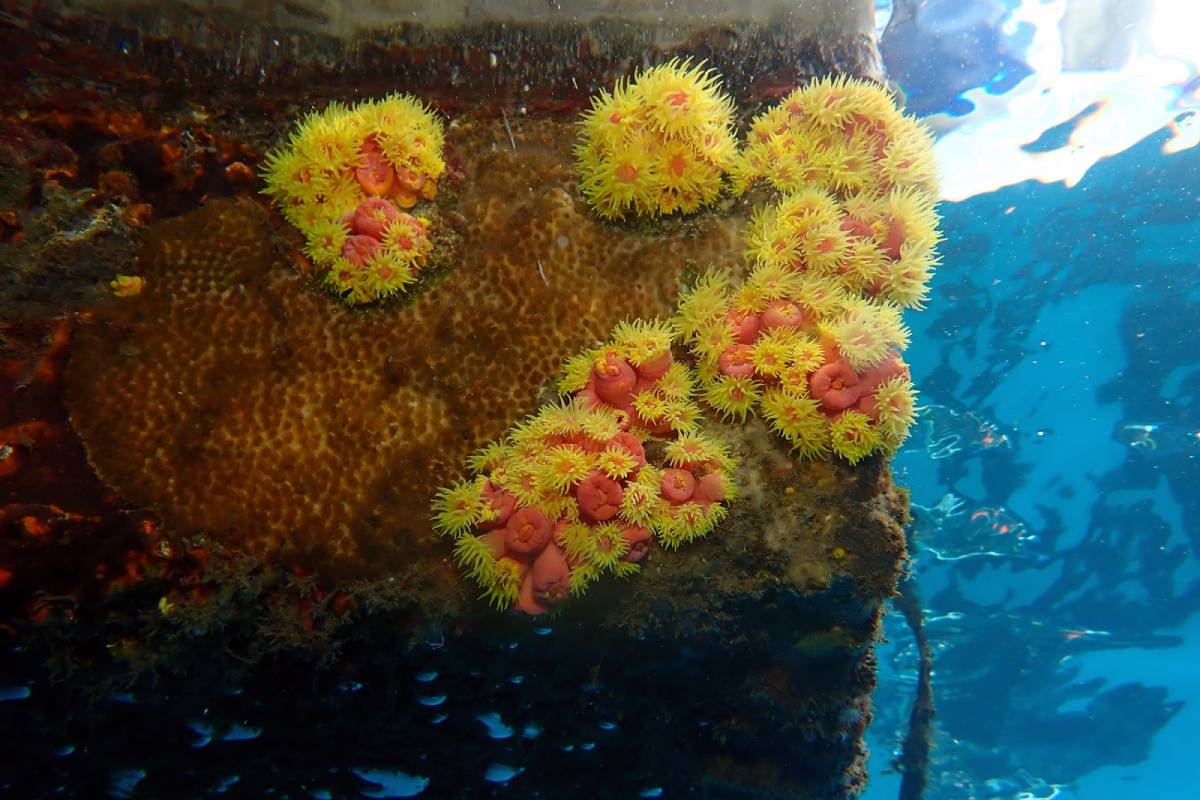
A study from the research group BIOECOMAC. Biodiversity, Marine Ecology and Conservation from the University of La Laguna, published in the journal Marine Environmental Research, reveals that coral with high invasive potential Tubastraea coccinea, The species, originally from the Pacific and recently detected in the ports of Tenerife and Gran Canaria, could spread through the waters of the Canary archipelago despite the effects of climate change, posing a risk to the island ecosystems of the Canary Islands, known for their isolation, endemism and low resilience.
The work, led by assistant professor Dr. Adriana Rodríguez together with researchers Martí Vilanova, Hortensia Holgado and Alejandro Arechavaleta, analyzed the ecophysiological response and growth of this coral under conditions that simulate the future of the ocean according to the projections of the Intergovernmental Group of Experts on Climate Change (IPCC) for the end of the century: higher temperature (26ºC) and ocean acidification (pH 7.50).
The colonies, collected in March 2022 from the dikes of Santa Cruz de Tenerife, were kept in the laboratory in experimental aquariums with environmental control and then exposed to four different temperature and acidity scenarios for 30 and 80 days. During that time, water quality was monitored and their growth, respiration, and calcification were assessed.
The results showed that ocean acidification negatively affects coral, reducing its growth, metabolic activity, and polyp formation, as well as causing larvae with malformations. However, the increase in temperature had no adverse effects and in some cases mitigated the negative impacts of low pH.
Environmental tolerance, rapid dispersal, and adaptability make T. coccinea This poses a threat to local biodiversity. Its expansion could displace other invertebrate and algae species, as well as native organisms, altering marine communities and modifying the balance of island ecosystems.
The research team highlights the need to conduct long-term studies with several generations of corals to better understand their adaptability, as well as to analyze their interactions with local species, especially in the early stages of the life cycle, which are usually more vulnerable to environmental changes.

 Spanish
 English
 French