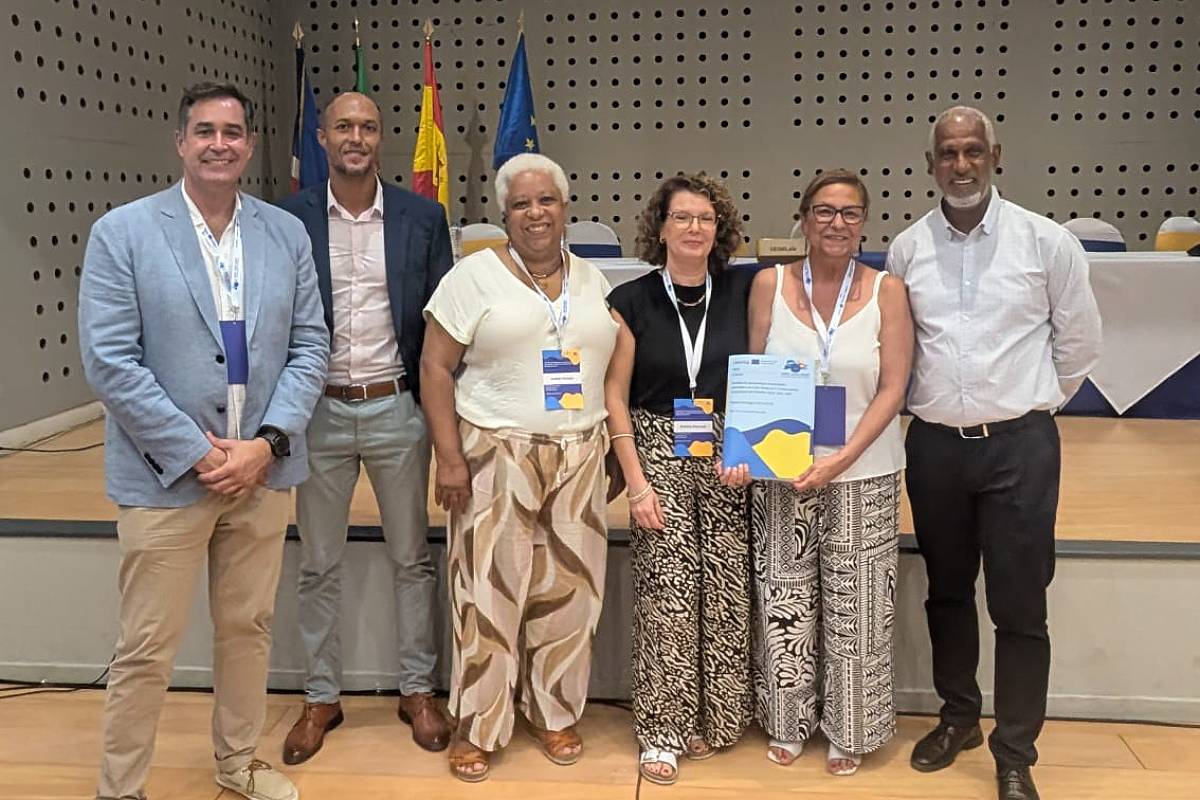
This week, the presentation of projects approved in the first call for proposals of the Interreg MAC (Madeira, Azores, Canary Islands) territorial cooperation program was held in Praia, Cape Verde. Two of these projects are led by the University of La Laguna. The Vice-Rector for Internationalization and Cooperation, Inmaculada González, along with her advisory team, participated in the event.
The event was held within the framework of the ATLANTE strategic project, a project supporting the governance of cooperation under the Interreg MAC Programme, which aims to boost cooperation between European and African entities within the cooperation area. Within this framework, the purpose of this event was to promote the visibility of Interreg MAC projects approved in partner African countries, facilitate networking between entities, and explore synergies between projects.
The event, aimed at presenting the 28 projects approved with partners from Cape Verde within the framework of the first call, was organized in collaboration with the State Secretariat for Foreign Affairs and Cooperation of Cape Verde and included the participation of the Interreg MAC program Management Authority, senior officials from the Regional Governments of Madeira, Azores and the Canary Islands, European and Cape Verdean partners of the projects, representatives of the European Union, Embassies of Portugal and Spain, multilateral organizations and other key agents competent in the action lines of the Interreg MAC 2021-2027 program.
ULL Projects
The projects led by the University of La Laguna are TecnoMAC y Alsemac. The first one, presented by the researcher Emma Carmelo, Its main objective is to develop innovative technologies for the detection of pathogens and other foodborne risks. This effort seeks to strengthen food safety and public health in the Macaronesian region and associated countries, contributing to sustainable development and the well-being of their communities. The project brings together academic institutions, research laboratories, and industrial partners to address common challenges in quality control and agri-food technology.
Led by the University of La Laguna and supported by key partners such as the Institute of Natural Products and Agrobiology (IPNA-CSIC), the University of La Laguna General Foundation, and entities from Cape Verde and São Tomé and Príncipe, TecnoMac is structured through multidisciplinary collaboration. Throughout the project, advanced methodologies will be developed and validated to identify microbiological and chemical risks in food, providing innovative and practical solutions for quality control and safety in the agri-food chain.
For its part, the Alsemac project, presented by Angel Jose Gutierrez, It is an initiative focused on promoting the responsible production and consumption of safe, healthy and sustainable (triple-S) food within a circular economy framework and involves universities, institutions and public bodies, including the Technological Institute of the Canary Islands and research centers in the Canary Islands, Madeira, Azores, Cape Verde, Senegal, Ivory Coast and Ghana.
Their work focuses on minimizing dependence on imported food (especially in island regions), reducing environmental impact and carbon footprint, as well as the excessive use of pesticides and fertilizers in agriculture, and ultimately, fostering sustainable local food production, promoting local consumption over imports as a key step in driving a circular economy. Furthermore, a cross-cutting objective will be to gather information on potential food safety hazards in the various regions participating in the project.

 Spanish
 English
 French