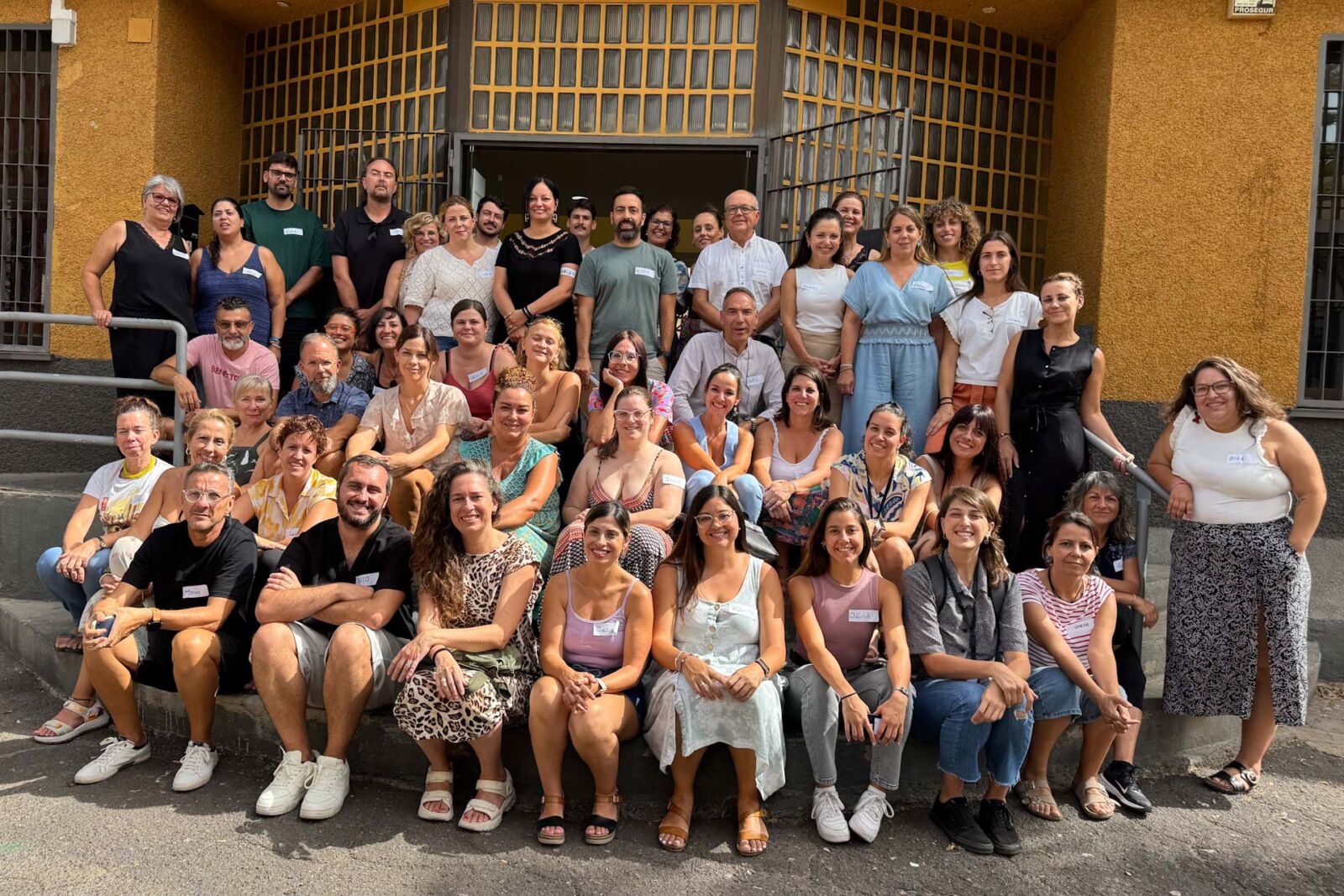
The technical teams of various projects of the University Innovation Agency of the University of La Laguna have held a meeting to delve deeper into the key aspects of the archipelago's demographic challenge in order to contribute to its proper management. Around fifty professionals from the social sphere who carry out their activity on different islands of the archipelago, linked to projects promoted by the University of La Laguna through its General Foundation, have met in Tenerife to begin a process of training and collaborative work.
The meeting was supported by the Deputy Ministry of the Presidency of the Government of the Canary Islands, represented by Silvia Nakoura González and Eva Padrón Sánchez, who are responsible for the technical and strategic coordination of the Canary Islands Demographic Challenge Strategy and its action plan. Professor José-León García Rodríguez, a renowned specialist from the University of La Laguna (ULL) in the analysis of the Canary Islands' population over time, also participated. These individuals presented the current framework related to the demographic challenge to facilitate the subsequent technical work of the teams.
Professor García Rodríguez, emeritus of Geography, emphasized the public policy nature of the demographic challenge, highlighting its unique characteristics in the Canary Islands, where “it goes beyond depopulation, since the population reality of our archipelago is much more complex compared to that of other peninsular and European territories.” For example, the islands are experiencing significant population growth, in addition to having a negative natural population growth rate for years and a rising incidence of migration. All of this, according to the expert, requires the development of proactive policies in various areas, addressing, for example, work-life balance, long-term care, youth emancipation, access to housing, and so on.
For their part, the professionals managing the Demographic Challenge and Territorial Cohesion Strategy for the Government of the Canary Islands reviewed the strategy's development process and the assessment of Canary Island municipalities based on their demographic circumstances, revealing the key elements and content of the recently defined Action Plan. In this regard, they encouraged participants to delve deeper into the challenge in order to align their projects with its objectives, also highlighting the crucial role of Canary Island universities in its development.
Julio Brito, managing director of the General Foundation, praised the meeting, noting that it fosters collaboration among projects that share similar approaches and methodologies, strengthening the University's capacity to work with other institutions to address the region's main challenges. Brito highlighted the track record of projects that contribute to issues of social interest, such as employability, social inclusion and cohesion, community development, and intercultural coexistence.
Participants emphasized the importance of more active collaboration with the municipalities involved in the challenge, given that their work is carried out in direct contact with their specific realities, interacting regularly with various stakeholders in the political, technical, and civic spheres. Emphasis was placed on the necessary consideration of the community dimension, since one of the most significant processes currently underway in the Canary Islands is its diversification due to immigration.
Finally, Professor Vicente Zapata, academic director of the represented projects, emphasized the sequence of “knowing, understanding, and connecting” to approach the challenges of the project with the appropriate framework and tools. “The trust that the Canary Islands institutions have placed in our projects,” Zapata noted, “must be transformed into more specific strategies, solutions, and responses.”.

 Spanish
 English
 French