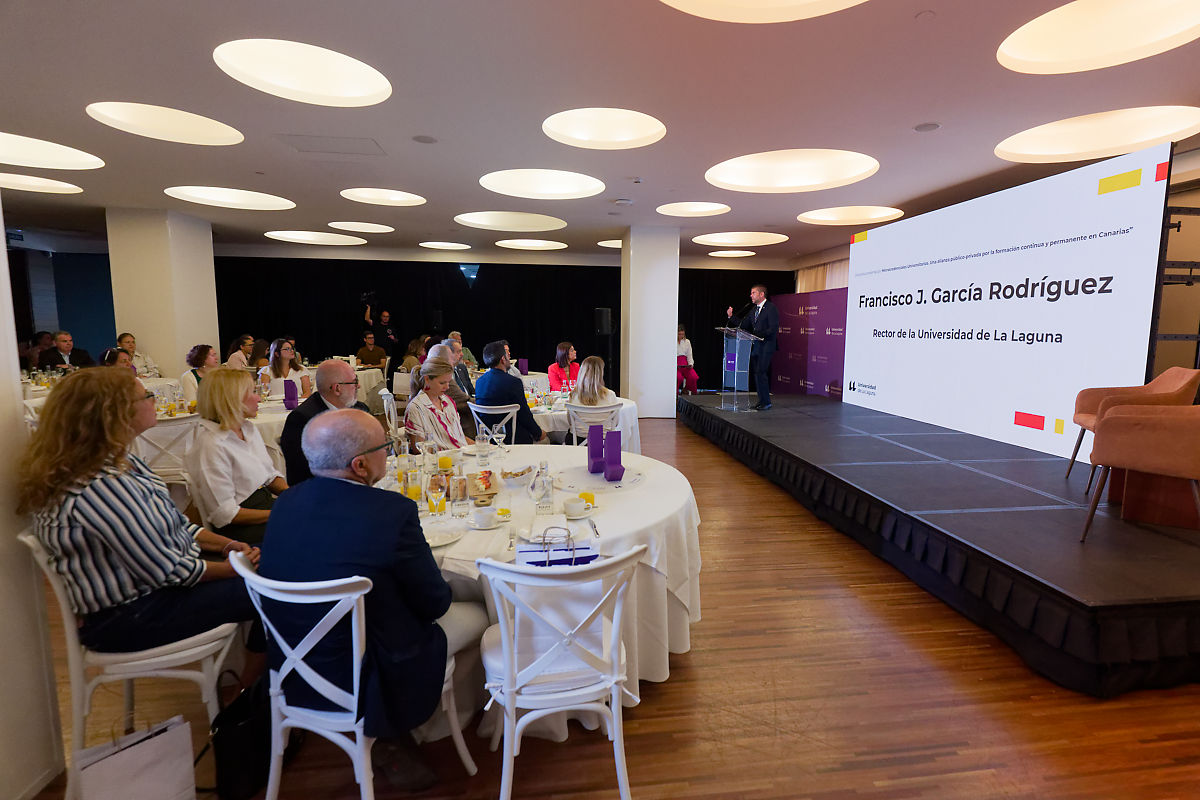
The University of La Laguna held an event today, September 23, to present its microcredentials program, These courses, endorsed by the Ministry of Universities, offer a unique opportunity to train professionals of all kinds, with or without prior training, with the aim of requalifying them through short courses that allow them to acquire specific skills and improve their professional profile.
All of this breaks the paradigm of universities as training centers for people with prior knowledge, and opens the training field to new profiles, while also creating an alliance with the productive sector, weaving a clear complicity with companies and institutions to offer fast, high-value training with immediate accreditation.
The event, held at the Hotel Mencey, welcomed around fifty people interested in this new university challenge: professional associations, business executives, representatives of the CEOE and media, who showed their great interest in this new training program.

General view of the room.
The session was opened by the rector, Francisco García, who described the university as a generator of new knowledge with great potential for social transformation. “Behind the climate change mitigation measures in the Canary Islands and the new challenges posed by more sustainable tourism is the University of La Laguna,” an institution with 47 undergraduate degrees, 38 master's degrees, and 22 doctoral programs. “We not only teach professional skills, but we also train future researchers to launch their scientific careers.”.
The rector explained that one of his first actions upon assuming his position was to conduct a thorough analysis of each undergraduate degree program, with input from alumni, business leaders, and experts. The aim of this process was to reorient the degree catalog, and in fact, the first steps have already been taken: seven new double degrees, one double master's degree, several successive pathways, and the finalization of profiles for open degree programs, all with the goal of modernizing the programs, making them more flexible, and better aligned with current demands.
The rector also reported that of the nearly five thousand new students, 111 (3-year-olds) come from Vocational Training programs, "which gives us clues about the connections we need to establish with other educational pathways." However, he said, having a university degree is a sign of greater job success, since the employment rate is higher, with better contracts and higher salaries.
In this context, the public university has a significant role to play in training the workforce, the rector stated, given that 501% of workers will need retraining in the coming years. To this end, the University of La Laguna has its Center for Continuing Education, directed by Professor Isabel González.
The idea is that all micro-credential requests from the productive sector will be processed through this center. This university has secured funding from the Ministry of Universities for this purpose, and this year it has the capacity to issue 2,500 accreditations, “and that makes no sense without public-private collaboration; we cannot and do not want to do it alone. It is essential that companies get involved, both in the design and implementation.”.
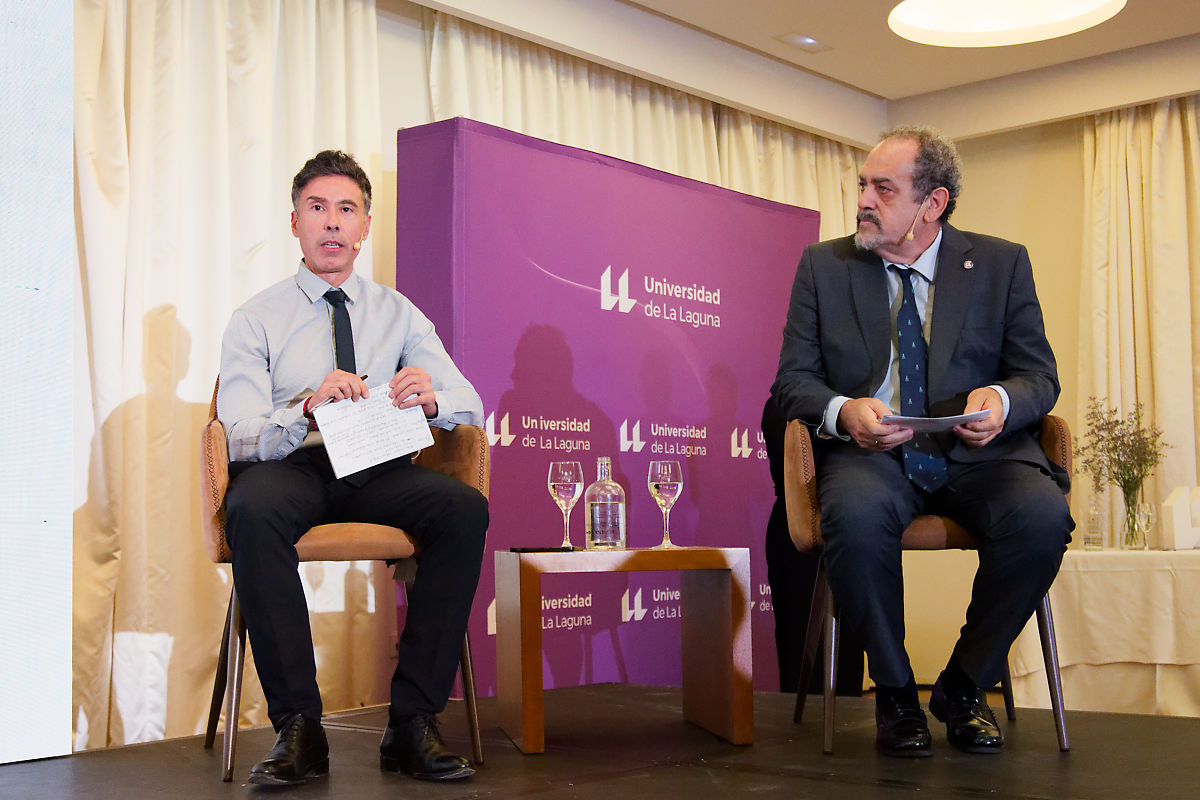
Pedro Martínez, from the Ministry of Universities (i), and the Vice-Rector for Teaching, José Manuel García Fraga (d).
New paradigm
To delve deeper into this matter, Pedro Martínez, Deputy Director General of Institutional Relations of Ministry of Science, Innovation and Universities, She began by discussing the transformations in the environment, the technological revolution, and the mobility of goods and services that society is experiencing. “We must reduce the gap between the educational and professional worlds, strengthen the alliance between the public and private sectors, and improve competitiveness through continuous training,” she stated.
Thus, the Microcreds Plan also aims to strengthen relations between universities and the productive sector, and seeks to transform universities into entities of continuing education, facilitate training pathways and lifelong learning.
These are short, flexible, certifiable training programs designed from a demand-driven perspective, which is key to changing the paradigm of continuing education. Therefore, the design of the micro-credential should be a collaborative effort between universities and companies, with the latter guiding which skills should be acquired, possibly even collaborating with the teaching staff. “This training is not intended to replace official degrees. It's about being able to work and produce immediately upon obtaining the micro-credential, which should provide a range of qualifications or competitive advantages,” he explained.
It's a flexible element that must be adapted almost monthly to market needs, Martínez pointed out. The idea is to encourage companies to identify these training needs so that universities can design the programs in collaboration with the companies. "We have the financial resources to launch this initiative; if we don't take advantage of them, universities won't be able to train people.".
For his part, the Vice-Rector for Teaching, José Manuel García Fraga, added that the aim is not only to train new professionals, but also those with extensive experience who need updated skills. “The micro-credential would, to some extent, validate that experience,‘ he said, ’and it will also be part of Europass, making it digital and portable.”.
A shared need
It's a necessity. This is the main conclusion reached by the three members of the round table that followed the initial presentations, which included Sara Mateos, director
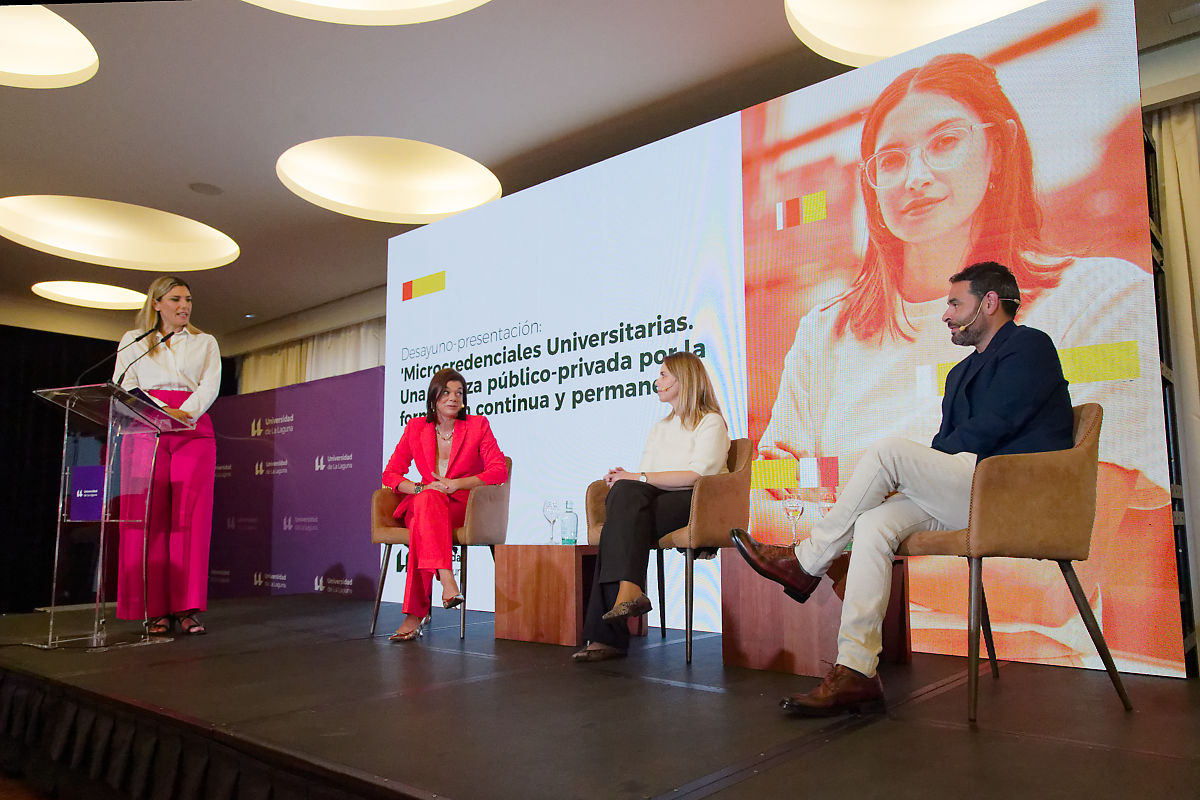
A moment from the round table with Sara Mateos, on the left, Daniela Postiglione, in the center, and Manuel Pestano.
From the DISA Foundation; Daniela Postiglione, Director of Human Resources at Cajasiete; and Manuel Pestano, consultant. All three maintained that continuous training is of utmost urgency in such a rapidly changing world.
They also indicated that we cannot lose sight of so-called 'soft skills'. ‘It seems that in this fast-paced world, interpersonal skills have been left behind: it's necessary to work in teams, lead, and know how to adapt to different situations.’ Therefore, the value lies once again in socio-communicative skills, which perhaps the new generations don't know how to master, they pointed out.
Adapting, for example, to new legislative changes that could drastically alter a company's operations while it still has to provide services is not easy. "Therefore, we need to be very flexible in our work arrangements and continuously pursue training." At this point, all three participants considered collaboration with the university vital. "We don't know how to develop a course for a complete training program, so we believe we're going to achieve great things with the University of La Laguna (ULL).".
Companies interested in participating in the ULL micro-credentials program should contact the Continuing Education Center via email dircfp@ull.edu.es. From there, a meeting will be scheduled to learn about the specific demands and develop the training program, which will be implemented immediately. “We need trust in the university to be able to forge this alliance,” the rector stated at the end of the meeting.

 Spanish
 English
 French