An international collaboration coordinated by a team from the French National Centre for Scientific Research (CNRS) and the University of Bordeaux Researchers have unearthed, at the Paleolithic site of La Roche-à-Pierrot (Saint-Césaire, Charente-Maritime), the oldest known workshop for making shell ornaments. Accompanied by red and yellow pigments, this assemblage, dated to at least 42,000 years ago, is associated with the Châtelperronian culture, which marks the transition between the last Neanderthals and the arrival of Homo sapiens in Europe. Carolina Mallol, attached to Antonio González Institute of Bio-Organic Medicine from the University of La Laguna, is one of the participants in this work published yesterday in the high-impact journal PNAS.
Between 55,000 and 42,000 years ago, Europe underwent profound biological and cultural changes. It was during this period that the last Neanderthals were gradually replaced by groups of Homo sapiens that arrived during their most recent exodus from Africa. For a long time, this transition was considered a rapid and uniform process, but today it is recognized as something far more complex. A great diversity is observed in the earliest Upper Paleolithic industries, as well as in the symbolic practices that began to proliferate.
Although these different cultures are distinguished mainly by their methods of toolmaking, they also show that the way of "culturalizing" the body —especially through ornamentation— was gradually accompanied by increasingly wider cultural networks, which probably played an essential role in the cohesion of human groups of that time.
The Châtelperronian, a prehistoric culture documented in France and northern Spain during this transition, occupies a central place in this debate. Today it is recognized as one of the earliest Upper Paleolithic industries in Eurasia, but a crucial question remains: should this culture be attributed to Neanderthals or to the Homo sapiens?
The La Roche-à-Pierrot site in Saint-Césaire (Charente-Maritime) is at the heart of this controversy. In 1979, under the direction of François Lévêque, archaeological excavations revealed partial remains of a Neanderthal skeleton associated with Châtelperronian tools. This find was interpreted as evidence that Neanderthals had been able to develop this industry. However, new research coordinated since 2013 by François Bachellerie and Eugène Morin, and since 2015 by Isabelle Crevecoeur, has led to a reassessment of the situation.
This collaborative research project, supported by the DRAC-SRA Nouvelle-Aquitaine, the Charente-Maritime department, and the University of Bordeaux, has demonstrated that the archaeological deposits at Saint-Césaire are the result of complex geological processes. In fact, they contain a mixture of Mousterian occupations—certainly associated with Neanderthals—and Châtelperronian artifacts, making the interpretation of this association much more nuanced.
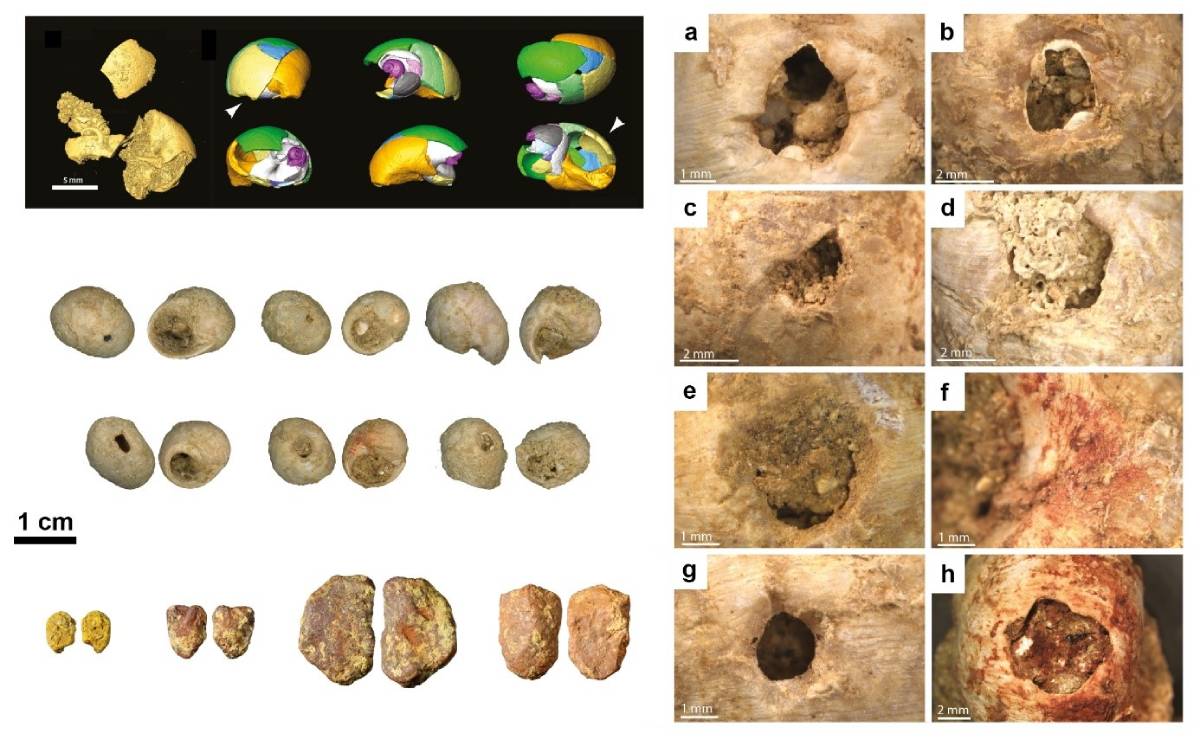
The new excavations revealed the best-preserved part of the archaeological sequence, offering a clearer view of the succession of human occupations. An exceptional collection was discovered there: a hundred Atlantic seashells of the genus *Polyspora*. Littorina, Of these, at least thirty were intentionally perforated. These shells were accompanied by about a hundred pigments, mainly red, but also yellow. The archaeological assemblage at this level also contains the highest concentration of Châtelperronian artifacts at the site.
Although other artifacts are also present, such as Mousterian tools and the remains of hunted animals (mainly bison and horses), the detailed spatial analysis carried out by the researchers shows that it is the Châtelperronian objects that are associated with the perforated shells and pigments. The absence of use-wear marks on the perforations and the presence of unperforated shells in the assemblage suggest that this was a workshop for the manufacture of ornaments.
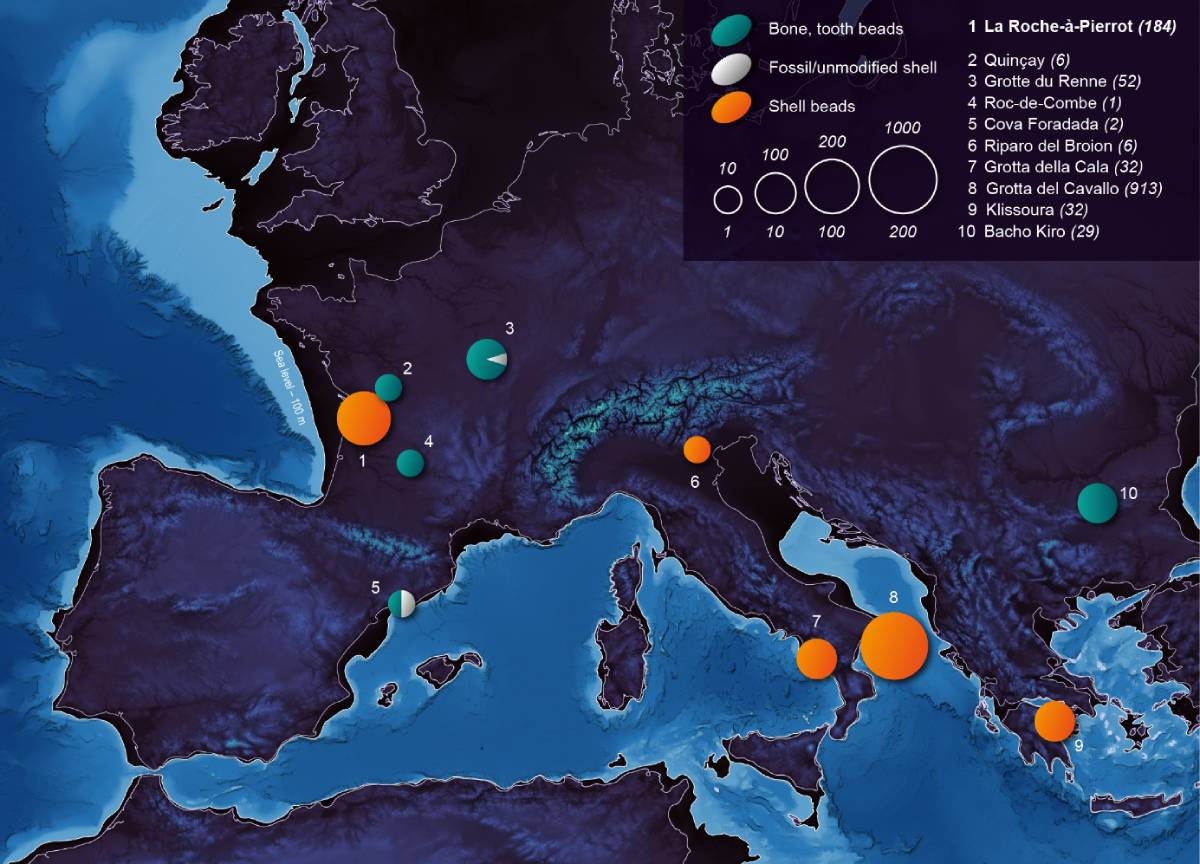
Map of Europe illustrating the categories of raw materials used for personal ornaments from archaeological contexts dating to the early pre-Aurignacian Upper Paleolithic. The regional characteristics of La Roche-à-Pierrot and Saint-Césaire are highlighted, where seashells were used to make ornaments.
This discovery is exceptional: it is the oldest evidence of this type of shell ornamentation in Western Europe, and the first clearly associated with the Châtelperronian culture. Until now, ornaments made with seashells had only been found in contemporary discoveries in southeastern Europe and the Mediterranean region, linked to other cultures from the early Upper Paleolithic.
Symbolic objects such as beads or pigments used to decorate the body are considered an important cultural marker of the Upper Paleolithic, generally associated with Homo sapiens. Symbolic objects have been documented in the Middle Paleolithic, but in a much more limited way. According to the authors of this study, the generalization and diversification of these practices in Europe could be related to contacts between different human groups, of diverse biological and cultural origins, and these exchanges would have played a key role in the emergence of more established symbolic expressions during the European Upper Paleolithic.
The recent discovery of a previously unknown association between an early Upper Paleolithic industry and shell beads provides new insights into cultural diversity in Western Europe. It also suggests that Châtelperronian artisans may have been influenced by, or even formed part of, the earliest waves of Homo sapiens that arrived in the region at least 42,000 years ago.

 Spanish
 English
 French