
The tenured professor of Human Geography at the University of La Laguna Vicente Zapata Hernández He emphasized the importance of placing people at the center as an essential driving force for community change during the inaugural lecture for the Tourism Degree program, held yesterday morning, September 22, in Adeje. The Rector of the University of La Laguna, Francisco García, and the Mayor of Adeje, José Miguel Rodríguez Fraga, presided over the event, which took place at the Adeje Convent and was attended by faculty and students from the university, members of the municipal council, business leaders, and other authorities. Also present were the Vice-Rector for Culture and University Extension, Isabel León; the Dean of the Faculty of Economics, Business, and Tourism, Inés Ruiz; and the Councilor for Culture, Sports, and Education of the Adeje City Council, Adolfo Alonso.
The rector closed the inaugural session by expressing his concern about the “complex” times in which universities face significant challenges. “Truth is a scarce commodity because we live in an era of disinformation and manipulation, where different narratives compete with the truth to influence and manipulate.” Therefore, in this “complex world of liquid reality,” he noted a pervasive sense of collective fear that permeates societies and even affects politics. “The future is only possible through diversity and equity, so I believe that, in this process of creating fear on a global scale, universities must resist and offer rigorous, evidence-based knowledge.”.

The mayor, José Miguel Rodríguez; the rector, Francisco García; and the vice-rector of Culture and University Extension, Isabel León.
García took advantage of the presence of students from the IES Adeje II Institute to mention that the university is in the process of designing new degree programs to be implemented in the 2026/27 academic year. “This year we have seven new double degrees, we have increased the number of new students, and recent reports confirm the importance of university experience linked to employment.” He noted that, while the unemployment rate is 13.5%, among university graduates it is 7%, and if they have a master's or doctoral degree, the figure is even lower. He acknowledged that the challenge for academia is speed: “We have to adapt more quickly to the constant demands of the productive sector.”.
For his part, the mayor of Adeje focused on two aspects. The first was to reaffirm his and the town council's commitment to the university in order to promote quality tourism that benefits the local population, improving their living conditions through knowledge, training, and collective intelligence. “The Southern Campus has already served more than 500 students, many of whom are now employed. It's a self-reinforcing process, because better employability leads to improved service.”.
Rodríguez Fraga emphasized that the future of the tourism sector cannot be based on empty rhetoric, shouting, or hasty decisions. “We must rely on research, experimentation, and deep reflection. From this perspective, the alliance with the University of La Laguna becomes a strategic asset for advancing toward a sustainable tourism model that prioritizes quality and avoids the risks of overcrowding or uncontrolled offerings that degrade the destination.” He highlighted that “the Costa Adeje destination is well-positioned, the workforce is committed, making efforts toward continuous training, and the business community is always seeking new synergies in partnership with the university.”.
Community change
In his inaugural lecture, Vicente Zapata explained that, although people should be at the center of the main effort during community changes, there is a paradox that other actors decide where, how, when, for what purpose and why they are placed.
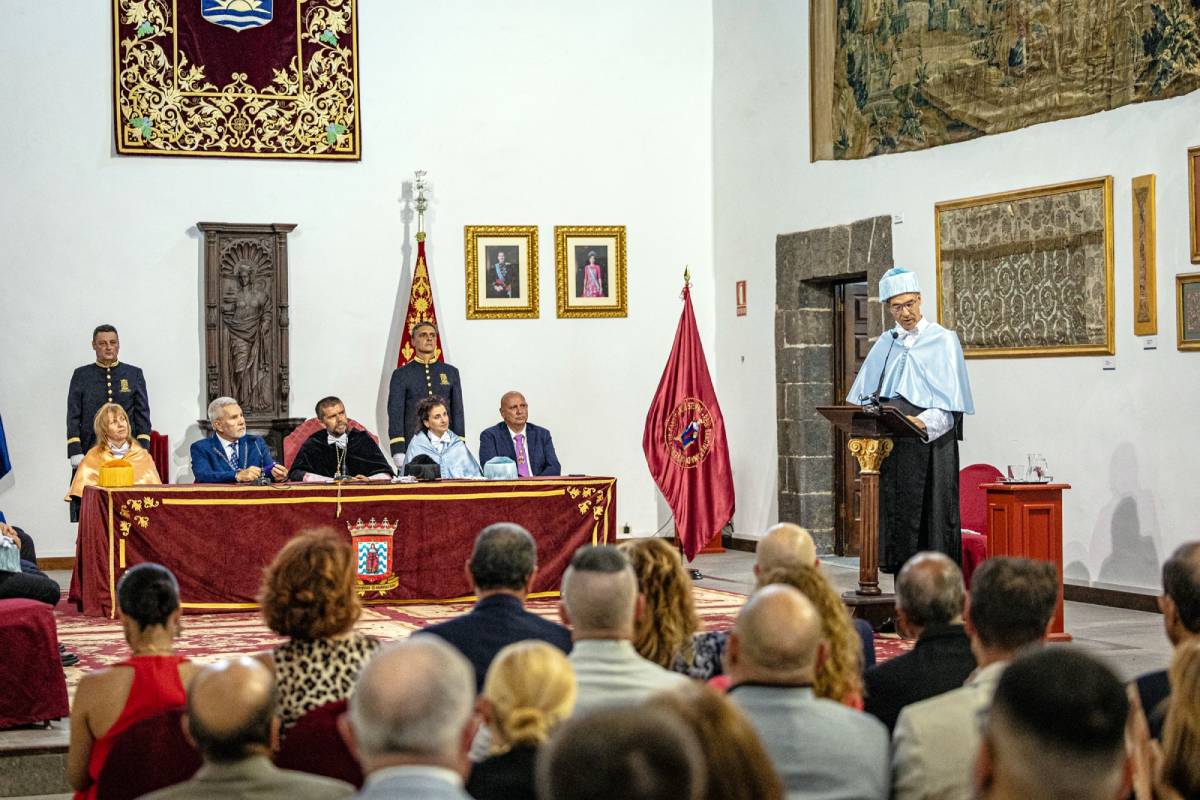 Zapata also emphasized shared responsibility: “Everyone has duties toward the community, since it is only within it that they can freely develop their personality. We are an essential part of community building.” He raised the need to establish policies that are not paternalistic. “Are we truly helping people to be at the center, to project themselves beyond their immediate surroundings, to achieve greater agency in their lives, and to build valuable communities?” the expert asked. “If we don't create frameworks for shared responsibility, social and territorial inequalities will be accentuated. The demographic challenge is a unique opportunity to reconnect our society with community values,” asserted Zapata Hernández, for whom “southern Tenerife, with its current diversity, is a privileged setting.”.
The opening speaker presented several proposals for achieving this goal, citing successful initiatives implemented in Adeje such as “SDG Neighborhoods” and “Adeje Friendly,” developed in collaboration with various government bodies and the university. “Neighborhoods foster encounters and promote understanding of broader processes like migration. Building a community means effectively connecting its members through interaction, so that each person can play their part. In doing so, we will be building more cohesive societies where every individual finds their place.”.
The opening of the Tourism Degree in Adeje also included the participation of the faculty and management of the Music School of the southern municipality, as well as the local singer Ainhoa Aguilar.

 Spanish
 English
 French