
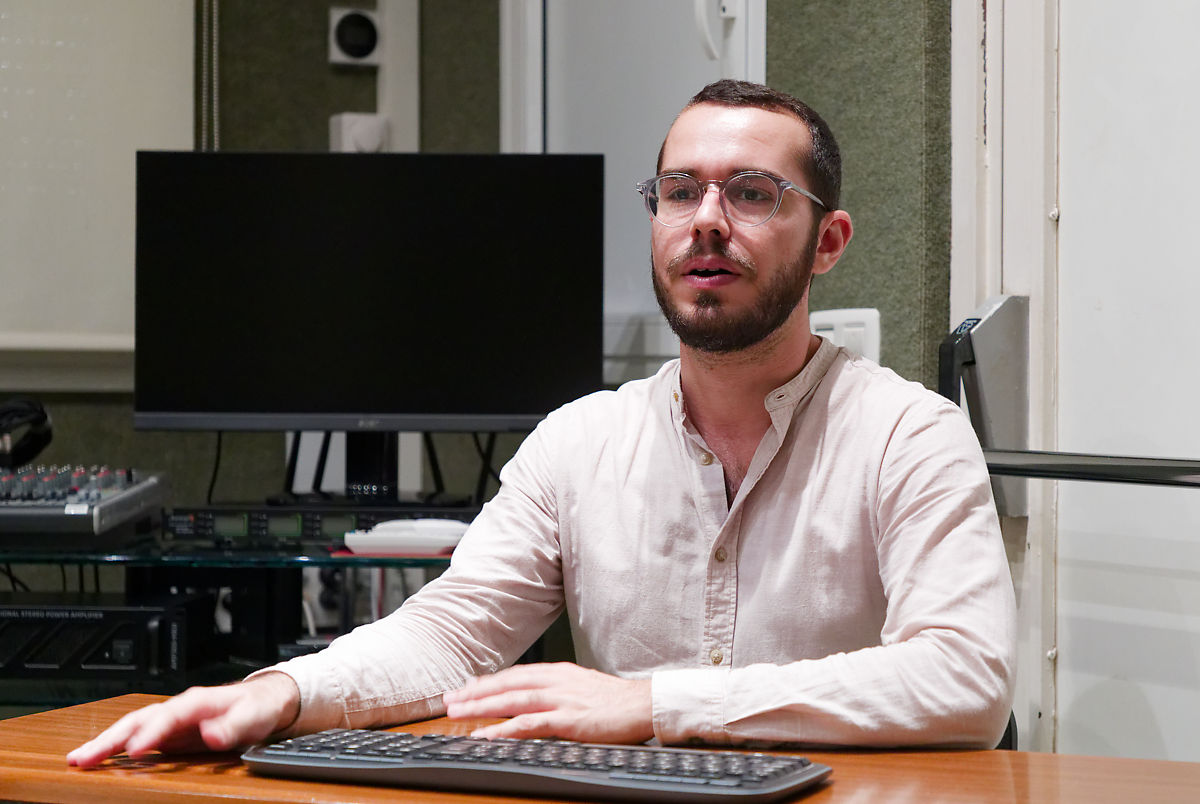
The memory of countercultural movements is sometimes fragile and can result in the loss of shared identities and histories if they are not documented in time. With the aim of preserving and reclaiming a little-explored aspect of Tenerife's culture, the doctoral thesis "Noise and Darkness: A Study of Punk and Its Derivatives in Tenerife," recently defended by Damián Martín Marrero in the doctoral program in Arts and Humanities at the University of La Laguna, analyzes the relevance of punk not only as a musical style, but also as a social and cultural phenomenon on the island.
The research examines the punk scene in Tenerife from the emergence of the first bands, influenced by the British context and tourism in the late 1970s, to its resurgence after the COVID-19 pandemic, driven by new generations disillusioned with the local music scene. One of the most significant findings was the discovery that bands like Escorbuto Crónico and Familia Real were not only pioneers in developing their own style, but also influenced the national scene: “Their musical style was not only not an imitation of what was coming from the mainland, but its characteristics notably influenced other bands in the country,” notes Martín Marrero.
In this way, his work dismantles prejudices such as the idea that Canarian culture always arrives filtered through Madrid or other large cities, and emphasizes that original proposals for the national punk scene also emerged from Tenerife.
 Ideological origins and projection
Through the study of popular works, recordings, fanzines, and interviews with members of both historical and current bands, the researcher has been able to reconstruct the different stages of the movement in Tenerife. The first stage begins in 1978, when two distinct centers emerged, both in style and ideology: in La Laguna, the bands were born with a strong ideological component linked to anarchism and the revolutionary left, while the groups in Santa Cruz de Tenerife tended in their lyrics towards a more nihilistic approach, focused on self-expression and rupture, without placing as much emphasis on political discourse.
From 1983 until the 1990s, the researcher identifies a period of intense activity, with the emergence of new groups and their rise to prominence beyond the archipelago. “Fanzines from that era document exchanges between these bands and collectives in the UK, Brazil, and the US.” A single by Familia Real even received airplay on US radio. During these years, many bands performed on major stages of the national punk scene, such as in the Basque Country, where they were praised for their musical innovation.
After several decades in which the genre was overshadowed by other urban trends like electronic music and rap, the post-pandemic landscape is fueling a new resurgence led by young people. “Alongside the conventional circuit of venues and festivals, these bands are reviving the underground style of earlier eras and starting to play small gigs.” The collective Hermano Mono and the group Tensö are some of the main exponents of this Tenerife punk revival, which in recent years has even reached international stages, such as those in Japan and Mexico.
For Martín Marrero, it is significant that the current punk scene in Tenerife shows more activity than it did twenty years ago, with veteran musicians still active and a new generation adapting their style to alternative spaces beyond conventional venues and halls, reviving the spirit do it yourself which marked the beginnings of the movement on the island.
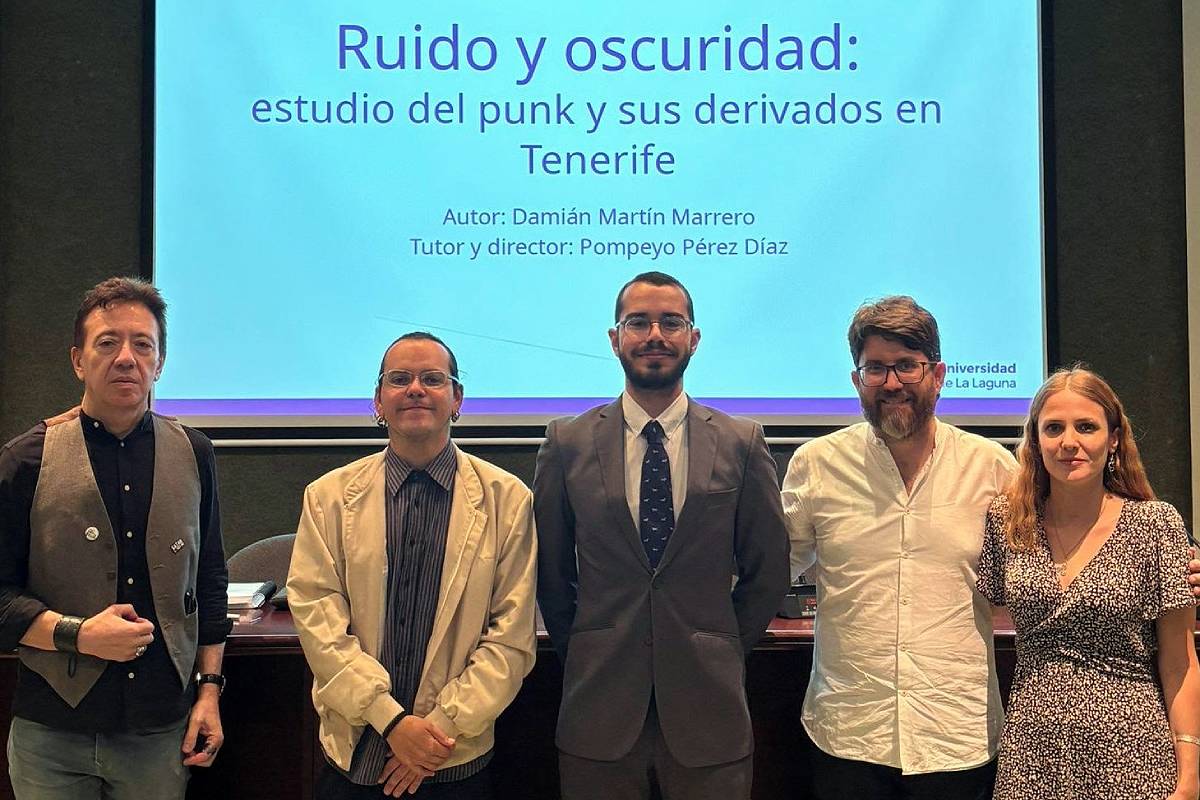
Martín and his thesis advisor Pompeyo Pérez (first on the left) after the thesis defense. (Photo provided).
Philosophy, history and sound
Although the chronological review of the movement constitutes its central focus, this thesis includes two other fundamental sections for understanding the complexity of the phenomenon. The first addresses a more philosophical and conceptual dimension, analyzing the theoretical roots of punk and interpreting the movement from different schools of thought.
The third section focuses on musical analysis, as Martín Marrero, a trained musician, considered it essential to also address the technical aspects of the genre. He emphasizes the importance of having appropriate analytical tools and terminology to examine this countercultural style from a specialized perspective. Musical study is often an underexplored dimension in punk research, so he felt it necessary to precisely define some key concepts to facilitate understanding for those without technical training, such as detuning, distortion, dissonance, and stridency.
This analysis cannot apply the same criteria as in the study of, for example, a Beethoven symphony: “I had to be a bit creative and explore the genre's own resources, beyond harmonic or formal aspects more typical of academic music.” His experience as a guitarist was valuable in practically approaching certain compositions that he couldn't understand from a purely theoretical perspective, and thus delving deeper into the creative processes of some of the pieces analyzed.
In addition to the interviews, Martín Marrero has compiled an extensive catalog of demos, fanzines, and recordings, both commercially released and available on internet forums. This detailed and comprehensive archive constitutes a valuable documentary contribution.
The researcher admits that he always felt an interest in studying urban popular music in the cultural context of Tenerife, but it was thanks to the encouragement of his thesis director, the tenured professor of the Department of Art History Pompey Juan Pérez Díaz, who decided to focus his work on punk. Although he considered himself a follower of the genre, he did not imagine the magnitude and influence that the local scene had had.
Scientific Culture and Innovation Unit (Cienci@ULL)

 Spanish
 English
 French