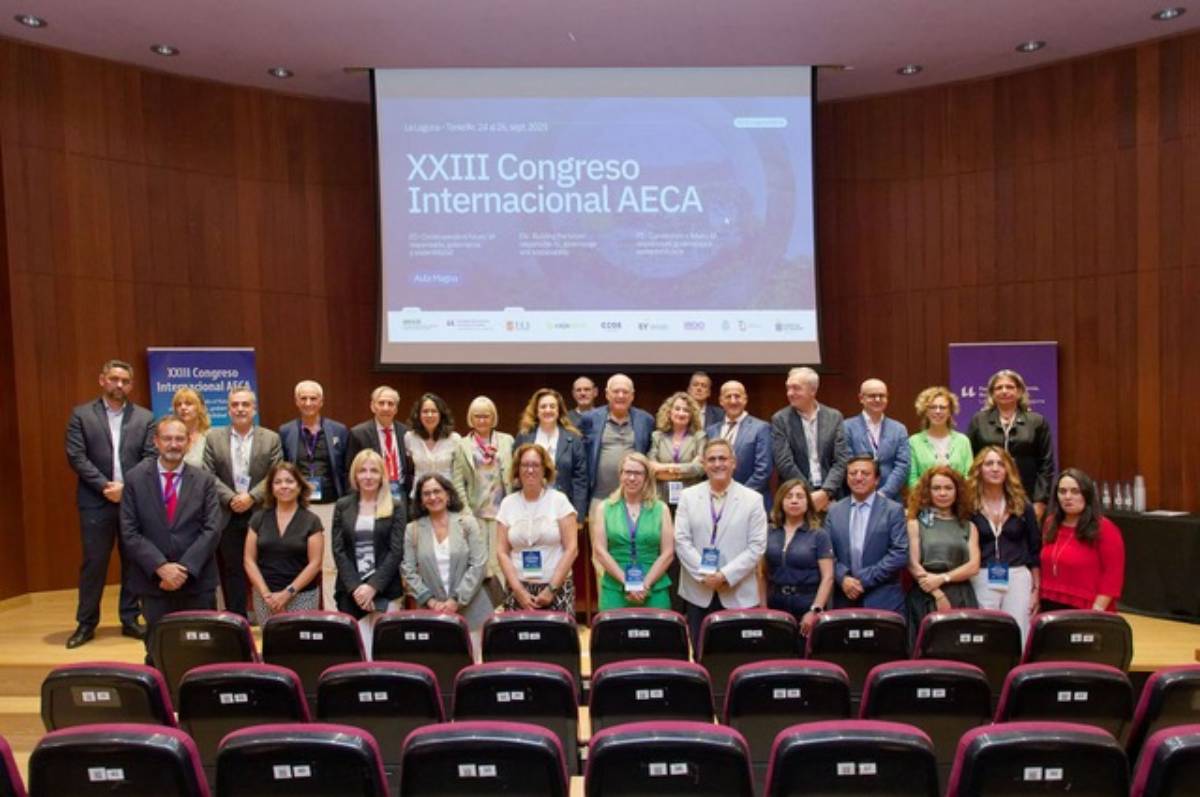
He XXIII International Congress of the Spanish Association of Accounting and Business Administration The AECA conference concluded last Friday, September 26, at the University of La Laguna after three days of work that combined conferences, roundtables, workshops, and the presentation of more than one hundred scientific papers. The event focused on key business challenges, with particular attention to artificial intelligence, governance, and sustainability.
The event brought together 225 attendees, 150 in person and the rest virtually. On the scientific front, 120 papers and 11 posters were presented, covering a wide range of topics including accounting, business management and organization, auditing, sustainability, new technologies, tourism, and non-profit organizations. This meeting had a strong international dimension, attracting representatives from 15 countries, notably Cuba, Colombia, Germany, Argentina, Brazil, and Portugal, which will host the next edition in 2026.
At the closing ceremony, the Dean of the Faculty of Economics, Business, and Tourism, Carmen Inés Ruiz, thanked everyone who made such a large-scale event possible. The president of the organizing committee, a professor from the same faculty, also spoke. Francisco Javier Calero, He highlighted that the University of La Laguna and the host faculty became the business epicenter of finance, sustainability and digitalization during those days, bringing together in one space specialists of great international prestige, business professionals and institutional representatives.
In their final assessment, along with another member of the organizing team María Victoria Pérez Monteverde, He emphasized that the congress has not only allowed for a comparison of the latest scientific research in accounting, auditing and management, but has also opened new avenues of collaboration that reaffirm the role of the public university as an engine of knowledge, innovation and social progress.
The congress has produced two novel contributions that stand out as the main milestones: the launch of monographic sessions organized by sponsoring entities, as well as the signing of a collaboration agreement between the Faculty of Economics, Business and Tourism and AECA.
This agreement will allow for the development of joint training programs, internships, and placements for students. It will also facilitate faculty participation in specialized forums and open new research opportunities related to current business challenges. This agreement is expected to foster the exchange of experiences between academia and the business and institutional sectors.
Conclusions
The content of the sessions highlighted the need to address business challenges from a perspective that considers both economic and regulatory factors. Specifically, it became clear that artificial intelligence applied to accounting and finance is not a tool of the future, but a present-day resource that offers competitive advantages, but also presents various risks that require regulation and specialized training. Another key aspect was the digitalization of business strategy, a process whose implementation must be guided by ethical principles and good governance.
Regarding sustainability, the congress stressed the need for companies and institutions to strengthen their real commitment through verifiable practices subject to the new European frameworks, which involve moving towards greater transparency in the information provided to society.
The academic event culminated with the presentation of several awards to the works submitted to different calls for proposals: the Enrique Fernández Peña Prize for History of Accounting 2025, which distinguishes research of special relevance in this field; the CDCC Certifications and the Differential Certificate of Scientific Quality, which endorse the methodological excellence of certain contributions; the Diplomas from the journals REFC and SBIR, which highlight articles with notable academic and professional impact; and the Diploma for Best Student Communication, as an incentive to emerging talent and the international projection of new generations.

 Spanish
 English
 French