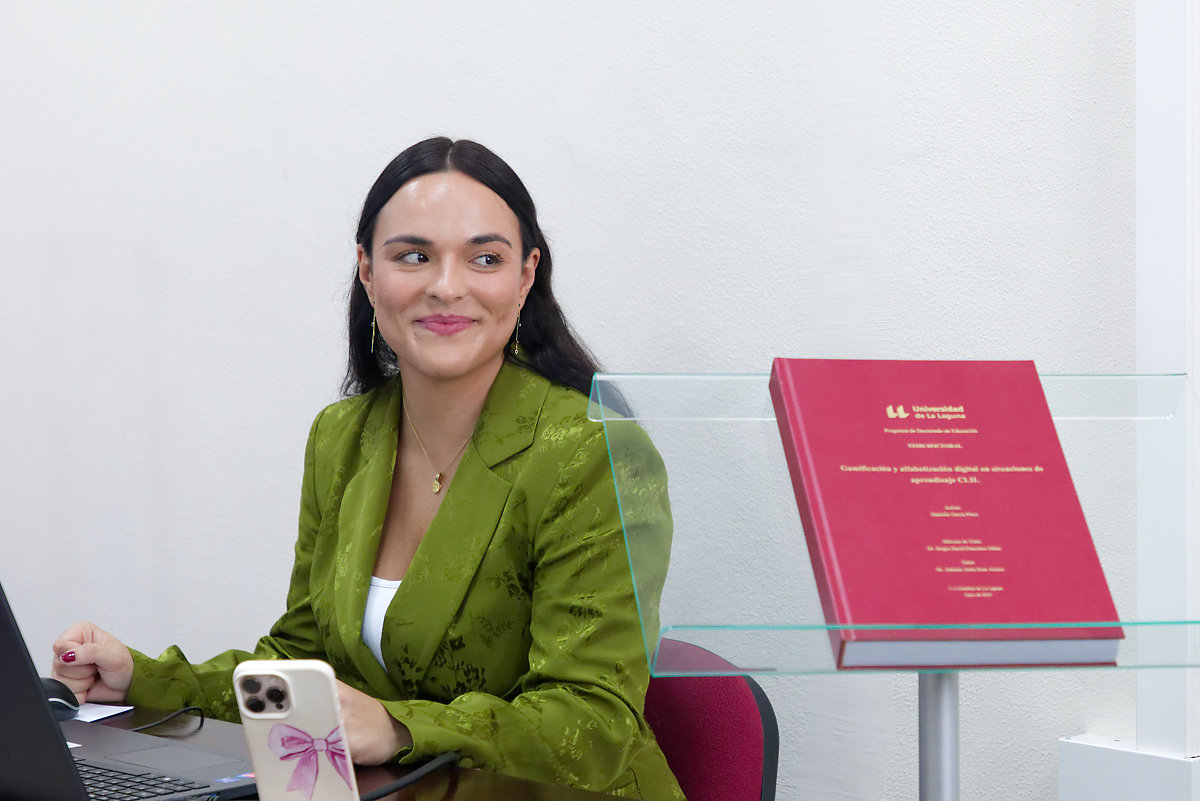
In an increasingly globalized world, education faces the challenge of adapting to new realities that demand proficiency in other languages, an understanding of different cultures, and the efficient use of technology. To address this need, Daniella García Pérez, a doctoral student in Education at the University of La Laguna and a primary school teacher, recently presented her doctoral thesis focused on an innovative pedagogical model that merges Content and Language Integrated Learning (CLIL) and gamification to transform teaching.
The research, led by the researchers Sergio David Francisco Déniz y Antonio Jesús Sosa Alonso, It starts from the premise that the educational model must evolve from a unidirectional approach, where the teacher transmits information, towards a system where the student is the protagonist of their own learning. "The goal is for students to work on their learning in a meaningful and digital way," explains the researcher.
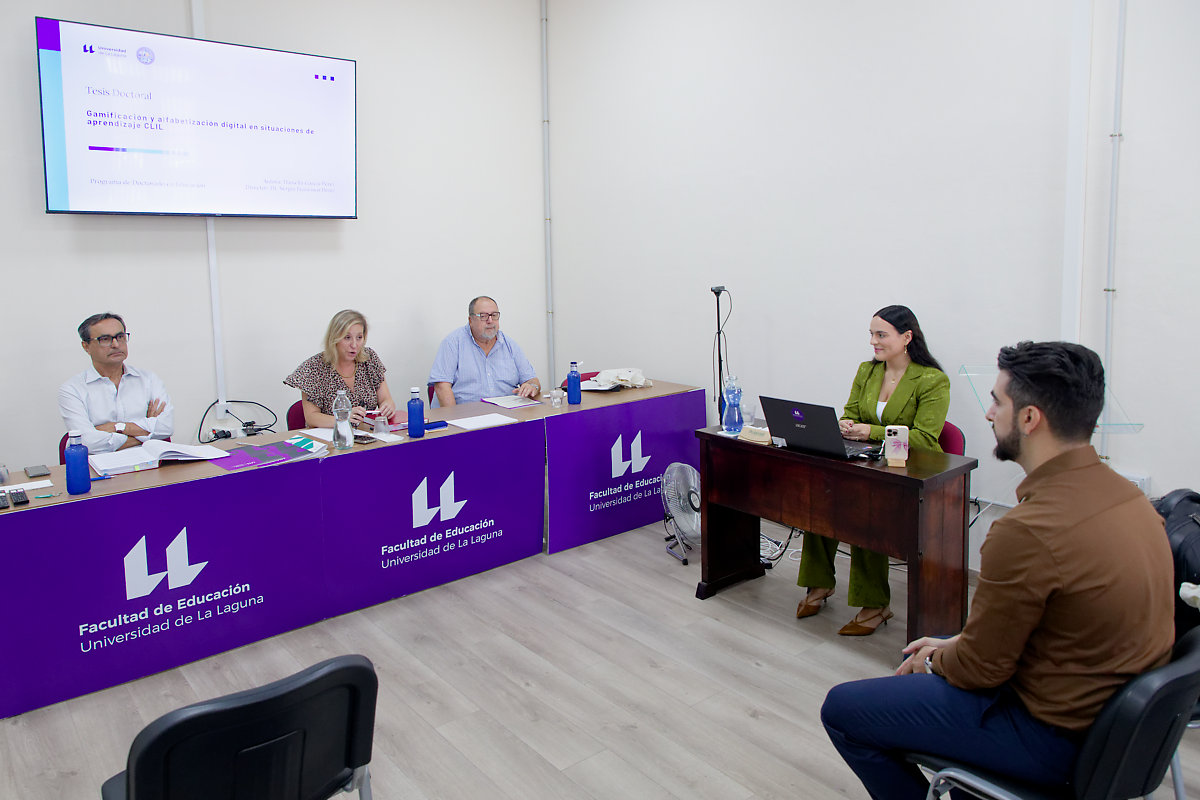
A moment from the defense act.
The researcher's pedagogical proposal is based on the combination of two innovative approaches: Content and Language Integrated Learning (CLIL) and gamification, which acts as the "engine of motivation." The CLIL approach, based on the "Four Cs" model (Content, Communication, Cognition, and Culture), allows students to acquire knowledge of subjects such as Natural or Social Sciences while using English in a practical and meaningful way. In this way, they not only improve their language skills but also develop critical thinking and foster respect for cultural diversity.
Added to this framework is gamification, a methodology that incorporates game mechanics such as challenges and rewards to increase student engagement. According to the researcher, the success of gamification lies in its ability to generate two key factors: intrinsic motivation, which drives students to participate out of their own interest in the activity and not for an external prize, and the state of "flow," an optimal level of concentration and enjoyment in which students become completely immersed in the task.
«"The interesting thing is that the student doesn't even realize they are learning," Daniela points out, "since they use the vocabulary and structures naturally to overcome challenges, rather than simply memorizing them for an exam.".
A digital escape room about sustainability
One of the most important parts of the research is the creation and application of a digital escape room developed with the Genially tool for fifth-grade students. This game not only serves to practice English but also addresses topics such as healthy habits and sustainability. The implementation for the study took place in a school through a nine-session learning experience, with activities before and after the game.
The students, working in cooperative groups, used tools like Canva to create a final product, applying what they had learned to solve the challenges. The results were "wonderful," with "100%" students who were already asking when they would be able to do a similar activity again. "This meaningful learning is sustainable throughout their lives, which is what we're aiming for," says the doctoral candidate. "I'm not interested in a child passing, I'm interested in them learning.".
According to the researcher's presentation, the thesis also underscores that the main obstacle to the implementation of these innovative methodologies is the lack of training of the
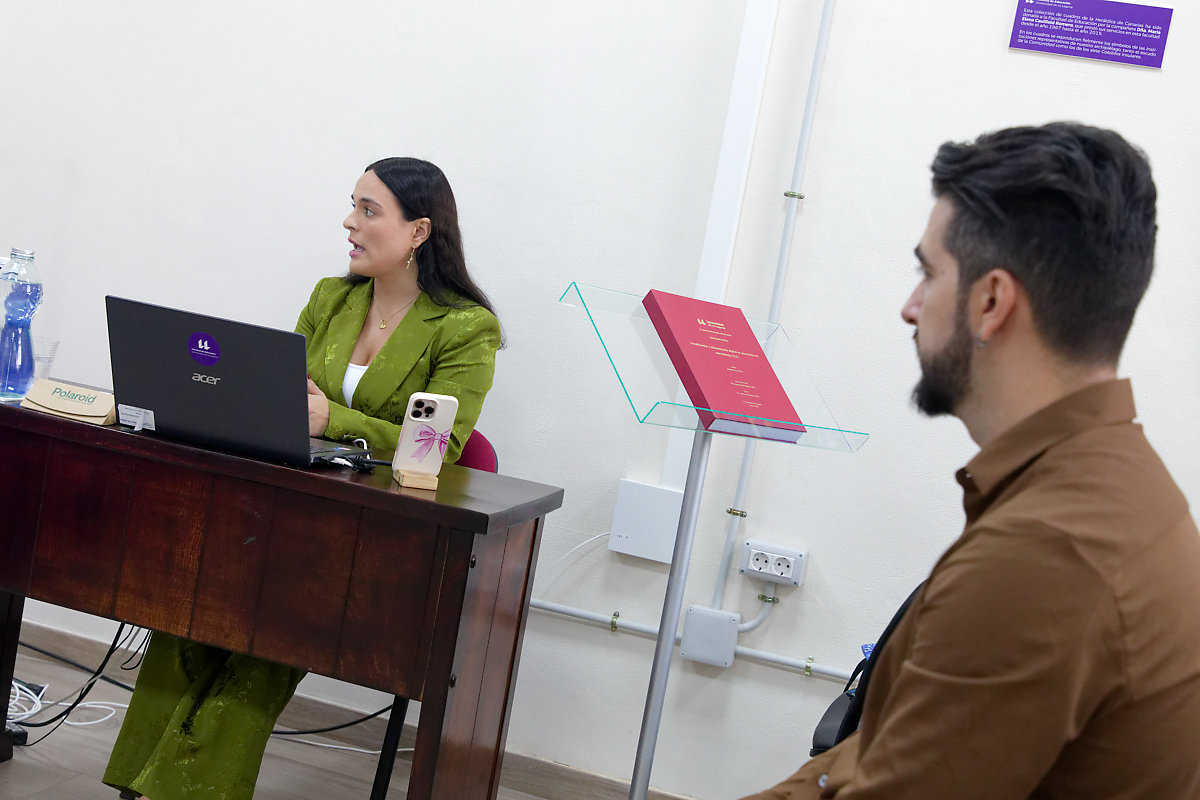
The doctoral student under the gaze of one of her supervisors.
The problem isn't a lack of motivation among teachers. "The teaching profession is one of the most motivated, but often teachers don't know how to apply these tools because they don't know how," she says, pointing to the need to improve the training offered by universities and schools.
The escape room created for this research is public and has been shared so that other teachers can use and adapt it, promoting a culture of collaboration and the creation of open and effective educational resources. The panel, composed of Plácido Bazo, Marcos Peñate y Gemma Delicado They valued the doctor's contributions and highlighted the detailed nature of the study, its quantitative measurement of the results, and its implementation at the center where she worked as a teacher.

 Spanish
 English
 French