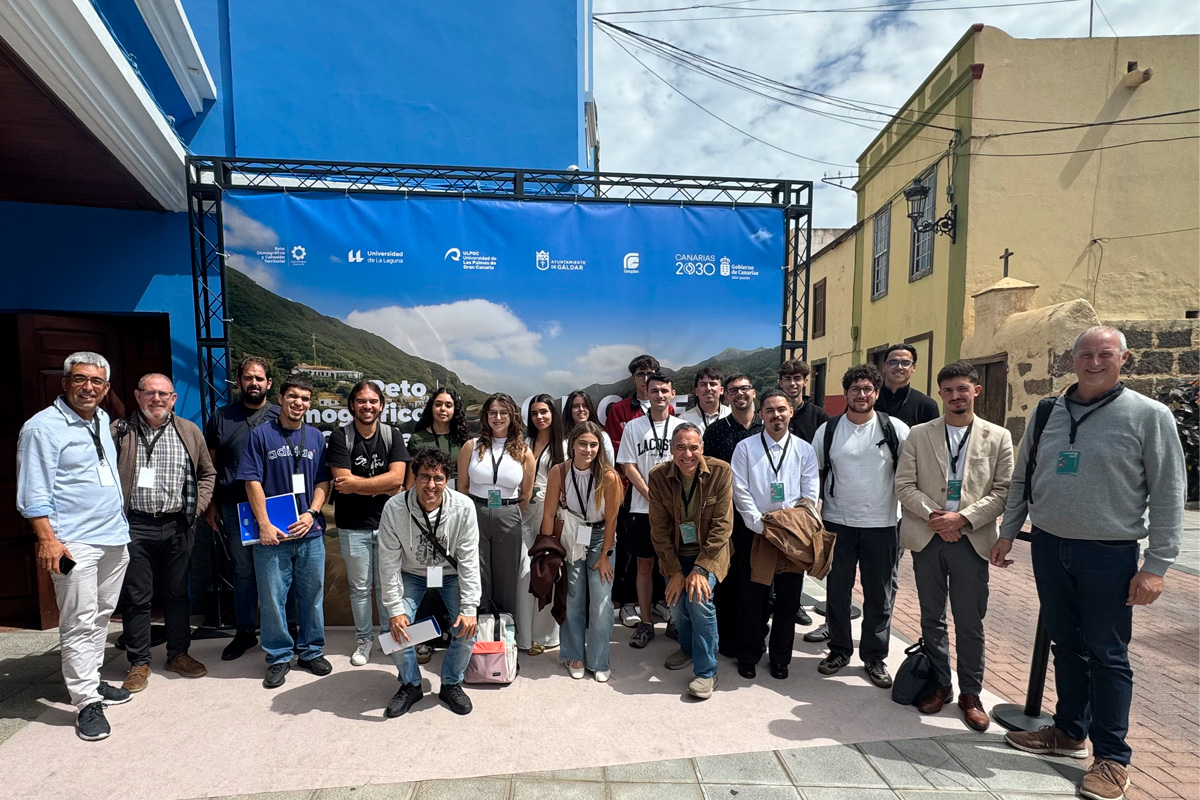
The first edition of Congress on the Demographic Challenge in the Canary Islands The conference recently held in the Gran Canaria municipality of Gáldar highlighted the significant contribution of its public universities to understanding the processes that shape it and to defining strategies for addressing its multiple effects and implications. In particular, the involvement of the University of La Laguna was noteworthy, both in addressing the key themes and developing roundtables, presenting papers, forming the scientific committee, and through the participation of scientific, academic, and technical staff, as well as a representation of students in their final years of degree programs closely related to the topics discussed.
Marta Domínguez Herrera, Vice-Rector for Sustainability and Infrastructure, expressed her satisfaction at the university's broad commitment, demonstrated by the involvement of many of its professors, to the scientific study of the various aspects of the demographic challenge facing the Canary Islands. This commitment has yielded significant results that are inspiring the adoption of specific strategies and measures to address processes such as depopulation, demographic aging, and some of the repercussions of human mobility. Domínguez also highlighted "the important role played by our colleagues in defining the Canary Islands Strategy for Demographic Challenge and Territorial Cohesion.".
This strategy will be approved by the Canary Islands Government Council on October 20, as announced by the Deputy Minister of the Presidency, Octavio Caraballo de León, at the closing session. Furthermore, it will serve as the prelude to the processing, during 2026, of the first Canary Islands law addressing the demographic challenge. Caraballo highlighted the work carried out in recent months with the participation of institutions and experts in the search for solutions to the archipelago's population challenge, specifically mentioning the involvement of the Canary Islands' public universities, which have once again been key to the development of this first edition of the Congress. In this regard, he announced that the next edition will take place next June in the municipality of Breña Alta on the island of La Palma.
Researchers affiliated with the University of La Laguna, representing various scientific disciplines such as law, economics, engineering, ecology, and geography, gathered in Gáldar. Among those present were Francisco Villar Rojas, Serafín Corral Quintana, Antonio Machado Carrillo, Moisés Simancas Cruz, Jaime Díaz Pacheco, Rafael Daranas Carballo, and Vicente Manuel Zapata Hernández. Also participating as members of the organizing and scientific committees were Abel López Díez, Noelia Cruz Pérez, and José-León García Rodríguez, among others.
Also in attendance were staff involved in a wide range of projects undertaken by this university on various islands of the archipelago through its General Foundation, which address several aspects of the demographic challenge in the Canary Islands, such as Neighborhoods for Employment: Stronger Together, Together In the same direction, Fuerteventura in the spotlight, Aridane Project, as well as a representation of the program Canarias Convive The Canary Islands Immigration and Intercultural Coexistence Plan is currently managed from this office. The students in attendance, most of whom were studying Geography and Spatial Planning, specifically organized a study trip to Gran Canaria to participate in the Congress.

 Spanish
 English
 French