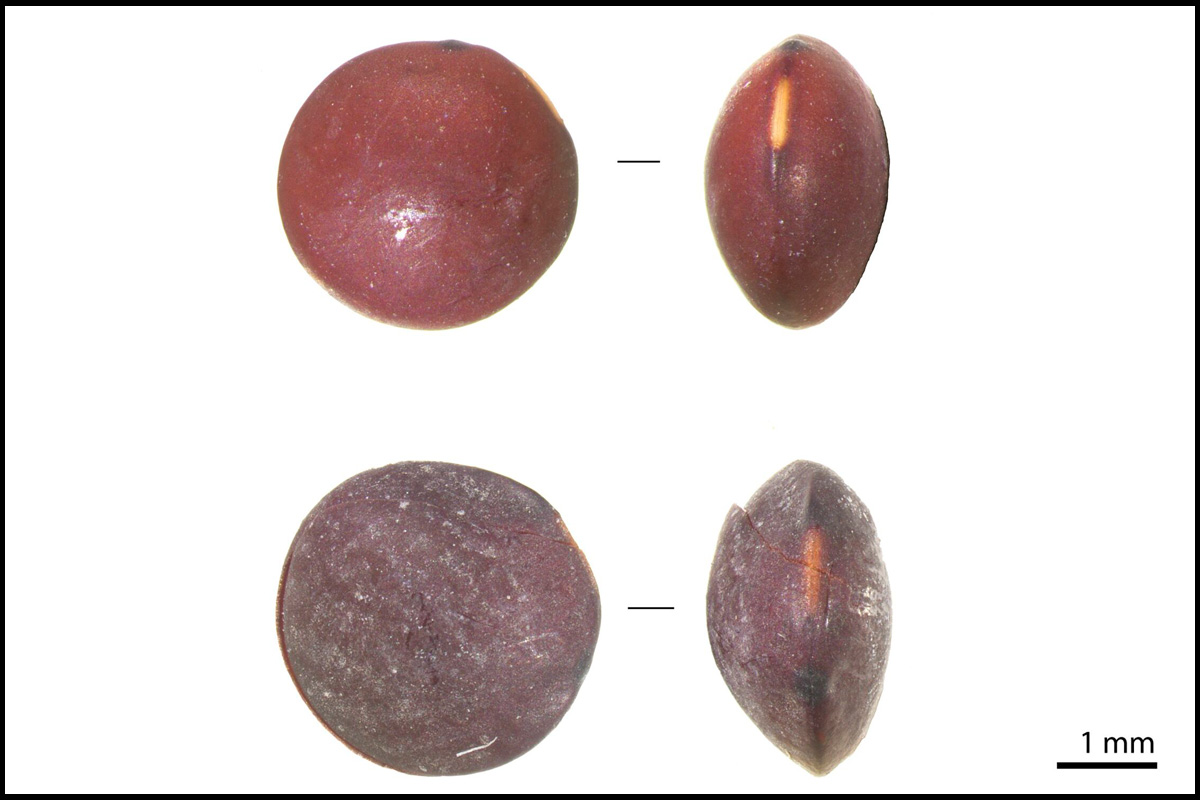
Analysis of archaeological lentils preserved in aboriginal silos on the island of Gran Canaria has dated the cultivation of this legume on the islands to two thousand years ago, according to a study led by the University of Las Palmas de Gran Canaria (ULPGC) in collaboration with the University of La Laguna and Linköping University in Sweden. This is the first genetic study of archaeological lentils, and it has answered questions such as when they began to be cultivated and how they have evolved.
Key to this has been the exceptional state of preservation of the grains found in the silos that the aboriginal inhabitants of Gran Canaria carved into the volcanic rock, in hard-to-reach places where the seeds remained fresh and dry. Thanks to this, the plants' DNA has been preserved virtually intact to this day. Comparing the genetic information of these lentils with that of those currently cultivated in the Canary Islands, Spain, and Morocco allows us to trace how these crops have evolved.
Researchers have found that the lentils of the pre-Hispanic populations were well adapted to dry and warm climates like that of the archipelago, and come from the lentils brought by the indigenous peoples who arrived in the Canary Islands from North Africa in the 3rd century.
Written documentation from both the European explorers who first set foot in the Canary Islands and that produced after the conquest of the archipelago in the 15th century describes the agricultural practices of the aboriginal inhabitants, but makes no mention of lentil cultivation. This study, therefore, also fills a gap in historical knowledge, revealing that those who occupied the islands continued to cultivate lentils. The research team believes this persistence is due to the seed's excellent adaptation to the climate and the role indigenous women played in transmitting agricultural knowledge.
Jacob Morales, a professor at the University of Las Palmas de Gran Canaria (ULPGC), explains that the fact that the Canary Islands have preserved the cultivation of indigenous lentils for so long is not just a curiosity. “There is a growing interest in the islands' cultural heritage, and many people want to cook and eat foods rooted in their history. This new study confirms that lentils, like other crops such as barley, are part of that cultural heritage.”.
For his part, Jonathan Santana, another ULPGC professor who co-authored the study, asserts that it has been verified that different types of lentils are cultivated on different islands—even on islands where it was previously believed they had never been grown. “It is important to preserve the lentils of each island, because genetic diversity can be valuable for the future of agriculture.”.
Lanzarote-style lentils
Another interesting finding of this study concerns the so-called "Lanzarote-type lentil," which, despite its name, is not actually grown on the island. This variety has been hybridized over time with mainland Spanish lentils to ensure greater adaptability. Professor Rosa Fregel of the University of La Laguna explains that Lanzarote lentils have contributed their genes to Spanish lentils. "Given current climate change, Canary Island lentils, adapted to growing in warm, dry conditions, could be of great interest for the future genetic improvement of these plants.".
The study, whose results have been published in the journal Journal of Archaeological Science, This project has received funding from, among others, the European Research Council and the Spanish Ministry of Science, Innovation and Universities. Data analysis was performed using the Swedish National Academic Supercomputing Infrastructure (NAISS), partly funded by the Swedish Research Council.

 Spanish
 English
 French